January 14, 2026
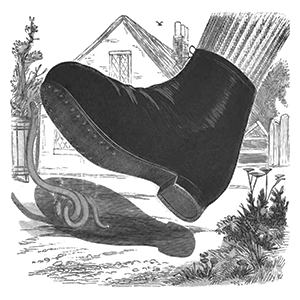
‘Even a worm will turn‘ is an English language expression used to convey the message that even the meekest or most docile of creatures will retaliate or seek revenge if pushed too far.
The phrase was first recorded in a 1546 collection of proverbs by John Heywood, in the form ‘Treade a worme on the tayle, and it must turne agayne.’ At the time ‘agayne’ also meant ‘against’ or ‘oppose.’
read more »
Posted in Language |
Leave a Comment »
October 20, 2025
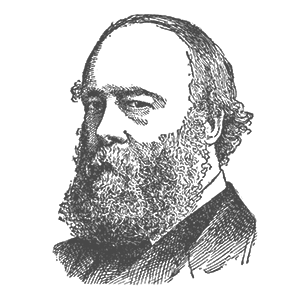
Bob’s your uncle is an idiom commonly used in the United Kingdom and Commonwealth countries that means ‘and there it is,’ or ‘and there you have it,’ or ‘it’s done.’ Typically, someone says it to conclude a set of simple instructions or when a result is reached. The meaning is similar to that of the French expression et voilà!’
The origins are uncertain, but a common hypothesis is that the expression arose after Conservative Prime Minister Robert Gascoyne-Cecil, 3rd Marquess of Salisbury (Bob), appointed his nephew Arthur Balfour as Chief Secretary for Ireland in 1887, an act of nepotism, which was apparently both surprising and unpopular. Whatever other qualifications Balfour might have had, ‘Bob’s your uncle’ was seen as the conclusive one.
read more »
Posted in Language, World |
Leave a Comment »
June 25, 2024

Quis custodiet ipsos custodes? is a Latin phrase found in the ‘Satires,’ a work of the 1st–2nd century Roman poet Juvenal. It may be translated as ‘Who will guard the guards themselves?’ or ‘Who will watch the watchmen?”.
The original context deals with the problem of ensuring marital fidelity, though the phrase is now commonly used more generally to refer to the problem of controlling the actions of persons in positions of power, an issue discussed by Plato in the ‘Republic.’ It is not clear whether the phrase was written by Juvenal, or whether the passage in which it appears was interpolated into his works.
read more »
Posted in Philosophy, Politics |
Leave a Comment »
August 29, 2023

Guns don’t kill people, people kill people is a slogan popularized by the National Rifle Association of America (NRA) and other gun advocates. The slogan and connected understanding dates back to at least the 1910s, and it became widely popular among gun advocates in the second half of the 20th century, so much so that some have labeled it a cliché.
Gun control proponents claim the slogan is an example of bumper sticker logic and supports the larger folk psychology behind gun advocacy. In colloquial use, both parts of the statement are largely considered true. However, when the statement is used in the context of gun debates it becomes misdirection and can be considered a fallacy.
read more »
Posted in Death, Language, Politics |
Leave a Comment »
October 19, 2022

Let’s Go Brandon is a political slogan and Internet meme, used as a substitute for the phrase ‘Fuck Joe Biden’ in reference to Joe Biden, the 46th president of the United States.
Chants of ‘Fuck Joe Biden’ began during sporting events in early September 2021. On October 2, 2021, during a televised interview of the Sparks 300 race winner Brandon Brown at Talladega Superspeedway, NBC Sports reporter Kelli Stavast incorrectly described the chant in the background as ‘Let’s Go Brandon,’ which sparked the meme. The slogan has become well known through use by Republican politicians and critics of Biden. The phrase quickly spread to popular culture.
read more »
Posted in Humor, Politics |
Leave a Comment »
November 1, 2021
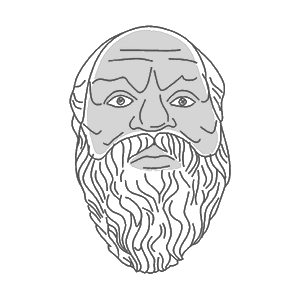
‘Kids these days‘ is the belief that the present generation of young people is inferior or deficient compared to previous generations.
Such beliefs have been reported since 624 BCE. Ancient philosopher Socrates complained, ‘The children now love luxury; they have bad manners, contempt for authority; they show disrespect for elders and love chatter in place of exercise.’
Posted in Language, Philosophy |
Leave a Comment »
December 8, 2020
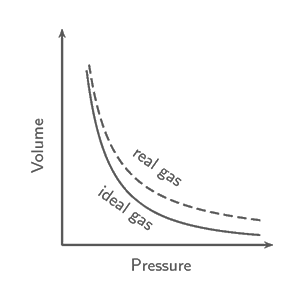
‘All models are wrong‘ is a common aphorism in statistics; it is often expanded as ‘All models are wrong, but some are useful.’ It is usually considered to be applicable to not only statistical models, but to scientific models generally. The aphorism recognizes that statistical or scientific models always fall short of the complexities of reality but can still be of use.
The aphorism is generally attributed to the statistician George Box, although the underlying concept predates Box’s writings. He offered the ‘ideal gas law’ as an example: ‘PV = RT relating pressure P, volume V and temperature T of an ‘ideal’ gas via a constant R is not exactly true for any real gas, but it frequently provides a useful approximation and furthermore its structure is informative since it springs from a physical view of the behavior of gas molecules.’
read more »
Posted in Education, Philosophy, Science |
Leave a Comment »
April 9, 2020

‘Lies, damned lies, and statistics‘ is a phrase describing the persuasive power of numbers, particularly the use of statistics to bolster weak arguments. It is also used colloquially to doubt statistics cited to prove an opponent’s point.
The phrase derives from the full sentence, ‘There are three kinds of lies: lies, damned lies, and statistics.’ It was popularized by Mark Twain and others, who mistakenly attributed it to the British prime minister Benjamin Disraeli. The true originator is uncertain, but it has, at times, been attributed to an anonymous writer in mid-1891 and later that year to English politician Sir Charles Dilke.
read more »
Posted in Humor, Language, Politics |
Leave a Comment »
December 16, 2019
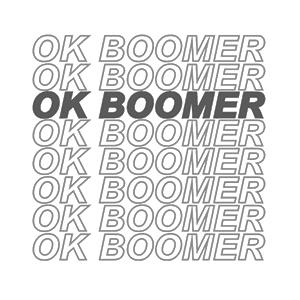
OK Boomer is a catchphrase and internet meme that gained popularity among younger cohorts throughout 2019, used to dismiss or mock attitudes stereotypically attributed to the baby boomer generation. The phrase first drew widespread attention in a 2019 TikTok video in response to an older man, though the phrase was coined years before that. It is considered by some to be ageist.
The phrase is a pejorative retort used to dismiss or mock perceived narrow-minded, outdated, negatively-judgemental, or condescending attitudes of older people, particularly baby boomers. The term has been used as a retort for perceived resistance to technological change, climate change denial, marginalization of minorities or opposition to younger generations’ ideals.
read more »
Posted in Humor, Politics |
Leave a Comment »
October 8, 2019
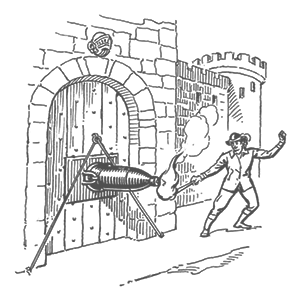
‘Hoist with his own petard’ is a phrase from a speech in William Shakespeare’s play ‘Hamlet’ that has become proverbial.
The phrase’s meaning is literally that the bomb-maker (a “petard” is a small explosive device) is blown up (‘hoisted’ off the ground) by his own bomb, and indicates an ironic reversal, or poetic justice.
read more »
Posted in Art, Language, War |
Leave a Comment »
November 16, 2016

‘May you live in interesting times’ is an English expression purported to be a translation of a traditional Chinese curse. While seemingly a blessing, the expression is always used ironically, with the clear implication that ‘uninteresting times,’ of peace and tranquillity, are more life-enhancing than interesting ones, which from historical perspective usually include disorder and conflict.
Despite being so common in English as to be known as ‘the Chinese curse,’ the saying is apocryphal, and no actual Chinese source has ever been produced. The nearest related Chinese expression is usually translated as ‘Better to be a dog in a peaceful time, than to be a human in a chaotic (warring) period.’ The expression originates from a 1627 short story collection, ‘Stories to Awaken the World.’
Posted in Humor, Philosophy, World |
Leave a Comment »
November 11, 2016

‘Don’t mourn, organize!‘ is an expression often incorrectly supposed to be the last words spoken by labor activist and songwriter Joe Hill, who was charged with murder and executed in Utah in 1915. In truth, the expression is part of a telegram sent to Bill Haywood, the founding member and leader of the Industrial Workers of the World (IWW), in which Joe wrote, ‘Goodbye, Bill, I die like a true blue rebel. Don’t waste any time mourning. Organize!’ It wasn’t Joe’s last telegram; he sent another in which he implored Haywood, ‘Could you arrange to have my body hauled to the state line to be buried? I don’t want to be found dead in Utah.’
Since the death of Hill, the phrase has been used in association with other labor leaders’ deaths. The phrase has also been used in conjunction with a severe defeat and not the death of an individual.
Posted in Death, Money, Politics |
Leave a Comment »


 The Daily Omnivore