February 21, 2011
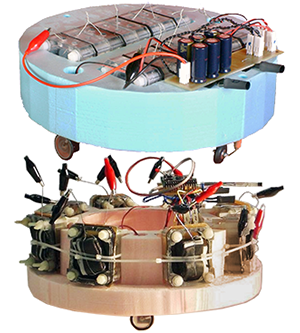
EcoBot refers to a class of robots that can remain self-sustainable by collecting their energy from waste in the environment. The only by-product from this process is carbon dioxide, which would have been produced from biodegradation in the first place. EcoBots do not employ any other form of conventional power supply and do not require any form of initial charging from an external source. Instead, they are powered directly by the on-board microbial fuel cells (MFCs).
EcoBot-I, was developed in 2002 at Bristol Robotics Laboratory (U.K.); it utilized sugar as the fuel to perform phototaxis (move towards the light). EcoBot-II (2004) was the first robot in the world to perform sensing, information processing, communication and phototaxis, by utilizing unrefined biomass (e.g. dead flies, rotten fruits and crustacean shells). EcoBot-II operated continuously for 12 days after having been fed with 8 houseflies.
Posted in Food, Technology |
Leave a Comment »
February 21, 2011
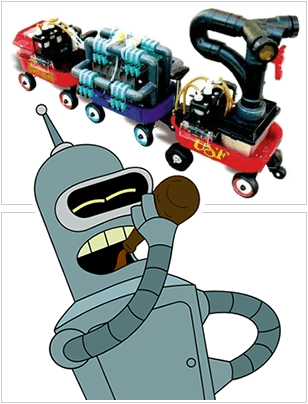
Gastrobot (literally ‘robot with stomach’) was a term coined in 1998 by the University of South Florida Institute’s director, Dr. Stuart Wilkinson. A gastrobot is a machine that derives all its energy from the digestion of food (a mixture of carbohydrates and protein). These molecules are obtained through a microbial fuel cell (MFC) which then converts the food into gases and other potential energy. The gases and liquids are used to help fuel things such as a hydrogen fuel cell which help create more energy, along with other gases that help power the mechanics of the gastrobot.
The future of these robots supposedly is for certain types of so called ‘start and forget’ missions on an ecological plateau which would be Earth at the current period in time. Their optic sensors may have artificial intelligence software that allows them to determine what is edible for consumption and energy conversion. Possible future commercial uses would be a self powered lawnmower that would obtain energy for itself from the cellulose in the grass cuttings.
Posted in Food, Technology |
Leave a Comment »
February 2, 2011

Keepon is a small yellow robot designed to study social development by interacting with children. It was developed at the National Institute of Information and Communications Technology (NICT) in Kyoto, Japan. Keepon has four motors, a rubber skin, two cameras in its eyes, and a microphone in its nose.
Its simple appearance and behavior are intended to help children, even those with developmental disorders such as autism, to understand its attentive and emotive actions. The robot, usually under the control of a teleoperator, has interacted with children in schools and remedial centers for developmental disorders since 2003. Keepon is currently available for purchase at $30,000, though a price drop is speculated after simpler mechanisms are developed.
Posted in Health, Humor, Technology |
Leave a Comment »
January 25, 2011

A robot jockey is commonly used on camels in camel racing. Early designs confused or frightened the camels, so the robots were modified to include more human-like features, including a mannequin-like face, sunglasses, hats, racing silks and even traditional perfumes used by human jockeys. Developed since 2004, the robotic jockeys are slowly phasing out the use of human jockeys, which, in the case of camel racing in the Middle East, often employs small children who reportedly suffer repeated systemic human rights abuses. In response to international condemnation of such abuses, the nations of Qatar and the UAE have banned the use of human jockeys in favor of robots.
Camel racing has been around for thousands of years. ‘The Sport of Sheiks’ almost exclusively utilized small children, usually boys around the age of four, to ride and direct the camels. Often, the boys would be starved to be as light as possible. Many of the boys used for the races were often sold to race organizers or camel owners, and there was an active child slave trade for camel jockeys, involving victims of kidnapping or the children of destitute families who sold them into servitude.
Posted in Politics, Technology, World |
Leave a Comment »
December 22, 2010
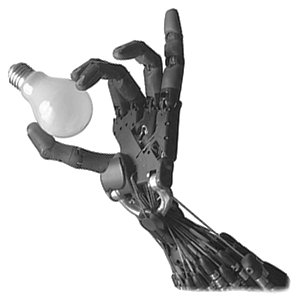
The Shadow Dexterous Hand is a humaniform robot hand system developed by The Shadow Robot Company in London. The hand is comparable to a human hand in size and shape, and reproduces all of its degrees of freedom. The Hand is commercially available and currently used by NASA, Bielefeld University and Carnegie Mellon University. It reportedly costs more than $100,000. The Hand uses the sense of touch, pressure, and position to reproduce the human grip in all its strength, delicacy, and complexity.
The SDRH was first developed by Richard Greenhill and his team of engineers in Islington, London, as part of The Shadow Project, (now known as the Shadow Robot Company) an ongoing research and development program whose goal is to complete the first convincing humanoid. An early prototype can be seen in NASA’s collection of humanoid robots, or robonauts. The Hand has haptic sensors embedded in every joint and finger pad, which relay information to a central computer for processing and analysis.
Posted in Money, Technology |
1 Comment »
October 18, 2010
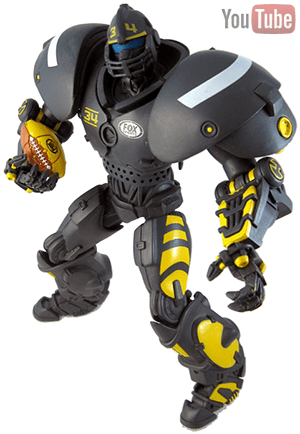
‘Cleatus the Robot,’ is the official mascot of Fox NFL Sunday, named by a viewer during a contest in the winter of 2007 in which fans were able to submit entries as to what they thought the robot’s name should be. Cleatus made his first appearance during the 2005-2006 NFL season, but was not used regularly until the following season. Cleatus mainly appears during the intro sequence of the show as well as brief commercials for movies and TV shows.
In commercials he commonly gets attacked by a CGI character from whatever the advertisement is about. He has thus far been attacked by Iron Man, a dragon, and a Terminator robot. Cleatus is also known to hop on two feet, play the electric guitar, shake out his limbs, and do dance moves such as the swim and the electric slide. In response to Cleatus, NASCAR on Fox created ‘Digger,’ an animated gopher mascot.
Posted in Games, Humor, Money |
Leave a Comment »
October 12, 2010
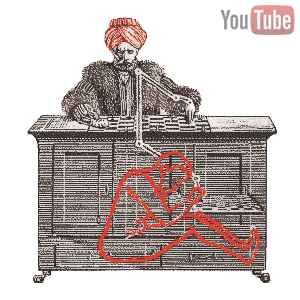
The Turk was a fake chess-playing machine constructed in the late 18th century. From 1770 until its destruction by fire in 1854, it was exhibited by various owners as an automaton. Constructed and unveiled in 1770 by Wolfgang von Kempelen (1734–1804) to impress the Empress Maria Theresa, the mechanism appeared to be able to play a strong game of chess against a human opponent. The Turk was in fact a mechanical illusion that allowed a human chess master hiding inside to operate the machine.
With a skilled operator, the Turk won most of the games played during its demonstrations around Europe and the Americas for nearly 84 years, playing and defeating many challengers including statesmen such as Napoleon Bonaparte and Benjamin Franklin. Although many had suspected the hidden human operator, the hoax was initially revealed only in the 1820s by the Londoner Robert Willis.
Posted in Games, Humor, Technology |
1 Comment »
October 10, 2010
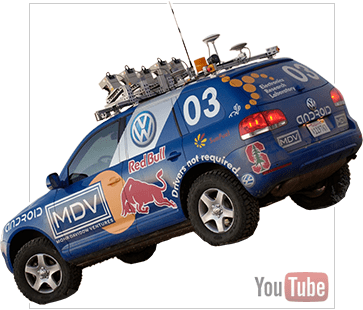
Stanley is an autonomous vehicle created by Stanford University’s Stanford Racing Team in cooperation with the Volkswagen Electronics Research Laboratory (ERL). It competed in, and won, the 2005 DARPA Grand Challenge, earning the Stanford Racing Team the 2 million dollar prize. Stanley’s descendant ‘Junior’ placed second in the 2007 DARPA Urban Challenge. Stanley is based on a diesel engined Volkswagen Toureg, Junior on a Passat. The Stanford Racing Team chose the Touareg for its ‘drive by wire’ control system which could be adapted to run directly from an on-board computer.
To navigate, Stanley used five roof mounted LIDAR units to build a 3-D map of the environment, supplementing the position sensing GPS system. An internal guidance system utilizing gyroscopes and accelerometers monitored the orientation of the vehicle and also served to supplement GPS and other sensor data. Additional guidance data was provided by a video camera used to observe driving conditions out to eighty meters (beyond the range of the LIDAR) and to ensure room enough for acceleration. Stanley also had sensors installed in a wheel well to record a pattern imprinted on the tire and to act as an odometer in case of loss of signal (such as when driving through a tunnel). Using the data from this sensor, the on-board computer can extrapolate how far it has traveled since the signal was lost.
Posted in Technology |
Leave a Comment »
August 2, 2010
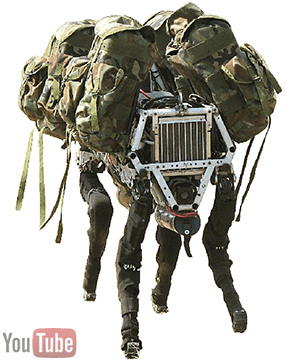
BigDog is a dynamically stable quadruped robot created in 2005 by Boston Dynamics with Foster-Miller, the NASA Jet Propulsion Laboratory, and the Harvard University Concord Field Station. BigDog is 3 feet long, stands 2.5 feet tall, and weighs 240 pounds, about the size of a small mule. It is capable of traversing difficult terrain at 4 miles per hour, carrying 340 pounds, and climbing a 35 degree incline. Locomotion is controlled by an onboard computer that receives input from the robot’s various sensors. Navigation and balance are also managed by the control system.
Posted in Technology |
Leave a Comment »


 The Daily Omnivore