May 2, 2012

Yo is an English slang interjection, commonly associated with American English. It was popularized by Italian and African Americans in Philadelphia in the 1970s. It is used to signify informality, close cultural understanding, and communal bonding. It remains very popular among Philadelphia Italian Americans, possibly arising from the Italian language word ‘io’ (meaning ‘I’). In Italian, first person statements are often preceded by io.
Although often used as a greeting, yo may come at the end of a sentence, often to direct focus onto a particular individual or group or to gain the attention of another individual or group. It may specify that a certain statement that was previously uttered is more important, or may just be an ‘attention grabber’ (e.g. ‘Listen up, yo!’). In the Japanese language, the sentence-final particle ‘yo’ is used to emphasize sentences as is often the case in English slang as above, but is etymologically unrelated. ‘YŌ’ is also used by Japanese teens as casual greetings between friends, but is pronounced with a more drawn-out tone.
Posted in Language, World |
Leave a Comment »
March 5, 2012
Not safe for work (NSFW) is Internet slang or shorthand to mark URLs or hyperlinks which contain material such as pornography or profanity, which the viewer may not want to be seen accessing in a public or formal setting such as at work. Determining a site to be NSFW is invariably subjective. The less frequently used warnings PNSFW (Probably/Possibly Not Safe for Work), LSFW (Less Safe for Work), TSFW (Technically Safe for Work), and PNFO (Probably Not for the Office) are sometimes used to indicate content possibly considered salacious (lustful) by certain censors, such as images of underwear or swimwear models, or a news story about sexual issues that does not contain explicit images.
NSFW is also sometimes used to refer to any media that produces sound, such as a game or video file; the implication being that the noises may alert others in the vicinity that the user is taking a break with entertainment materials instead of working. An alternative abbreviation is NSFL, meaning not safe for lunch or not safe for life – this indicates subject matter too grim, shocking, stark, or frank to be recommended without a disclaimer.
Posted in Money, Sex, Technology |
Leave a Comment »
February 13, 2012
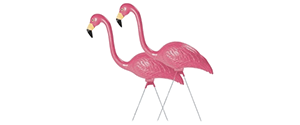
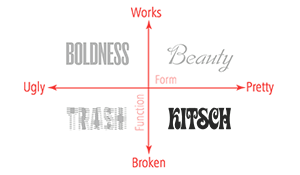
Camp is an aesthetic sensibility that regards something as appealing or humorous because of its deliberate ridiculousness. The concept is closely related to kitsch, and things with camp appeal may also be described as being ‘cheesy.’
When the usage appeared, in 1909, it denoted: ostentatious, exaggerated, affected, theatrical, and effeminate behaviour, and, by the middle of the 1970s, the definition comprised: banality, artifice, mediocrity, and ostentation so extreme as to have perversely sophisticated appeal. American writer Susan Sontag’s essay ‘Notes on ‘Camp” (1964) emphasised its key elements as: artifice, frivolity, naïve middle-class pretentiousness, and ‘shocking’ excess. Camp as an aesthetic has been popular from the 1960s to the present.
read more »
Posted in Art, Humor, Language |
Leave a Comment »
February 3, 2012

Blue balls is a slang term for the condition of temporary fluid congestion (vasocongestion) in the testicles and prostate region, accompanied by acute testicular pain, or a prolonged dull aching pain emanating from the prostate, caused by prolonged and unsatisfied sexual arousal in the human male. The term is thought to have originated in the United States, first appearing in 1916. Some urologists call the condition ‘epididymal hypertension.’ The condition is not universally experienced by all males.
Although widely discussed, there has been scant information in the medical research literature until a 2000 article by Chalett and Nerenberg in ‘Pediatrics’ which found little formal data regarding the condition but concluded that ‘the treatment is sexual release, or perhaps straining to move a very heavy object—in essence doing a Valsalva maneuver,’ a moderately forceful attempted exhalation against a closed airway.
Posted in Health, Sex |
Leave a Comment »
January 15, 2012
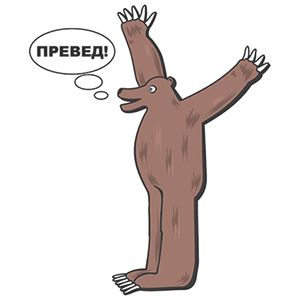
Preved is a term used in Russian Internet slang (Padonkaffsky jargon); it is a meme which developed out of a heavily-circulated picture, and consists of choosing alternative spellings for words for comic effect. The picture, a modified version of John Lurie’s watercolor ‘Bear Surprise,’ features a man and a woman having sex in the clearing of a forest, being surprised by a bear calling ‘Surprise!’ with its paws raised. In later Russian adaptations, the bear shouts ‘Preved!’ (a deliberate misspelling of ‘privet,’ ‘hi!’).
The word and the bear image have found their way into the mainstream mass media, such as a poster for the Russian edition of ‘Newsweek.’ In 2006 at an online conference, Vladimir Putin was asked: ‘PREVED, Vladimir Vladimirovich! How do you regard MEDVED?’ No answer was given, but the Associated Press, informing on the questions collection process, reportedly interpreted it as a reference to then-vice-prime-minister Dmitry Medvedev. It was the most popular question asked at the conference (the third most popular question was ‘How does one patch KDE2 under FreeBSD?’).
Posted in Humor, Sex, World |
Leave a Comment »
December 30, 2011

‘Breeder‘ is a denigrating term for heterosexuals used in LGBT slang. It is often used pejoratively. The use in homosexual groups is drawn from the fact that their sexual activity cannot lead to reproduction, where as heterosexual sexual intercourse can, with implicit mocking by connotation of animal husbandry, the original usage of the word. Along these lines a particularly fecund woman may be referred to as a ‘brood sow,’ implying low ethical standards and an absence of due diligence in the reproductive process.
‘Breeder’ may also be used as a derogatory term by childfree people of any sexual orientation, to refer to parents who focus on their children and abandon their previous friends and lifestyle. The phrases ‘breeder, not parent’ (BNP) or ‘parent, not breeder’ (PNB) are used by some childfree communities to differentiate between what they regard as positive and negative parenting.
Posted in Politics, Sex |
1 Comment »
December 1, 2011
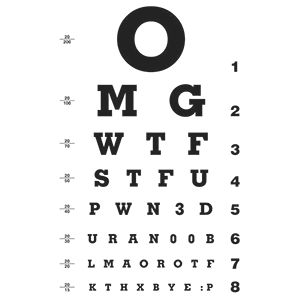
Leet (or ‘1337’), short for ‘elite,’ also known as leetspeak, is an alternative alphabet for the English language that is used primarily on the Internet. It uses various combinations of ASCII characters to replace Latinate letters. For example, leet spellings of the word leet include 1337 and l33t; eleet may be spelled 31337 or 3l33t.
The term is derived from the word ‘elite.’ Leet may also be considered a substitution cipher, although many dialects or linguistic varieties exist in different online communities. The term ‘leet’ is also used as an adjective to describe formidable prowess or accomplishment, especially in the fields of online gaming and in its original usage, computer hacking.
read more »
Posted in Language, Technology |
Leave a Comment »
November 29, 2011
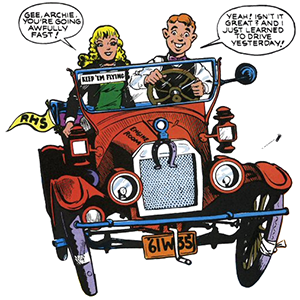
A jalopy [juh-lop-ee] (also clunker or hooptie or beater) is a decrepit car, often old and in a barely functional state. A jalopy is not a well kept antique car, but a car which is mostly rundown or beaten up.
As a slang term in American English, ‘jalopy’ was noted in 1924 but is now slightly passé. The term was used extensively in the book ‘On the Road’ by Jack Kerouac, first published in 1957, although written from 1947. The equivalent English term is old banger, often shortened to banger, a reference to older poorly maintained vehicles’ tendency to backfire.
read more »
Posted in Language, Money, Technology |
1 Comment »
November 18, 2011

‘The Man‘ is a slang phrase that may refer to the government or to some other authority in a position of power. In addition to this derogatory connotation, it may also serve as a term of respect and praise. The phrase ‘the Man is keeping me down’ is commonly used to describe oppression. The phrase ‘stick it to the Man’ encourages resistance to authority, and essentially means ‘fight back’ or ‘resist,’ either openly or via sabotage.
The term ‘the Man’ in the American sense dates back to the late 19th Century. In the Southern U.S. states, the phrase came to be applied to any man or any group in a position of authority, or to authority in the abstract. From about the 1950s the phrase was also an underworld code word for police, the warden of a prison or other law enforcement or penal authorities.
read more »
Posted in Humor, Language, Politics |
Leave a Comment »
November 17, 2011
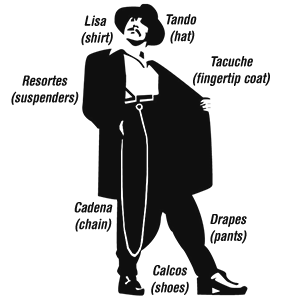
Pachucos [puh-choo-koh] are Chicano youths who developed their own subculture during the 1930s and 1940s in the Southwestern United States. They wore distinctive clothing (such as zoot suits) and spoke their own dialect of Mexican Spanish, called Caló or Pachuco. Due to their double marginalization stemming from their youth and ethnicity, there has always been a close association and cultural cross-pollination between the Pachuco subculture and gang subculture.
The Pachuco style originated in El Paso, Texas, and Ciudad Juárez, Mexico, and moved westward, following the line of migration of Mexican railroad workers (‘traqueros’) into Los Angeles, where it developed further. The word ‘pachuco’ originated, probably early in the 20th century, in a Mexican Spanish slang term for a resident of the cities of El Paso and Juárez. Even today, El Paso and Juárez are the ‘El Chuco’ or ‘El Pasiente’ by some.
read more »
Posted in Language, Politics, World |
1 Comment »
November 17, 2011
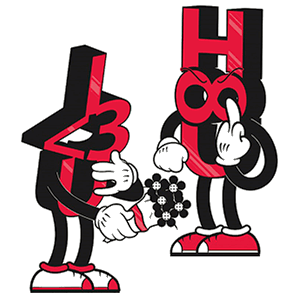
SMS language or textese is a term for the abbreviations and slang most commonly used due to the necessary brevity of mobile phone text messaging, in particular the widespread SMS (short message service) communication protocol. SMS language is also common on the Internet, including in email and instant messaging. It can be likened to a rebus, an allusional device that uses pictures to represent words or parts of words (e.g. ‘i <3 u’ which uses the pictogram of a heart for ‘love,’ and the letter ‘u’ replaces ‘you’).
The objective of SMS language is to use the least number of characters needed to convey a comprehensible message, also as many telecommunication companies have an SMS character limit, another benefit of SMS language is to reduce the character count of a message, hence, punctuation, grammar, and capitalization are largely ignored.
read more »
Posted in Language, Technology |
Leave a Comment »
November 16, 2011


Wigger [wig-er] is a pejorative slang term for a white person who emulates mannerisms, language, and fashions associated with African-American culture, particularly hip hop in the United States or the Grime/Garage scene in Britain. The term is a portmanteau of either wannabe or white and n****r. The term is considered derogatory, reflecting stereotypes of African-American or Black British culture, and can be used pejoratively, because of its connotations of cultural appropriation. It is also often used in a racist manner, not only belittling the person perceived as acting black, but also demeaning black people and culture by proxy. Some, however, use the term neutrally, or as a light joke, without any racism intended.
The phenomenon of white people adopting stereotypical black mannerisms, speech, and apparel – which in the general case is called allophilia – has appeared in several generations since slavery was abolished in the western world. The concept has been documented in the United States, Canada, United Kingdom, Australia and other white-majority countries. An early form of this was the ‘white negro’ in the jazz and swing music scenes of the 1920s and 1930s; as examined in the 1957 Norman Mailer essay, ‘The White Negro.’ It was later seen in the Zoot suiter of the 1930s and 1940s; the hipster of the 1940s; and the beatnik and rock and roller of the 1950s.
Posted in Language, Politics, World |
1 Comment »


 The Daily Omnivore