December 11, 2012
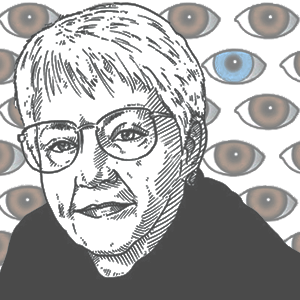
Jane Elliott (b. 1933) is an American anti-racism activist and educator (she is also a feminist and LGBT activist).
She created the famous ‘blue-eyed/brown-eyed’ exercise, first done with grade school children in the 1960s, and which later became the basis for her career in diversity training.
read more »
Posted in Education, Money, Politics |
Leave a Comment »
November 29, 2012
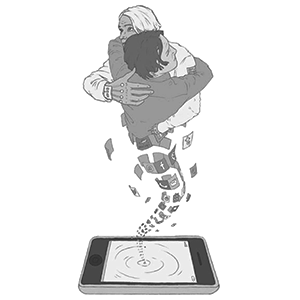
Cyborg anthropology is the discipline that studies the interaction between humanity and technology from an anthropological perspective. The topic originated as a sub-focus group within the American Anthropological Association’s annual meeting in 1993. The sub-group was very closely related to two other academic disciplines, STS (Science, technology and society) and the Society for the Social Studies of Science.
Historian and feminist Donna Haraway’s 1985 ‘Cyborg Manifesto’ could be considered the founding document of cyborg anthropology by first exploring the philosophical and sociological ramifications of the term. More recently, Amber Case has been responsible for setting up the Cyborg Anthropology Wiki.
read more »
Posted in Philosophy, Technology, World |
1 Comment »
November 21, 2012
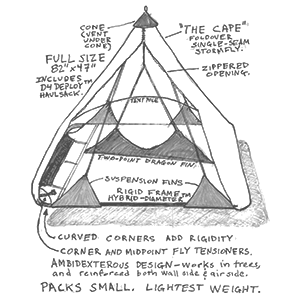
A portaledge is a deployable hanging tent system designed for rock climbers who spend multiple days and nights on a big wall climb. An assembled portaledge is a fabric-covered platform surrounded by a metal frame that hangs from a single point and has adjustable suspension straps. A separate cover, called a ‘stormfly,’ covers the entire system in the event of bad weather.
The first portaledges used in Yosemite were non-collapsible cots purloined from Housekeeping Camp, a Yosemite Valley campground that featured primitive metal framed bunks for the campers. These heavy cots were used on multi-day climbs on granite monoliths like El Capitan, and then sometimes tossed off the summit for later retrieval.
read more »
Posted in Games, Money, Technology |
Leave a Comment »
November 15, 2012
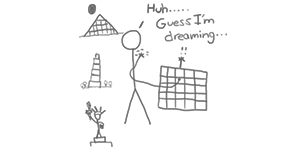

A lucid dream is any dream in which one is aware that one is dreaming. The term was coined by the Dutch psychiatrist and writer Frederik van Eeden (1860–1932). In a lucid dream, the dreamer may be able to exert some degree of control over their participation within the dream or be able to manipulate their imaginary experiences in the dream environment. Lucid dreams can be realistic and vivid.
It is shown that there are higher amounts of beta waves (normally associated with waking consciousness) experienced by lucid dreamers, hence there is an increased amount of activity in the parietal lobes making lucid dreaming a conscious process.
read more »
Posted in Philosophy, Science |
Leave a Comment »
November 9, 2012


Founded in 2001 by a team of MIT students, Design that Matters (DtM), is a nonprofit design company that partners with social entrepreneurs to design products that address basic needs in developing countries. DtM’s core competencies include ethnography, design, and engineering. DtM manages a collaborative design process through which hundreds of students and professional volunteers contribute to the design of new product and services for the poor in developing countries. DtM has completed projects in in healthcare, education, microfinance, and renewable energy.
DtM partners include the East Meets West Foundation, Solar Ear, World Education, the Center for Integration of Medicine and Innovative Technology’s Global Health Initiative (CIMIT GHI), the Centre for Mass Education in Science (CMES) in Bangladesh and the Mann Deshi Mahila Sahakari Bank in India.
read more »
Posted in Health, Technology, World |
Leave a Comment »
November 9, 2012

Will Shortz (b. 1952) is the long-time crossword puzzle editor for ‘The New York Times.’ Shortz was born and raised on an Arabian horse farm in Indiana. He is the only person known to hold a college degree in enigmatology, the study of puzzles.
Shortz achieved this feat by designing his own curriculum through Indiana University’s Individualized Major Program. He also earned a Juris Doctor degree from the University of Virginia School of Law (1977), though he forewent the bar exam and began a career in puzzles instead. Shortz began his career at ‘Penny Press Magazines,’ then moved to ‘Games’ magazine for 15 years, serving as its editor from 1989–1993.
read more »
Posted in Games, Humor, Language |
Leave a Comment »
November 7, 2012

Pablo Ferro (b. 1935) is a graphic designer and film titles designer. Born in Cuba, he was raised on a remote farm before emigrating to New York with his family as a teenager. Ferro taught himself animation from a book by Preston Blair.
Ferro worked on films as diverse as Stanley Kubrick’s ‘Dr. Strangelove’ to the split-screen montage of the original ‘The Thomas Crown Affair.’ He was a pioneer of quick-cut editing, multiple screen images (the first in film and television in 1963). Ferro’s visual style has influenced many in film, television, animation, commercials, novels and children’s books.
read more »
Posted in Art |
Leave a Comment »
November 7, 2012
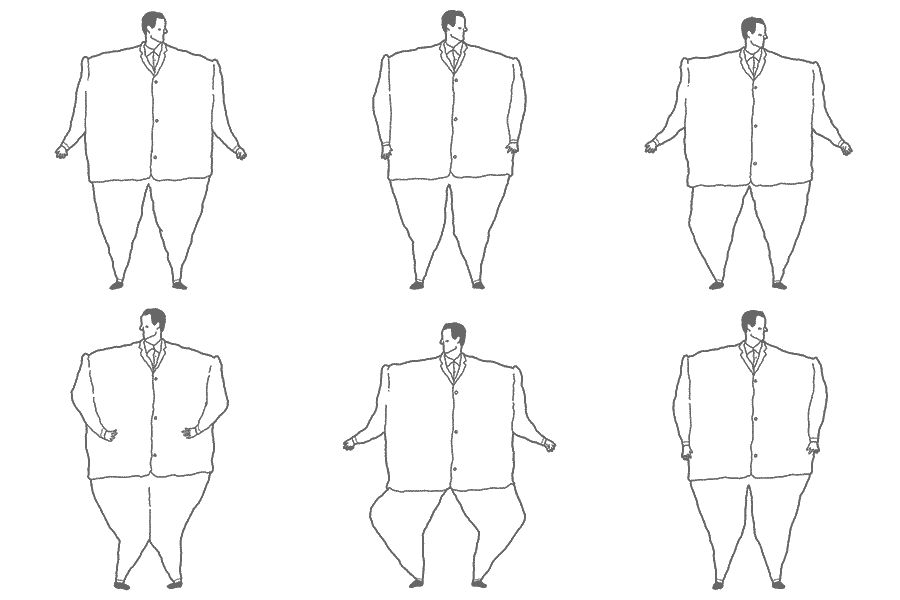
Stop Making Sense (1984) is a concert movie featuring Talking Heads live on stage. Directed by Jonathan Demme, it was shot over the course of three nights at Hollywood’s Pantages Theater in December 1983, as the group was touring to promote their new album ‘Speaking in Tongues.’ The movie is notable for being the first made entirely using digital audio techniques. The band raised the budget of $1.2 million themselves.
The title comes from the lyrics of the song ‘Girlfriend Is Better’: ‘As we get older and stop making sense…’ The movie begins with the opening credits, using a style similar to Stanley Kubrick’s ‘Dr. Strangelove or: How I Learned to Stop Worrying and Love the Bomb’ (the movie trailer also makes references to ‘Dr. Strangelove’). Title designer Pablo Ferro was responsible for both title sequences.
read more »
Posted in Art |
1 Comment »
November 4, 2012

In astrophysics and cosmology, the anthropic [an-throp-ik] principle is the philosophical consideration that observations of the physical Universe must be compatible with the conscious life that observes it. Some proponents of the anthropic principle reason that it explains why the Universe has the age and the fundamental physical constants necessary to accommodate conscious life. As a result, they believe it is unremarkable the universe’s fundamental constants happen to fall within the narrow range thought to be compatible with life.
The strong anthropic principle (SAP) as explained by Barrow and Tipler states that this is all the case because the Universe is compelled, in some sense, for conscious life to eventually emerge. English writer Douglas Adams, who wrote ‘The Hitchhiker’s Guide to the Galaxy,’ used the metaphor of a living puddle examining its own shape, since, to those living creatures, the universe may appear to fit them perfectly (while in fact, they simply fit the universe perfectly).
read more »
Posted in Philosophy, Science |
2 Comments »
October 28, 2012

Global Village is a term closely associated with Marshall McLuhan, popularized in his books ‘The Gutenberg Galaxy: The Making of Typographic Man’ (1962) and ‘Understanding Media’ (1964). McLuhan described how the globe has been contracted into a village by electric technology and the instantaneous movement of information from every quarter to every point at the same time. In bringing all social and political functions together in a sudden implosion, electric speed heightened human awareness of responsibility to an intense degree.
The Hindu concept of Vasudhaiva Kutumbakam (the whole world is one single family) is a similar thought, according to which: ‘Only small men discriminate saying: One is a relative; the other is a stranger. For those who live magnanimously the entire world constitutes but a family.’ The same concept is to be found in an ancient Tamil poem as, ‘every country is my own and all the people are my kinsmen.’
read more »
Posted in Language, Technology, World |
Leave a Comment »
October 1, 2012

‘The Extended Mind‘ is a book in the field of philosophy of mind edited by MIT philosopher Richard Menary. It contains several papers by different philosophers. The ‘extended mind thesis’ (EMT) refers to an emerging concept that addresses the question as to the division point between the mind and the environment by promoting the view of active externalism.
The EMT proposes that some objects in the external environment are utilized by the mind in such a way that the objects can be seen as extensions of the mind itself. Specifically, the mind is seen to encompass every level of the cognitive process, which will often include the use of environmental aids.
read more »
Posted in Health, Philosophy, Technology |
Leave a Comment »
October 1, 2012
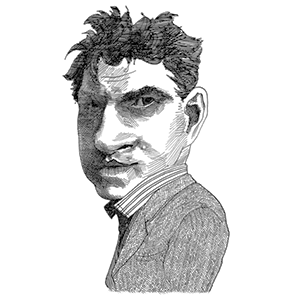
‘The Ascent of Money: A Financial History of the World’ is a 2008 book by Harvard historian Niall Ferguson’s, which was adapted into a series of documentary feature for public television in the US and UK. It examines the long history of money, credit, and banking. From Shylock’s pound of flesh to the loan sharks of Glasgow, from the ‘promises to pay’ on Babylonian clay tablets to the Medici banking system.
Professor Ferguson explains the origins of credit and debt and why credit networks are indispensable to any civilization. He also investigates human bondage. Studying the question: How did finance become the realm of the masters of the universe? Through the rise of the bond market in Renaissance Italy. With the advent of bonds, war finance was transformed and spread to north-west Europe and across the Atlantic. It was the bond market that made the Rothschilds the richest and most powerful family of the 19th century. The book also explores why stock markets produce bubbles and busts.
read more »
Posted in Money |
1 Comment »


 The Daily Omnivore