October 10, 2010


Lomography is the commercial trademark of Lomographische AG, an Austria photography company. The name is inspired by the former state-run optics manufacturer LOMO PLC of Saint Petersburg, Russia. LOMO created and produced the 35 mm LOMO LC-A Compact Automat camera — which became the centerpiece of Lomography’s marketing and sales activities. This camera was loosely based upon the Cosina CX-1 and introduced in the early 1980s.
read more »
Posted in Art, Money |
Leave a Comment »
October 10, 2010
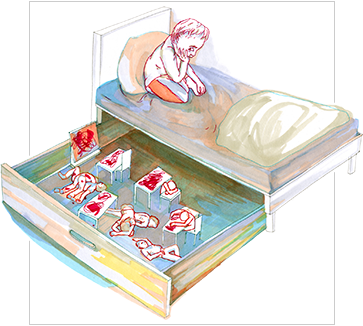
Hikikomori (literally ‘pulling away,’ being confined’) is a Japanese term to refer to the phenomenon of reclusive people who have chosen to withdraw from social life, often seeking extreme degrees of isolation and confinement because of various personal and social factors in their lives.
The term hikikomori refers to both the sociological phenomenon in general as well as to people belonging to this societal group. In Western terminology this group may include individuals suffering from social phobia or social anxiety problems. This could also be due to agoraphobia, avoidant personality disorder or painful or extreme shyness.
Posted in Health, Language, World |
Leave a Comment »
October 10, 2010

The term vignette [vin-yet] originated in French language in 1751, and referred to ‘decorative designs,’ originally in the form of vine tendrils around the borders of a book page, especially a picture page. Other theories hold that the term generally means something small and that originally it meant ‘something that may be written on a vine-leaf.’ Presently the term has application in a number of fields from graphic design to viticulture.
Posted in Language |
Leave a Comment »
October 10, 2010

Stanley is an autonomous vehicle created by Stanford University’s Stanford Racing Team in cooperation with the Volkswagen Electronics Research Laboratory (ERL). It competed in, and won, the 2005 DARPA Grand Challenge, earning the Stanford Racing Team the 2 million dollar prize. Stanley’s descendant ‘Junior’ placed second in the 2007 DARPA Urban Challenge. Stanley is based on a diesel engined Volkswagen Toureg, Junior on a Passat. The Stanford Racing Team chose the Touareg for its ‘drive by wire’ control system which could be adapted to run directly from an on-board computer.
To navigate, Stanley used five roof mounted LIDAR units to build a 3-D map of the environment, supplementing the position sensing GPS system. An internal guidance system utilizing gyroscopes and accelerometers monitored the orientation of the vehicle and also served to supplement GPS and other sensor data. Additional guidance data was provided by a video camera used to observe driving conditions out to eighty meters (beyond the range of the LIDAR) and to ensure room enough for acceleration. Stanley also had sensors installed in a wheel well to record a pattern imprinted on the tire and to act as an odometer in case of loss of signal (such as when driving through a tunnel). Using the data from this sensor, the on-board computer can extrapolate how far it has traveled since the signal was lost.
Posted in Technology |
Leave a Comment »
October 10, 2010

The lion’s mane jellyfish (Cyanea capillata) is the largest known species of jellyfish. Its range is confined to the cold waters of the Arctic, northern Atlantic, and northern Pacific Oceans, seldom found farther south than 42°N latitude. Similar jellyfish, which may be the same species, are known to inhabit seas near Australia and New Zealand. The largest recorded specimen found, washed up on the shore of Massachusetts Bay in 1870, had a bell (body) with a diameter of 2.3 m (7 feet 6 inches) and tentacles 36.5 m (120 feet) long.
Posted in Science |
Leave a Comment »
October 10, 2010

By definition, a hunky punk is an architectural feature that serves no purpose. Therefore, a true gargoyle is not a hunkypunk because it serves to drain water through its mouth. Hunky punks were often carved to create a balance of decoration. A typical example might be found at the corner of a church tower, along the coping ridge below any castellations. Often there are carvings on each corner, yet the roof may only drain in one direction and so there might be three hunkypunks and one true gargoyle.
There is a belief that a hunky punk is only a short squatting figure typical of those found in the churches of western England. The origin of the term hunkypunk has been ascribed to the Old English ‘hunkers’ which means haunches and ‘punchy’ which means short-legged. The balance of good and evil in church design reminds worshippers of the narrow path they tread. For every good and benign creature such as a saint or an animal to signify purity, there is typically an opposite to bring out the fear of evil.
Posted in Art, Philosophy |
Leave a Comment »
October 9, 2010

Sheela na Gigs are carvings of naked women displaying an exaggerated vulva found on churches, castles and other buildings, particularly in Ireland and Britain. Such carvings are said to ward off death and evil.
Other grotesques such as gargoyles and Hunky Punks are frequently found on churches all over Europe and it is commonly said that they are there to keep evil spirits away. They are often positioned over doors or windows, presumably to protect these openings.
Posted in Art, Philosophy, Sex |
Leave a Comment »
October 9, 2010

Celebratory gunfire is the shooting of a firearm into the air in celebration. It is culturally accepted in the Balkans, the Middle East, the South Asian regions of Northern India as well as Pakistan and Afghanistan and Latin American regions such as Puerto Rico as well as some areas of the United States. The practice may result in random death and injury from stray bullets. Property damage is sometimes another result of celebratory gunfire; shattered windows and damaged roofs are often found after such celebrations. People are injured, sometimes fatally, when bullets discharged into the air fall back down. In Puerto Rico about two people die and about 25 more are injured each year from celebratory gunfire on New Year’s Eve.
The mortality rate among those struck by falling bullets is about 32%, compared with about 2% to 6% normally associated with gunshot wounds. The higher mortality is related to the higher incidence of head wounds from falling bullets. Between the years 1985 and 1992, doctors at the King/Drew Medical Center in Los Angeles, California, treated some 118 people for random falling-bullet injuries. Thirty-eight of them died. Kuwaitis celebrating in 1991 at the end of the Gulf War by firing weapons into the air caused 20 deaths from falling bullets.
Posted in Death, Games, World |
Leave a Comment »
October 9, 2010

A Roman dodecahedron [doh-dek-uh-hee-druhn] is a small hollow object made of bronze or stone, with twelve flat pentagonal faces, each having a circular hole in the middle which connects to the hollowed-out center. Roman dodecahedra date from the 2nd or 3rd centuries CE. About a hundred have been found from England to Hungary and to the east of Italy, with most found in Germany and France. Ranging from 4cm to 11cm in size, they also vary in terms of textures.
The function or use of the dodecahedra remains a mystery; no mention of them has been found in contemporary accounts or pictures of the time. Speculated uses include candlesticks (wax was found inside one example); dice; survey instruments; a tool for calibrating water pipes; and parts of a military standard. It has also been suggested that they may have been religious artifacts of some kind.
Posted in World |
4 Comments »
October 9, 2010

In Ireland, the Great Famine was a period of mass starvation, disease and emigration between 1845 and 1852. It is also known, mostly outside of Ireland, as the Irish Potato Famine. In the Irish language it is called ‘An Gorta Mór‘ (The Great Hunger) or ‘An Drochshaol’ (The Bad Times). During the Famine, Ireland’s population fell by between 20 and 25 percent. Approximately one million people died and a million more emigrated from Ireland. The proximate cause of famine was a plant disease commonly known as potato blight. The blight ravanged much of Europe but hit Ireland particularly hard due to a number of political, social and economic factors which remain the subject of historical debate.
For example, views of the Irish as racially inferior, and for this reason significantly responsible for their circumstances, gained purchase in Great Britain during and immediately after the famine. Discussion of the British government’s response to the failure of the potato crop in Ireland and the subsequent large-scale starvation, and whether or not this constituted genocide, remains a politically-charged issue in Ireland.
Posted in Death, Politics, World |
Leave a Comment »
October 9, 2010

Abelardo is a green, full-bodied Muppet parrot who appears on Plaza Sésamo, the Mexican co-production of Sesame Street. He joined the cast in 1981 and soon became the show’s most recognizable figure. Abelardo also guest starred on the American Sesame Street on May 5, 1997 as part of the Cinco de Mayo celebration. On the Mexican show, he occasionally keeps contact with his cousin Big Bird via letters and video-chatting.
His character was originally a a tall orange-and-yellow scaled dragon which had a soft, gentle voice and a very particular way of talking, making pauses after every sentence. His favorite treat were pumpkin seeds or ‘semillas de calabaza’ which in Mexico are a very popular snack, also known as ‘Pepitas.’ In later seasons Abelardo the Dragon was replaced by Serapio Montoya, a large parrot-like character with a strong resemblance to Big Bird, of whom he is a cousin. However, children and others continued to refer to Serapio as ‘Abelardo’ and therefore his name was later changed to Abelardo Montoya. The reason the dragon character was dismissed when the series was re-launched in 1982, remains unexplained.
Posted in Education, World |
Leave a Comment »
October 1, 2010

The Olduvai Gorge in northern Tanzania is commonly referred to as ‘The Cradle of Mankind.’ The old name for the Gorge was Olduvai Gorge, which was a mispronunciation of Oldupai. The Gorge was re-named in 2005 to correct this mistake. Oldupai is the Maasai word for the wild plant which grows in the gorge that is used as an antiseptic and natural bandage. Excavation work there was pioneered by Louis and Mary Leakey beginning in 1931 and continued into the twenty-first century by Professor Fidelis Masao of the Open University of Tanzania supported by Earthwatch; there have also been teams from Rutgers University.
The earliest archaeological deposit, known as Bed I, has produced evidence of campsites and living floors along with stone tools made of local basalt and quartz. Since this is the site where these kinds of tools were first discovered, these tools are called Oldowan. It is now thought that the Oldowan toolmaking tradition started about 2.6 million years ago. Above this, in Bed II, pebble tools begin to be replaced by more sophisticated handaxes of the Acheulean industry and made by H. ergaster. This layer has not yet been successfully dated, but likely falls between 1.75 and 1.2 million years.
Posted in Technology |
Leave a Comment »





 The Daily Omnivore