December 16, 2010
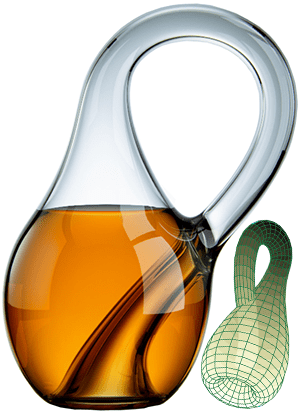
In mathematics, the Klein bottle is a geometrical object, named after the German mathematician Felix Klein. He described it in 1882, and named it Klein’sche Fläche (Klein surface). Like the Möbius strip, it only has one surface. Mathematicians call this a non-orientable surface. Klein bottles only exist in four-dimensional space, but a model of a Klein bottle can be made in 3D.
This model is different from the original because at some point the shape touches itself. In 3D, part of the shape is ‘inside’ the rest. Because the surface is non-orientable, there is no ‘inside’ or ‘outside.’ This means that if a liquid were filled ‘in the bottle,’ it would run down its surface. This may not be true for the 3D models of the bottle.
Posted in Art, Science, Technology |
Leave a Comment »
December 16, 2010

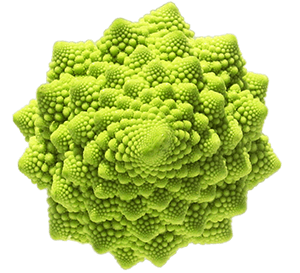
Many mathematicians derive aesthetic pleasure from their work, and from mathematics in general. They express this pleasure by describing mathematics as beautiful. Sometimes mathematicians describe mathematics as an art form or, at a minimum, as a creative activity. Hungarian mathematician Paul Erdős expressed his views on the ineffability of mathematics when he said, ‘Why are numbers beautiful? It’s like asking why is Beethoven’s Ninth Symphony beautiful. If you don’t see why, someone can’t tell you. I know numbers are beautiful. If they aren’t beautiful, nothing is.’
Comparisons are often made with music and poetry. British mathematician Bertrand Russell expressed his sense of mathematical beauty in these words: ‘Mathematics, rightly viewed, possesses not only truth, but supreme beauty — a beauty cold and austere, like that of sculpture, without appeal to any part of our weaker nature, without the gorgeous trappings of painting or music, yet sublimely pure, and capable of a stern perfection such as only the greatest art can show. The true spirit of delight, the exaltation, the sense of being more than Man, which is the touchstone of the highest excellence, is to be found in mathematics as surely as poetry.’
Posted in Art, Science |
Leave a Comment »
December 16, 2010

The Möbius strip [mo-bee-uhs] is a surface with only one side and only one edge. It can be made using a strip of paper by gluing the two ends together with a half-twist. The twisting is possible in two directions; so there are two different (mirror-image) Möbius strips.
The Möbius strip was discovered independently by the German mathematicians August Ferdinand Möbius and Johann Benedict Listing in 1858. The Mobius strip is known for its unusual properties. A bug crawling along the center line of the loop would go around twice before coming back to its starting point. Cutting along the center line of the loop creates one longer band, not two.
Posted in Art, Science |
Leave a Comment »
December 16, 2010

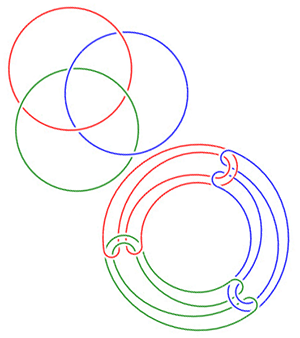
Topology [tuh-pol-uh-jee] is the study of how spaces are organized, how the objects are structured in terms of position. It also studies how spaces are connected. Topology has sometimes been called rubber-sheet geometry, because in topology there is no difference between a circle and a square (a circle made out of a rubber band can be stretched into a square) but there is a difference between a circle and a figure eight (you cannot stretch a figure eight into a circle without tearing).
The spaces studied in topology are called topological spaces. They vary from familiar manifolds to some very exotic constructions.
read more »
Posted in Science |
Leave a Comment »
December 16, 2010

A human milk bank is a service which collects, screens, processes, and dispenses by prescription human milk donated by nursing mothers who are not biologically related to the recipient infant. There are currently eleven milk banks in North America. They are usually housed in hospitals, although sometimes they are free standing.
read more »
Posted in Drugs, Food, Health |
Leave a Comment »
December 15, 2010

Light tubes or light pipes are used for transporting or distributing natural or artificial light. In their application to daylighting, they are also often called sun pipes, sun scopes, solar light pipes, or daylight pipes. The first commercial reflector systems were patented and marketed in the 1850s by British photographer Paul Emile Chappuis, utilising various forms of angled mirror designs.
Posted in Technology |
1 Comment »
December 15, 2010

Slow Cow is a ‘relaxation beverage’ launched in Quebec in December 2008, dubbed an ‘anti-energy’ drink by its creators.
Slow Cow’s principal ingredient is L-Theanine, an amino acid found in tea plants, which is said to produce a ‘feeling of relaxation and well-being.’ Other ingredients include extracts of chamomile, passiflora, valerian, tilia cordata, and hops.
Posted in Drugs, Food, Health |
Leave a Comment »
December 15, 2010


The United States Cyber Command (USCYBERCOM), located on Ft. Meade in Maryland, was officially activated in May of 2010. The command is led by National Security Agency Director General Keith B. Alexander. Elements of the command are responsible for the evolving mission of Computer Network Attack (CNA) – destroying networks and penetrating enemy computers to steal or manipulate data, and taking down command-and-control systems, for example. Some of these capabilities are known as Special Technical Operations (STO).
It has been suggested within the military that the cultures of the Army, Navy and Air Force are fundamentally incompatible with that of cyber warfare, and requires a fourth branch, a cyber-warfare branch. COL John Surdu (chief of staff of the United States Army Research, Development and Engineering Command) stated that the three major services are ‘properly positioned to fight kinetic wars, and they value skills such as marksmanship, physical strength, the ability to leap out of airplanes and lead combat units under enemy fire. These skills are irrelevant in cyber warfare.’
Posted in Politics, Technology, War |
Leave a Comment »
December 15, 2010
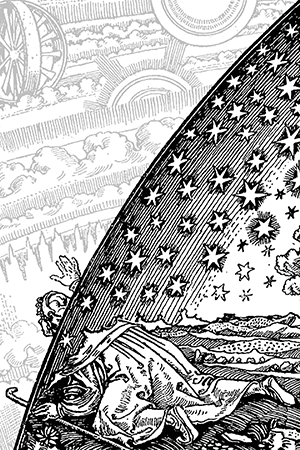
The Flammarion [fla-ma-ryawn] woodcut is an anonymous wood engraving (once believed to be a woodcut), so named because its first documented appearance is in Camille Flammarion’s 1888 book L’atmosphère: météorologie populaire (‘The Atmosphere: Popular Meteorology’).
The engraving depicts a man, dressed as a mediaeval pilgrim and carrying a pilgrim’s staff, who peers through the sky as if it were a curtain to look at the hidden workings of the universe. One of the elements of the cosmic machinery bears a strong resemblance to traditional pictorial representations of the ‘wheel in the middle of a wheel’ (Merkabah).
Posted in Art, Philosophy |
Leave a Comment »
December 15, 2010

Wood engraving is a technique in printmaking where the ‘matrix’ worked by the artist is a block of wood. It is a variety of woodcut and so a relief printing technique, where ink is applied to the face of the block and printed by using relatively low pressure. A normal engraving, like an etching, has a metal plate as a matrix and is printed by the intaglio method.
Wood engraving traditionally utilizes the end grain of wood as a medium for engraving, while in the older technique of woodcut the softer side grain is used. The technique of wood engraving developed at the end of the 18th century and the beginning of the 19th century, with the works of Thomas Bewick.
Posted in Art, Technology |
Leave a Comment »
December 15, 2010

Woodcut—formally known as xylography—is a relief printing artistic technique in printmaking in which an image is carved into the surface of a block of wood. the non-printing parts are removed, typically with gouges. The areas to show ‘white’ are cut away with a knife or chisel, leaving the characters or image to show in ‘black’ at the original surface level.
The block is cut along the grain of the wood (unlike wood engraving where the block is cut in the end-grain). Beechwood is commonly used in Europe. Cherry wood is favored in Japan. The surface is covered with ink by rolling over the surface with an ink-covered roller (brayer), leaving ink upon the flat surface but not in the non-printing areas. Multiple colors can be printed by keying the paper to a frame around the woodblocks (where a different block is used for each color).
Posted in Art, Technology |
Leave a Comment »
December 15, 2010
The Gini coefficient is a measure of statistical dispersion developed by the Italian statistician Corrado Gini in 1912. It has found application in the study of inequalities in disciplines as diverse as economics, health science, ecology, chemistry and engineering. It is commonly used as a measure of inequality of income or wealth. Worldwide, on a scale of 0 (total equality) to 1 (total inequality) Gini coefficients for income range from approximately 0.23 (Sweden) to 0.70 (Namibia) although not every country has been assessed.
Posted in Politics, Science, World |
Leave a Comment »




 The Daily Omnivore