December 8, 2010
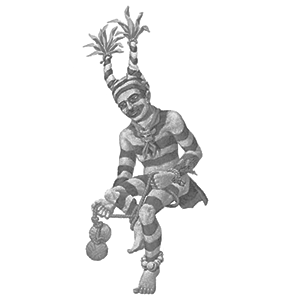
Clown society is a term used in anthropology and sociology for an organization of comedic entertainers (or ‘clowns’) who have a formalized role in a culture or society. Sometimes clown societies have a sacred role, to represent a trickster character in religious ceremonies. Other times the purpose served by members of a clown society is only to parody excessive seriousness, or to deflate pomposity. A clown shows what is wrong with the ordinary way of doing things, and a clown shows how to do ordinary things the wrong way.
Members of a clown society always dress in some kind of a special costume reserved for clowns, which is usually an absurdly extreme form of normal dress. While in their costume, clowns have special permission from their society to parody or criticize defective aspects of their own culture. Clown societies usually train new members to become clowns in an apprentice system. Sometimes the training is improvisational comedy, but usually a clown society trains members in well known forms of costume, pantomime, song, dance, and common visual gags
Posted in Humor, Philosophy, World |
Leave a Comment »
December 8, 2010

Bouffon is a modern french theater term that was re-coined in the early 1960s by French acting instructor Jacques Lecoq to describe a specific style of performance work that has a main focus in the art of mockery. Similar to, but distinct from clowning, the bouffon draws from burlesque, commedia dell’arte, farce, gallows humor, parody, satire, and slapstick.
According to Lecoq, ‘the difference between the clown and the bouffon is that while the clown is alone, the bouffon is part of a gang; while we make fun of the clown, the bouffon makes fun of us. At the heart of the bouffon is mockery pushed to the point of parody. Bouffons amuse themselves by reproducing the life of man in their own way, through games and pranks.’
Posted in Art, Humor, Language |
Leave a Comment »
December 8, 2010


Chautauqua [shuh-taw-kwuh] is an adult education movement in the United States, highly popular in the late 19th and early 20th centuries that still exists in parts of the U.S.. Chautauqua assemblies expanded and spread throughout rural America until the mid-1920s. The Chautauqua brought entertainment and culture for the whole community, with speakers, teachers, musicians, entertainers, preachers and specialists of the day. Former U.S. President Theodore Roosevelt was quoted as saying that Chautauqua is, ‘the most American thing in America.’
The first Chautauqua, the New York Chautauqua Assembly, was organized in 1874 by Methodist minister John Heyl Vincent and businessman Lewis Miller at a campsite on the shores of Chautauqua Lake in New York State. The educational summer camp format proved to be a popular choice for families and was widely copied. Within a decade, Chautauquas sprang up in various locations across North America. The popularity of the movement can be attributed in part to the social and geographic isolation of American farming and ranching communities. People in such areas would naturally be hungry for education, culture and entertainment, and Chautauqua was a timely response to that need in the late 19th century and early 20th century. The advent of the radio and the automobile diminished its role significantly.
Posted in Education, Philosophy |
Leave a Comment »
December 8, 2010

Bisha’a (‘trial by fire’) is a ritual practiced today by some Bedouin tribes for the purpose of lie detection. It is the best-known of various forms of trial by ordeal which are practiced by the Bedouin, but is increasingly uncommon, with more and more Bedouins preferring standard courts of law for enactment of justice. The basic ritual consists of the accused being asked to lick a hot metal object thrice. He is provided with water for rinsing after the ceremony. He is then inspected by the official who presides over the ceremony, the Mubesha, and by the designated witnesses of the ritual.
read more »
Posted in Language, Philosophy, World |
Leave a Comment »
December 7, 2010
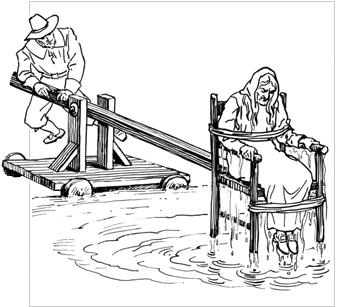
Ducking-stools and cucking-stools are chairs formerly used for punishment. They were both instruments of social humiliation and censure, primarily for the offense of scolding or back biting, and less often for sexual offenses like having an illegitimate child or prostitution. They were technical devices which formed part of the wider method of law enforcement through social humiliation.
Most were simply chairs into which the victim could be tied and exposed at her door or the site of her offence and publicly shamed. Some were on wheels and could be dragged around the parish. Some were put on poles so that they could be plunged into water, hence ‘ducking’ stool.
read more »
Posted in Language, Philosophy, Politics |
Leave a Comment »
December 7, 2010

Kangura was a Kinyarwanda- and French-language magazine in Rwanda that served to stoke ethnic hatred in the run-up to the Rwandan Genocide. It was established in 1990, following the invasion of the rebel Rwandan Patriotic Front (RPF), and continued publishing up to the genocide. Sponsored by the dominant MRND party and edited by founder Hassan Ngeze, the magazine was a response to the RPF-sponsored Kanguka, adopting a similar informal style.
‘Kangura’ was a Kinyarwanda word meaning ‘wake others up,’ as opposed to ‘Kanguka,’ which meant ‘wake up.’ The magazine was the print equivalent to the later-established Radio Télévision Libre des Mille Collines (RTLM), publishing articles harshly critical of the RPF and of Tutsis generally. Its sensationalist news was passed by word-of-mouth through the largely illiterate population. Copies of Kangura were read in public meetings and, as the genocide approached, during Interahamwe militia rallies.
Posted in Language, Politics, War |
Leave a Comment »
December 7, 2010

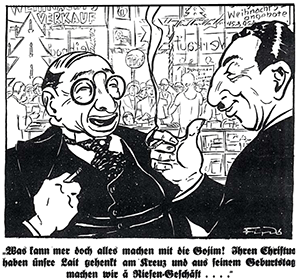
Der Stürmer (literally, ‘The Stormer;’ or more accurately, ‘The Attacker’) was a weekly Nazi newspaper published from 1923 to the end of World War II in 1945. It was a significant part of the Nazi propaganda machinery and was vehemently anti-Semitic. Unlike the ‘Völkischer Beobachter’ (‘The People’s Observer’), the official party paper which gave itself an outwardly serious appearance, the tabloid-style ‘Der Stürmer’ often ran obscene materials such as anti-Semitic caricatures and accusations of blood libel, pornography, anti-Catholic, anti-capitalist and anti-reactionary propaganda. The paper originated at Nuremberg; the first copy was published April 20, 1923. Its circulation grew over time, distributing to a large percentage of the German population as well as Argentina, Brazil, Canada and the United States.
‘Der Stürmer’ was best-known for its effective anti-semitic caricatures, which revealed Jews as ugly characters with exaggerated facial features and misshapen bodies. Many of these drawing were the work of Philipp Rupprecht, known as Fips, who was one of the best-known anti-Semitic cartoonists, his virulent attacks wedding ‘Jewish capitalists’ with ‘Jewish Communism.’ At the bottom of the title page there was always the motto ‘Die Juden sind unser Unglück!’ (‘The Jews are our misfortune!’), coined by German historian, Heinrich von Treitschke in the 1880s. The paper’s other motto was: ‘Deutsches Wochenblatt zum Kampfe um die Wahrheit’ (‘German Weekly Newspaper in the Fight for Truth’).
Posted in Language, Politics, War |
Leave a Comment »
December 7, 2010

A folk devil is a person or group of people who are portrayed in folklore or the media as outsiders and deviant, and are blamed for crimes or other sorts of social problems. The pursuit of folk devils frequently intensifies into a mass movement that is called a moral panic. When a moral panic is in full swing, the folk devils are the subject of loosely organized but pervasive campaigns of hostility through gossip and the spreading of urban legends. The concept of the folk devil was introduced by sociologist Stanley Cohen in 1972, in his study ‘Folk Devils and Moral Panics,’ which analyzed media controversies concerning the Mods and Rockers subcultures in the United Kingdom of the 1960s.
The basic pattern of agitations against folk devils can be seen in the history of witch hunts and similar manias of persecution (Christian Europeans branded adherents of the rival faiths folk devils). Minorities and immigrants have often been seen as folk devils; in the long history of anti-Semitism, which frequently targeted Jews with allegations of dark, murderous practices, such as blood libel; or the Roman persecution of Christians (blaming the military reverses suffered by the Roman Empire on the Christians’ abandonment of paganism). In modern times, political and religious leaders in many nations have sought to present atheists and secularists as deviant outsiders who threaten the social and moral order.
Posted in Language, Politics, War |
Leave a Comment »
December 7, 2010

Area code 321 is the area code serving Brevard County, Florida and home to the Kennedy Space Center. It has been in use since November 1, 1999, and was assigned to the area after a successful petition drive due to the Space Coast’s impact on the county (if pronounced properly – ‘three, two, one’– the code resembles the countdown which launches the many spacecraft from Cape Canaveral).
Posted in Humor, Politics, Technology |
Leave a Comment »
December 7, 2010

Tongue-in-cheek is a figure of speech used to imply that a statement or other production is humorously or otherwise not seriously intended, and it should not be taken at face value. The facial expression typically indicates that one is joking or making a mental effort. In the past, it may also have indicated contempt, but that is no longer common. By 1842, the phrase had acquired its contemporary meaning. Early users of the phrase include Sir Walter Scott in his 1828 novel ‘The Fair Maid of Perth.’ The ironic usage originates with the idea of suppressed mirth—biting one’s tongue to prevent an outburst of laughter.
Putting one’s tongue into a cheek was formerly used to signify contempt. For example, in Scottish author Tobias George Smollett’s ‘The Adventures of Roderick Random,’ which was published in 1748, the eponymous hero is taking a coach to Bath and apprehends a highwayman. This provokes an altercation with a less brave passenger: ‘He looked black and pronounced with a faultering voice, ‘O! ’tis very well—damn my blood! I shall find a time.’ I signified my contempt of him by thrusting my tongue in my cheek, which humbled him so much, that he scarce swore another oath aloud during the whole journey.’
Posted in Humor, Language |
Leave a Comment »
December 7, 2010

(With) a grain of salt is a literal translation of a Latin phrase, ‘(cum) grano salis.’ It is often used to show that intelligence and personal judgment are needed, as in ‘I drink wine cum grano salis since I must drive’ (with care, moderately) or ‘please, repair this electric cable cum grano salis’ (aware of the dangers). ‘Cum grano salis’ also means, like in modern English, that something should not be taken too literally. In Italy ‘to have salt on your pumpkin’ (pumpkin being your head) means to have intelligence and reasoning capabilities.
The phrase comes from Pliny the Elder’s ‘Naturalis Historia,’ regarding the discovery of a recipe for an antidote to a poison. In the antidote, one of the ingredients was a grain of salt. Threats involving the poison were thus to be taken ‘with a grain of salt’ and therefore less seriously. An alternative account says that the Roman general Pompey believed he could make himself immune to poison by ingesting small amounts of various poisons, and he took this treatment with a grain of salt to help him swallow the poison. In this version, the salt is not the antidote, it was taken merely to assist in swallowing the poison.
Posted in Food, Humor, Language |
Leave a Comment »
December 7, 2010

Parahawking combines paragliding and falconry. Birds of prey are trained to fly with paragliders, guiding them to thermals for in-flight rewards and performing aerobatic manoeuvres. It was developed by British falconer Scott Mason in 2001. Mason began a round-the-world trip in Pokhara, Nepal, where many birds of prey – such as the griffon vulture, steppe eagle and black kite – can be found. He has been based in Pokhara ever since, training and flying birds during the dry season between September and March.
The team started by training two black kites, but have since added an Egyptian vulture and a Mountain hawk-eagle to the team. Only rescued birds are used – none of the birds have been taken from the wild. Mason and Hill documented their endeavors, with help from colleague Graham Saunders-Griffiths, in a film entitled Parahawking.
Posted in Games |
Leave a Comment »

.png/1024px-Ducking-Stool_1_(PSF).png "ducking stool")




 The Daily Omnivore