February 2, 2011

Soap Opera Rapid Aging Syndrome (SORAS) is a term used to describe the practice of accelerating the age of a television character (usually a child or teenager) in conflict with the timeline of a series and/or the real-world progression of time. Characters unseen on screen for a time might reappear portrayed by an actor several years older than the original. Usually coinciding with a recast, rapid aging is typically done to open up the character to a wider range of storylines, and to attract younger viewers.
The process originated in (and is most commonly used in) daytime soap operas. SORAS generally refers to cases in which a character’s rapid aging happens off-screen without any explanation, rather than to storylines in science fiction and fantasy in which a character ages rapidly due to technology, magic, or non-human biology. Coined by Soap Opera Weekly founding editor-in-chief Mimi Torchin in the early days of the magazine, the term is now widely used in the soap opera media.
Posted in Art, Humor |
Leave a Comment »
February 2, 2011
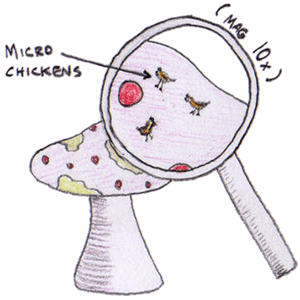
Quorn is the leading brand of mycoprotein food product in the UK and Ireland. The mycoprotein is extracted from a fungus, Fusarium venenatum, which is grown in large vats. Quorn is produced as both a cooking ingredient and a range of ready meals. It is sold (largely in Europe, but also in other parts of the world) as a health food and an alternative to meat, especially for vegetarians. As it uses egg white as a binder, it is not a vegan food.
During production, it is textured, giving it some of the grained character of meat, and pressed either into a mince resembling ground beef; forms resembling chicken breasts, meatballs, and turkey roasts; or chunks resembling diced chicken breast. In these forms, Quorn has a varying color and a mild flavour resembling the imitated meat product, and is suitable for use as a replacement for meat in many dishes, such as stews and casseroles. The final Quorn product is high in protein and dietary fibre and is low in saturated fat and salt. It contains less dietary iron than do most meats.
Posted in Food, Health, Technology |
Leave a Comment »
February 2, 2011
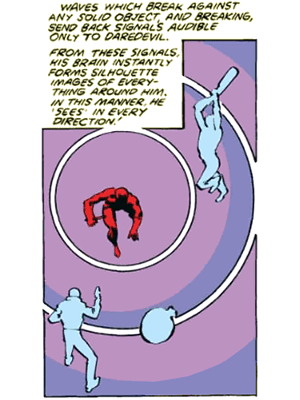
Human echolocation [ek-oh-loh-key-shuhn] is the ability of humans to detect objects in their environment by sensing echoes from those objects. This ability is used by some blind people to navigate within their environment. They actively create sounds, such as by tapping their canes, lightly stomping their foot or by making clicking noises with their mouths (however, because humans click with much lower frequencies and slower rates than other animals, only larger objects can be sensed). The principle is comparable to active sonar in submarines and to echolocation by bats and dolphins.
Vision and hearing are closely related in that they can process reflected waves of energy. Vision processes light waves as they travel from their source, bounce off surfaces throughout the environment and enter the eyes. Similarly, the auditory system processes sound waves as they travel from their source, bounce off surfaces and enter the ears. Both systems can extract a great deal of information about the environment by interpreting the complex patterns of reflected energy that they receive. In the case of sound, these waves of reflected energy are called ‘echoes.’
Posted in Health, Science |
Leave a Comment »
February 2, 2011

Near field communication or NFC, is a short-range high frequency wireless communication technology which enables the exchange of data between devices over about a 10 centimeters (3.9 in) distance. The technology combines the interface of a smartcard and a reader into a single device. An NFC device can communicate with both existing smartcards and readers, as well as with other NFC devices, and is thereby compatible with existing contactless infrastructure already in use for public transportation and payment. NFC is primarily aimed at usage in mobile phones.
Posted in Money, Technology |
Leave a Comment »
February 2, 2011

Keepon is a small yellow robot designed to study social development by interacting with children. It was developed at the National Institute of Information and Communications Technology (NICT) in Kyoto, Japan. Keepon has four motors, a rubber skin, two cameras in its eyes, and a microphone in its nose.
Its simple appearance and behavior are intended to help children, even those with developmental disorders such as autism, to understand its attentive and emotive actions. The robot, usually under the control of a teleoperator, has interacted with children in schools and remedial centers for developmental disorders since 2003. Keepon is currently available for purchase at $30,000, though a price drop is speculated after simpler mechanisms are developed.
Posted in Health, Humor, Technology |
Leave a Comment »
February 1, 2011

A script doctor is a highly-skilled screenwriter, hired by a film or television production, to rewrite or polish specific aspects of an existing screenplay, including structure, characterization, dialogue, pacing, theme, and other elements. Script doctors generally do their work uncredited, for a variety of commercial and artistic reasons. Script doctors are usually brought in during the development and pre-production phases of a film, to address specific issues with the script, as identified by the financiers, production team, and cast. They may also be employed during post production, to help address narrative problems that crop up during the editing process.
The use of script doctors was first revealed at the 1973 Academy Awards when Francis Ford Coppola thanked Robert Towne for his work on The Godfather. Since then, the use of script doctors has been downplayed within the industry, to avoid overshadowing the work of the original writers. Under the WGA screenwriting credit system, a screenwriter must contribute 50 percent to the story and/or characterization in order to qualify for credit. Uncredited screenwriters are not eligible to win the Academy Award for Best Screenplay or the Writers Guild of America Awards.
Posted in Art, Language, Money |
Leave a Comment »
February 1, 2011

In vitro meat, also known as cultured meat, is an animal flesh product that has never been part of a complete, living animal. Several current research projects are growing in vitro meat experimentally, although no meat has yet been produced for public consumption. The first-generation products will most likely be minced meat, and a long-term goal is to grow fully developed muscle tissue. Potentially, any animal’s muscle tissue could be grown through the in vitro process.
Posted in Food, Money, Science |
Leave a Comment »
February 1, 2011

EarthBound is a 1994 role-playing video game co-developed by Ape and HAL Laboratory and published by Nintendo for the Super NES video game console. The game has been lauded by gamers for its humorous depictions of American culture and parody of the RPG genre, and has since become a cult classic.
The game takes place on Earth in the year 199X. The game’s main antagonist is Giygas, an alien from a distant galaxy with the power to influence people using their own evil nature.
Posted in Art, Games, Humor |
Leave a Comment »
February 1, 2011

Ronald Jenkees is an American composer and musician best known for his YouTube keyboard performances. He has released two independent albums: the self-titled Ronald Jenkees (2007), and Disorganized Fun (2009).
Posted in Art, Technology |
Leave a Comment »


 The Daily Omnivore