
Hi-C is a juice drink made by the Minute Maid division of The Coca-Cola Company. Hi-C was created by Niles Foster in 1946. By 1958 it had become an American supermarket staple, available nationwide. Foster’s original formula contained orange juice concentrate, peel oil and orange essences, sugar, water, citric acid and ascorbic acid (vitamin C). The name ‘Hi-C’ stressed the vitamin content. Hot-packed in enamel-lined 56-ounce cans, the product needed no refrigeration before opening.
Grape, the second flavor introduced, evolved naturally from the fact that the Geneva, Ohio, co-packer was also processing fresh grapes. Apple and cherry drinks were introduced as a result of the fresh fruit processing operations at the Paw Paw, Michigan, co-packer plant. The contract packing concept is still used today by the Coca-Cola Foods Division. In 1987, Ecto-Cooler was a product tie-in with the cartoon series ‘The Real Ghostbusters,’ based on the 1984 live-action film.
Hi-C
Slush

A slush or a slushie is a flavored frozen drink. Frozen carbonated beverages, typified by the Slurpee or ICEE, are made by freezing a carbonated drink. These machines are complicated and expensive, and notably require a carbon dioxide supply. They make a very fine and ‘dry’ slush. Frozen uncarbonated beverages are made by freezing a non-carbonated juice or liquid. These machines do not require a pressure chamber, and so are much cheaper and easier to maintain. They make a slightly wetter slush. They are notable in the wide variety of drinks they create, including coffee-flavored ices and alcoholic drinks like margaritas and daiquiris.
Conventional slush drinks, typified by the Slush Puppie, use a single slurry made by freezing a sweetened base, similar to apple juice. This slurry is mixed at serving time with a flavoring syrup. These drinks are notable in that the flavored syrup can be drawn out of the drink, leaving a relatively-unflavoured base ice behind. ‘Instant’ slush drinks (beverages that turn to slush upon opening) are formed via supercooling (e.g. Slush-It!, the Chill Chamber which allows businesses to store beverages at below freezing temperatures, and supercooled Sprite from Coca-Cola which required special vending machines).
Nano Hummingbird

The Nano Hummingbird or Nano Air Vehicle (NAV) is a tiny, remote controlled aircraft built to resemble and fly like a hummingbird, developed in the United States by AeroVironment, Inc. to specifications provided by the Defense Advanced Research Projects Agency (DARPA). The Hummingbird is equipped with a small video camera for surveillance and reconnaissance purposes and operates in the air for up to 11 minutes. It can fly outdoors, or enter a doorway to investigate indoor environments.
Mars 500


Mars-500 is a multi-part ground-based experiment simulating a manned flight to Mars. The experiment’s facility is located at the Russian Academy of Sciences’ Institute of Biomedical Problems (IBMP) in Moscow, Russia. A total of 640 experiment days have been scheduled, divided into three stages. During each stage, a crew of six volunteers live and work in a mockup spacecraft. Communication with the outside world is limited, and has a simulated 20 minute delay. The supply of on-board consumables is limited.
The longest stage of the experiment is intended to simulate a complete 520-day mission to Mars, and began on June 3, 2010.
EcoBot
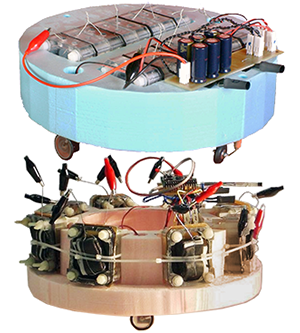
EcoBot refers to a class of robots that can remain self-sustainable by collecting their energy from waste in the environment. The only by-product from this process is carbon dioxide, which would have been produced from biodegradation in the first place. EcoBots do not employ any other form of conventional power supply and do not require any form of initial charging from an external source. Instead, they are powered directly by the on-board microbial fuel cells (MFCs).
EcoBot-I, was developed in 2002 at Bristol Robotics Laboratory (U.K.); it utilized sugar as the fuel to perform phototaxis (move towards the light). EcoBot-II (2004) was the first robot in the world to perform sensing, information processing, communication and phototaxis, by utilizing unrefined biomass (e.g. dead flies, rotten fruits and crustacean shells). EcoBot-II operated continuously for 12 days after having been fed with 8 houseflies.
Gastrobot
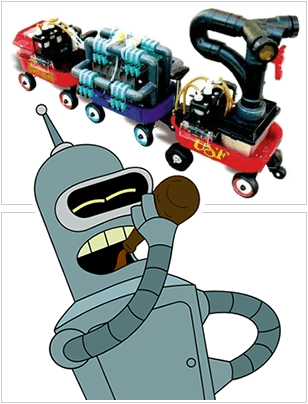
Gastrobot (literally ‘robot with stomach’) was a term coined in 1998 by the University of South Florida Institute’s director, Dr. Stuart Wilkinson. A gastrobot is a machine that derives all its energy from the digestion of food (a mixture of carbohydrates and protein). These molecules are obtained through a microbial fuel cell (MFC) which then converts the food into gases and other potential energy. The gases and liquids are used to help fuel things such as a hydrogen fuel cell which help create more energy, along with other gases that help power the mechanics of the gastrobot.
The future of these robots supposedly is for certain types of so called ‘start and forget’ missions on an ecological plateau which would be Earth at the current period in time. Their optic sensors may have artificial intelligence software that allows them to determine what is edible for consumption and energy conversion. Possible future commercial uses would be a self powered lawnmower that would obtain energy for itself from the cellulose in the grass cuttings.
Canard


Canard [kuh-nahrd] is the French word for duck. The word also can mean an unfounded or false, deliberately misleading fabrication, a false report, rumor or hoax. That usage derives from the phrase ‘vendre un canard à moitié’ (‘to half-sell a duck’), thus, from some long-forgotten joke, ‘to cheat.’ The Canard Digérateur, or Digesting Duck, was an automaton in the form of a duck, created in 1739 by Jacques de Vaucanson (the French inventor credited with creating the world’s first true robots, as well as the first automated loom).
The mechanical duck appeared to have the ability to eat kernels of grain, and to metabolize and defecate them. While the duck did not actually have the ability to do this – the food was collected in one inner container, and the pre-stored feces was ‘produced’ from a second, so that no actual digestion took place – Vaucanson hoped that a truly digesting automaton could one day be designed.
Matthew Lillard

Matthew Lillard (b. 1970) is an American actor known for his roles as Stu Macher in ‘Scream,’ Stevo in ‘SLC Punk,’ and Shaggy Rogers in the ‘Scooby-Doo’ film series – he has taken over the providing the voice of Shaggy in the cartoon series since the reboot ‘Mystery Incorporated.’ Lillard made a dramatic turn in Alexander Payne’s critically acclaimed comedy-drama ‘The Descendants.’
Lillard attended Foothill High school in Santa Ana, California and later the American Academy of Dramatic Arts in Pasadena, California, with fellow actor Paul Rudd, and later, the theater school Circle in the Square in New York City. While still in high school, he was co-host of a short-lived TV show titled ‘SK8 TV.’ After high school, he was hired as an extra for ‘Ghoulies 3: Ghoulies Go to College’ (1991).
SLC Punk!

SLC Punk! is a 1999 American independent film, written and directed by James Merendino. The film is about the young punk rock fan Steven ‘Stevo’ Levy, a college graduate living in Salt Lake City. Merendino created the film based on his experience growing up in Salt Lake City. Although not autobiographical, Merendino has said that many characters were based on people he knew. The film features several cliques presented as ‘tribes’: Punks, Mods (wear suits and ties, and ride scooters), Rednecks, Skinheads, Heavy Metal Guys, and New Wavers (neo-hippies).
Small Is Beautiful

Small Is Beautiful: Economics As If People Mattered is a collection of essays by British economist E. F. Schumacher. It is often used to champion small, appropriate technologies that are believed to empower people more, in contrast with phrases such as ‘bigger is better.’ First published in 1973, ‘Small Is Beautiful’ brought Schumacher’s critiques of Western economics to a wider audience during the 1973 energy crisis and emergence of globalization.
Schumacher argues that the modern economy is unsustainable. Natural resources (like fossil fuels), are treated as expendable income, when in fact they should be treated as capital, since they are not renewable, and thus subject to eventual depletion. He further argues that nature’s resistance to pollution is limited as well. He concludes that government effort must be concentrated on sustainable development.
Wicked Problem

‘Wicked problem‘ is a phrase originally used in social planning to describe a problem that is difficult or impossible to solve because of incomplete, contradictory, and changing requirements that are often difficult to recognize. Moreover, because of complex interdependencies, the effort to solve one aspect of a wicked problem may reveal or create other problems.
A problem whose solution requires a great number of people to change their mindsets and behavior is likely to be a wicked problem. Therefore, many standard examples of wicked problems come from the areas of public planning and policy. These include global climate change, natural hazards, healthcare, the AIDS epidemic, pandemic influenza, international drug trafficking, homeland security, nuclear weapons, and nuclear energy and waste.
Bread and Circuses

‘Bread and Circuses‘ (Latin: panem et circenses) is a metaphor for a superficial means of appeasement. In the case of politics, the phrase is used to describe the creation of public approval, not through exemplary or excellent public service or public policy, but through the mere satisfaction of the immediate, shallow requirements of a populace. The phrase also implies the erosion or ignorance of civic duty amongst the concerns of the common man (l’homme moyen sensuel).
In modern usage, the phrase has become an adjective to deride a populace that no longer values civic virtues and the public life. To many across the political spectrum, left and right, it connotes the triviality and frivolity that in popular culture is supposed to have characterized the Roman Empire prior to its decline.


 The Daily Omnivore