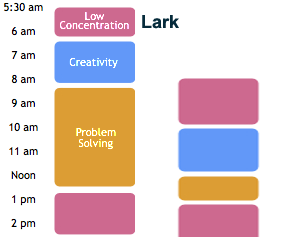
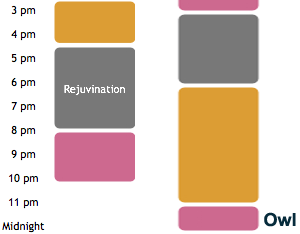
Chronotype is an attribute of animals, including human beings, reflecting at what time of the day their physical functions (hormone level, body temperature, cognitive faculties, eating and sleeping) are active. This phenomenon is commonly reduced to sleeping habits only, referring to people as ‘larks’ and ‘owls’ where morning people wake up early and are most alert in the first part of the day, and evening people are most alert in the late evening hours and prefer to go to bed late.
Humans are normally diurnal creatures, active in the daytime. Normal variation in chronotypes encompasses sleep/wake cycles that are from about two hours earlier to about two hours later than average. Extremes outside of this range can cause a person difficulty in participating in normal work, school, and social activities. If a person’s ‘lark’ or (more commonly) ‘owl’ tendencies are strong and intractable to the point of disallowing normal participation in society, the person is considered to have a circadian rhythm sleep disorder.
The 20th century saw greatly increased interest in and research on all questions about sleep. Tremendous strides have been made in molecular, neural and medical aspects of biological rhythmicity.
O. Öquist’s 1970 thesis at the Department of Psychology, University of Göteborg, Sweden, marks the beginning of modern research into chronotypes. Olov Östberg modified Öquist’s questionnaire and in 1976 and published the Morningness-Eveningness Questionnaire, MEQ, which is still used and referred to in virtually all research on this topic. A short version can be found online.
Researchers in many countries have worked on validating the MEQ with regard to their local cultures. Several other assessment tools have been developed: the Circadian Type Inventory; the Composite Scale of Morningness; the Lark-Owl Chronotype Indicator; and the Munich Chronotype Questionnaire. Some of these are designed with particular situations in mind, such as shift work scheduling, travel fatigue and jet lag, athletic performance or best timing of medical procedures.



Leave a Reply