March 3, 2011

The King of Kong: A Fistful of Quarters is a 2007 American documentary film that follows Steve Wiebe as he tries to take the world high score for the arcade game Donkey Kong from reigning champion Billy Mitchell. The film premiered at the 2007 Slamdance Film Festival.
A scripted film adaptation is already in the works. Director Seth Gordon has said that the movie might be a sequel instead of a remake, telling the story of how the documentary changed both men’s lives, as well as their continuing rivalry.
Posted in Art, Games, Humor |
Leave a Comment »
March 3, 2011


Electronic Sports, abbreviated e-Sports is used as a general term to describe the play of video games competitively. Other terms include competitive gaming, professional gaming, cybersports and V-Sports. Games that are played as electronic sports normally belong to the real-time strategy (RTS), fighting, first-person shooter (FPS), massively-multiplayer online (MMOG), and racing genres. They are played competitively at amateur, semi-professional and professional levels including in leagues and tournaments.
Recently, the massively-multiplayer online roleplaying (MMORPG) subgenre in particular has generated online tournaments. The most notable is perhaps World of Warcraft, which holds annual leagues with cash prizes for their tournaments. The prizes for 2010 World of Warcraft Global Arena totaled over US$200,000, with a first prize of $75,000.
Posted in Games, Money, Technology |
Leave a Comment »
March 3, 2011

Frag is a video game term originating from the word fragging, a term indicating to kill an unpopular superior officer with a fragmentation grenade. A frag is roughly equivalent to ‘kill,’ with the typical main difference that the player being ‘”fragged’ can instantly respawn (play again) in most games, i.e. the ‘kill’ is only temporary. In games it is mainly used as a kill count and score system. The term is used in various first-person shooter games like Quake by software developer Id.
Posted in Death, Games, Technology |
Leave a Comment »
March 3, 2011
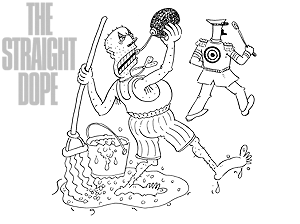
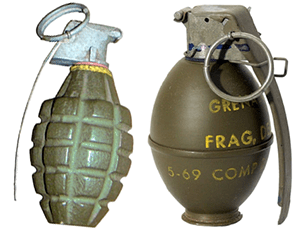
In the U.S. military, fragging refers to the act of attacking a superior officer in one’s chain of command with the intent to kill that officer. The term originated during the Vietnam War and was most commonly used to mean the assassination of an unpopular officer of one’s own fighting unit. Killing was often effected by means of a fragmentation grenade, hence the term.
The most common motive for choosing a fragmentation grenade or similar device is a perpetrator’s desire to avoid identification and the associated consequences at either the individual level (e.g., punishment by one’s superiors) or the collective level (e.g., dishonor brought to one’s unit): where a grenade is thrown in the heat of battle, soldiers can claim that the grenade landed too close to the person they ‘accidentally’ killed, that another member of the unit threw the grenade, or that an enemy soldier threw it back.
read more »
Posted in Death, Language, War |
Leave a Comment »
March 3, 2011
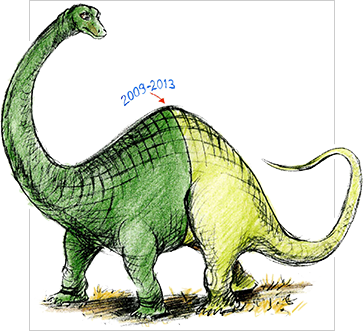
Peak oil is the idea that at some point a country, or the world, will be producing the most oil it can ever produce at one time. After this point, less oil will be produced and therefore people will have to use less oil because it will cost more money. The first person to come up with this idea was M.K. Hubbert, a U.S. geoscientist who worked at Shell, who said that a graph of oil production looks like a curve (which we now call Hubbert’s Curve).
Hubbert drew a graph in 1956 that predicted that the United States would reach its peak oil in the early 1970s, and the United States did indeed reach its peak oil in the early 1970s. It is unclear as to when the world’s peak oil will happen, though most scientists agree that it was reached in the early 2000s or will be reached before 2020. For example, the International Energy Agency (IEA) has said that peak oil may have happened in 2006.
Posted in Money, Politics, Science |
Leave a Comment »
March 3, 2011
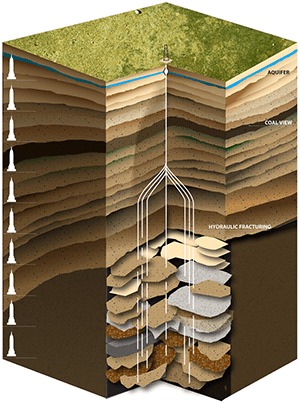
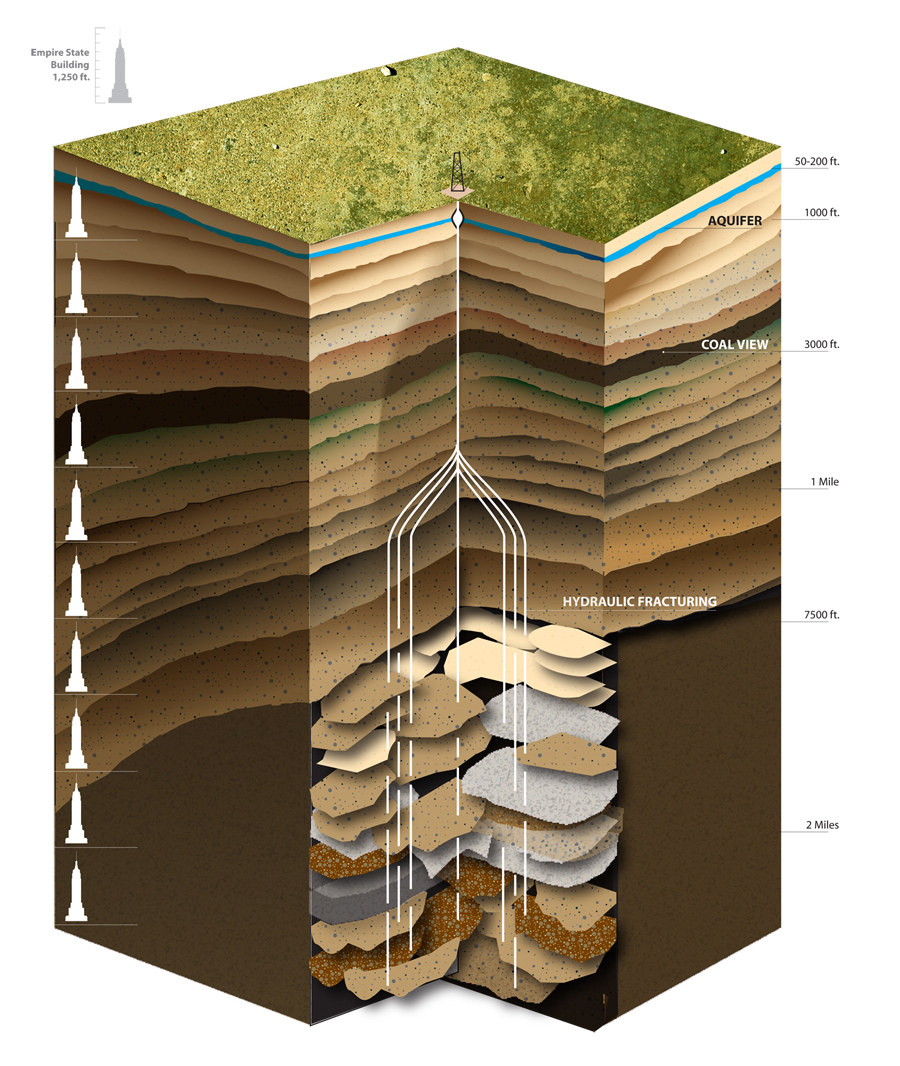
Hydraulic fracturing (‘fracking‘) is a process that results in the creation of fractures in rocks. The most important industrial use is in stimulating oil and gas wells, where hydraulic fracturing has been used for over 60 years. The fracturing is done from a wellbore drilled into reservoir rock formations to increase the rate and ultimate recovery of oil and natural gas.
Considerable controversy surrounds the current implementation of hydraulic fracturing technology in the United States. Environmental safety and health concerns have emerged and are being debated at the state and national levels. Natural hydraulic fractures include volcanic dikes, sills and fracturing by ice as in frost weathering. Man-made fractures are typically maintained after the injection by introducing a proppant, a material, such as grains of sand, ceramic, or other particulates, that prevent the fractures from closing when the injection is stopped.
Posted in Money, Politics, Technology |
Leave a Comment »
March 2, 2011

Lamborghini Aventador LP700-4 is the name of the high-performance two-door, two-seat sports car that replaces the Murciélago in the Italian automaker’s lineup. It was launched at the 2011 Geneva Motor Show. It features a brand new 6.5 litre V12 engine, producing 700 hp. It was designed by Filippo Perini of Lamborghini Centro Stile under the direction of Lamborghini chief of design Manfred Fitzgerald.
The etymology of the name comes from Lamborghini’s traditional fascination with the world of bullfighting. In this case, the Aventador was named for a Spanish fighting bull, that bore the number 32 singed on his hide, from the breeding stables of the sons of Don Celestino Cuadri Vides. Aventador gained fame in 1993 in the town of Zaragoza, Spain after a notably spirited, bloody and violent battle with a torero that led to the bull’s death.
Posted in Money, Technology |
Leave a Comment »
March 2, 2011

Transcendent Man is a documentary film by filmmaker Barry Ptolemy. The film chronicles the life and ideas of Ray Kurzweil, inventor, futurist, and author of ‘The Singularity is Near.’ ‘Transcendent Man’ presents his vision of technological singularity, the point in the future in which technology will be advancing so rapidly that humans will have to enhance themselves with artificial intelligence in order to keep up.
Kurzweil predicts the dawning of a new civilization in which humans will no longer be dependent upon their physical bodies, will become trillions of times more intelligent, and lose the ability to distinguish between real and virtual reality. He believes this will cause human aging and illness to be reversed, world hunger and poverty to be solved, and death to be ‘cured.’ Critics accuse him of being too optimistic, and argue that the dangers of the Singularity far outweigh the benefits, pointing out the apocalyptic implications.
Posted in Art, Philosophy, Technology |
Leave a Comment »
March 2, 2011

Kenneth Knowlton (b. 1931), is a computer graphics pioneer, artist, mosaicist and portraitist, who worked at Bell Labs. In 1963, Knowlton developed the BEFLIX (Bell Flicks) programming language for bitmap computer-produced movies, created using an IBM 7094 computer and a Stromberg-Carlson 4020 microfilm recorder. Each frame contained eight shades of grey and a resolution of 252 x 184. In 1966, Knowlton and Leon Harmon were experimenting with photomosaic, creating large prints from collections small symbols or images.
In Studies in Perception I they created an image of a reclining nude (the dancer Deborah Hay), by scanning a photograph with a camera and converting the analog voltages to binary numbers which were assigned typographic symbols based on halftone densities. It was printed in The New York Times on 11 October 1967, and exhibited at one of the earliest computer art exhibitions, The Machine as Seen at the End of the Mechanical Age, held Museum of Modern Art in New York City in 1968.
Posted in Art, Technology |
Leave a Comment »
March 2, 2011


ASCII art is a graphic design technique that uses computers for presentation and consists of pictures pieced together from the 95 printable (from a total of 128) characters of the ASCII compliant character sets. The term is also loosely used to refer to text based art in general. ASCII art can be created with any text editor, and is often used with free-form languages. Most examples of ASCII art require a fixed-width font (non-proportional fonts, as on a traditional typewriter) such as Courier for presentation.
Among the oldest known examples of ASCII art are the creations by computer-art pioneer Kenneth Knowlton from around 1966, who was working for Bell Labs at the time. One of the main reasons ASCII art was born was because early printers often lacked graphics ability and thus characters were used in place of graphic marks. Also, to mark divisions between different print jobs from different users, bulk printers often used ASCII art to print large banners, making the division easier to spot so that the results could be more easily separated by a computer operator or clerk. ASCII art was also used in early e-mail when images could not be embedded.
Posted in Art, Language, Technology |
Leave a Comment »
March 2, 2011

Superjail! is an American animated television series produced by Augenblick Studios. The series follows the events that take place in an unusual prison. The pilot episode aired on television in 2007. Superjail! is characterized by its psychedelic shifts in setting and plot and extreme graphic violence, which give the series a TV-MA rating. These elements are depicted through highly elaborate animated sequences, which have been described as ‘baroque and complicated and hard to take in at a single viewing.’
The majority of Superjail! is set inside the eponymous prison. Externally, Superjail is built inside a volcano which is itself located in a larger volcano. Internally, it seems to constitute its own reality, where the fabric of time and space is extremely fluid and changes at the whim of the Warden. Each episode begins with a linear story revolving around an irresponsible scheme concocted by the Warden to satisfy some whim. The episode builds up in both violence and surrealism until a climactic, psychedelic blood bath during which dozens of inmates are brutally murdered, either by one another or some external force.
Posted in Art, Humor |
Leave a Comment »
March 2, 2011
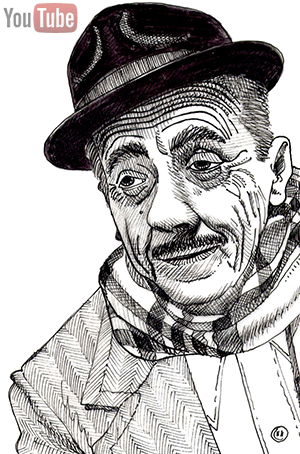
Adoniran Barbosa (1910 – 1982) was a famous Brazilian traditional samba singer and composer. The themes of his songs are drawn from the life of low-wage urban workers, the unemployed and the vagabonds. His first big hit was Saudosa Maloca (‘Shanty of Fond Memories,’ 1951), where three homeless friends recall with nostalgia their improvised shanty, which was torn down by the landowner to make room for a building. His next hit ‘Joga a Chave’ (‘Throw me the Doorkey,’ 1952) was inspired by his own frequent experiences of arriving late at home and finding the door locked by his wife, Matilde.
In his ‘Trem das Onze’ (‘The 11 PM Train,’ 1964), the protagonist explains to his lover that he cannot stay any longer because he has to catch the last train to the Jaçanã suburb, and besides his mother will not sleep before he arrives. Unlike the samba songs of the previous decades, which generally used the formal Portuguese of the educated class, Adoniran’s lyrics are a realistic record of the informal speech of São Paulo’s lower classes. He once said ‘I only write samba for the common people. That is why I write lyrics in ‘wrong’ Portuguese, because that is how the common people speak.’
Posted in Art, World |
Leave a Comment »


 The Daily Omnivore