March 23, 2011


Conveyor belt sushi (kaiten-zushi) is the popular English translation for Japanese fast-food sushi sometimes called a ‘sushi-g0-round.’ In Australia, it is known as ‘sushi train’ In South Korea, conveyor belt sushi has become popular and is known as ‘revolving sushi.’
Plates with the sushi are placed on a rotating conveyor belt that winds through the restaurant and moves past every table and counter seat. Customers may place special orders, but most simply pick their selections from a steady stream of fresh sushi moving along the conveyor belt. The final bill is based on the number and type of plates of the consumed sushi.
read more »
Posted in Food, Money, Technology |
Leave a Comment »
March 23, 2011

Dragon Skin a bulletproof vest made by Pinnacle Armor of California. Its characteristic two-inch-wide circular discs overlap like scale armor, creating a flexible vest that allows a good range of motion and can allegedly absorb a high number of hits compared with other military body armor.
The discs are composed of silicon carbide ceramic matrices and laminates, much like the larger ceramic plates in other types of bullet resistant vests. This armor has been known to withstand grenade blasts, and up to 40 rounds of ammo.
Posted in Money, Technology, War |
Leave a Comment »
March 23, 2011

A proximity fuze is designed to detonate an explosive device automatically when the distance to target becomes smaller than a predetermined value or when the target passes through a given plane. A shell with a standard ‘contact fuze’ explodes upon impact, and a ‘time fuze’ after a specified number of seconds. A ‘proximity fuze,’ however uses a radio detection system, and explodes when within a certain distance from a target.
One of the first practical proximity fuzes was codenamed the ‘VT fuze,’ an acronym of ‘Variable Time fuze,’ as deliberate camouflage for its operating principle. The VT fuze concept in the context of artillery shells originated in the UK with British researchers (particularly Sir Samuel Curran) and was developed under the direction of physicist Merle A. Tuve at The Johns Hopkins University Applied Physics Lab. It is considered one of the most important technological innovations of World War II.
Posted in Technology, War |
Leave a Comment »
March 23, 2011

The Schienenzeppelin (‘rail zeppelin’) was an experimental railcar which resembles a zeppelin airship. It was designed and developed by the German aircraft engineer Franz Kruckenberg in 1929. Propulsion was by means of a propeller located at the rear, it accelerated the railcar to 230 km/h (140 mph) setting the land speed record for a petrol powered rail vehicles. Only a single example was ever built, which due to safety concerns remained out of service and was finally dismantled in 1939.
Anticipating the design of the Schienenzeppelin, the earlier Aerowagon, an experimental Russian high-speed railcar, was also equipped with an aircraft engine and a propeller. The chassis of Schienenzeppelin was designed aerodynamically having some resemblance to the era’s popular Zeppelin airships and it was built of aluminum in aircraft style to reduce weight. The interior of the railcar was spartan and designed in Bauhaus-style.
Posted in Technology, World |
Leave a Comment »
March 23, 2011

The Bocuse d’Or [bo-kyewz dor] is a biennial world chef championship. Named for the chef Paul Bocuse, the event takes place during two days near the end of January in Lyon, France, and is frequently referred to as the culinary equivalent of the Olympic Games. The initial competition took place in 1987.
The audience atmosphere of the Bocuse d’Or evolved in 1997 when the support for the Mexican candidate included a mariachi band, foghorns, cowbells, cheering and yelling from the stands, marking the beginning of a tradition of noisy spectator presence. Originally the reigning champion nation was not permitted to participate in the following contest, but that rule was removed after the 1999 event when France was competing and did not win gold for the first time.
Posted in Food, Games, Money |
Leave a Comment »
March 23, 2011

Auguste Escoffier [es-kaw-fyey] (1846 – 1935) was a French chef, restaurateur and culinary writer who popularized and updated traditional French cooking methods. He is a legendary figure among chefs and gourmands, and was one of the most important leaders in the development of modern French cuisine.
Much of Escoffier’s technique was based on that of Antoine Carême, one of the codifiers of French haute cuisine, but Escoffier’s achievement was to simplify and modernize Carême’s elaborate and ornate style. Referred to by the French press as ‘roi des cuisiniers et cuisinier des rois’ (‘king of chefs and chef of kings’ —though this had also been previously said of Carême), Escoffier was France’s pre-eminent chef in the early part of the 20th century.
read more »
Posted in Food, Money |
Leave a Comment »
March 23, 2011

Antonin Carême [kah-rehm] (1784 – 1833), known as the ‘King of Chefs, and the Chef of Kings’ was an early practitioner and exponent of the elaborate style of cooking known as haute cuisine, the ‘high art’ of French cooking: a grandiose style of cookery favored by both international royalty and by the newly rich of Paris. Carême is often considered as one of the first, internationally renowned celebrity chefs.
He is remembered as the founder of the haute cuisine, and credited with creating the standard chef’s hat, the toque. He designed new sauces and dishes, and published a classification of all sauces into groups, based on four mother sauces. He is also frequently credited with replacing the practice of service à la française (serving all dishes at once) with service à la russe (serving each dish in the order printed on the menu).
read more »
Posted in Art, Food, Language |
Leave a Comment »
March 23, 2011

Nouvelle cuisine (‘new cuisine’) is an approach to cooking and food presentation used in French cuisine. By contrast with ‘cuisine classique,’ an older form of French ‘haute cuisine,’ nouvelle cuisine is characterized by lighter, more delicate dishes and an increased emphasis on presentation.
The modern usage can be attributed to author Henri Gault, who used it to describe the cooking of Paul Bocuse and Fernand Point. Bocuse claims that Gault first used the term to describe food prepared for the maiden flight of the Concorde airliner in 1969.
read more »
Posted in Art, Food, World |
Leave a Comment »
March 22, 2011


Kenneth Robert Howard (1929 – 1992), also known as Von Dutch, was a motorcycle mechanic, artist, pinstriper, metal fabricator, knifemaker and gunsmith. His father, Wally Howard, was a Los Angeles sign painter, and by the age of ten Kenny was able to paint and letter at a professional level. Some of his famous works include the flying eyeball and a custom Kenford truck.
Among many custom car and motorcycle enthusiasts, he is thought of as one of the fathers of Kustom Kulture (an aesthetic born out of the hot rod culture of Southern California of the 1960s). Dutch’s lifelong alcoholism led to major medical issues later in life, and he died from alcohol related complications. His daughters sold the ‘Von Dutch’ name to Michael Cassel and Robert Vaughn, who used it to form a clothing brand.
Posted in Art, Money, Technology |
Leave a Comment »
March 22, 2011

Kustom Kulture is an an aesthetic and lifestyle born out of the hot rod culture of Southern California of the 1960s, associated with artists such as Kenny Howard (also known as Von Dutch), custom car builders such as ‘Big Daddy’ Ed Roth and Dean Jeffries, hot rod and lowrider customizers such as the Barris Brothers, along with numerous tattoo artists, automobile painters, and movies and television shows such as ‘American Graffiti,’ ‘Happy Days,’ ‘The Munsters’ and ‘The Monkees.’
Kustom Kulture is usually identified with the greasers of the 1950s, the drag racers of the 1960s, and the lowriders of the 1970s. Other subcultures that have had an influence on Kustom Kulture are the Skinheads, mods and rockers of the 1960s, the punks of the 1970s, metal and rockabilly music, the scooterboys of the 1980s, and psychobilly of the 1990s. Each has its own style, but common themes include wild pinstriped paintjobs, choptop Mercurys, custom Harley-Davidson and Triumph Motorcycles, metalflake and black primer paint jobs, and monster movies.
Posted in Art, Politics, Technology |
1 Comment »
March 22, 2011
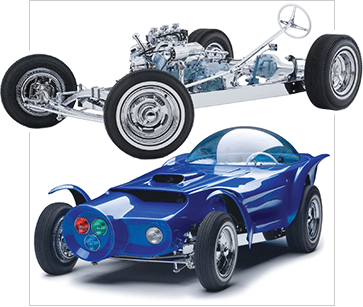
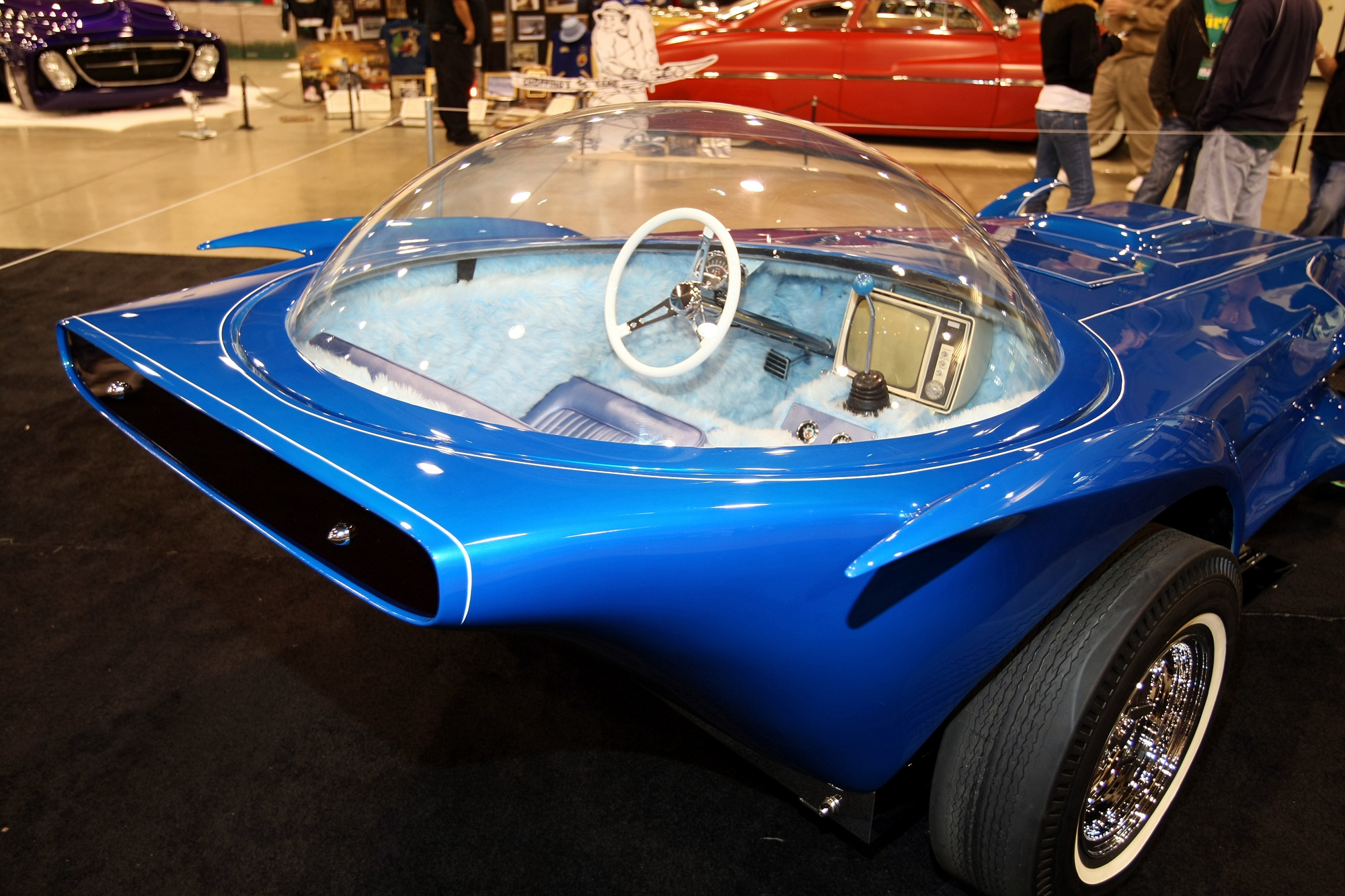
The Orbitron is a custom car built by Ed Roth and feared lost until its rediscovery in Mexico in 2007. Built in 1964, the vehicle was powered by a 1955 or 1956 Chevrolet V8 and was backed by a Powerglide automatic transmission. The body was hand-laid fiberglass which actually hid Roth’s extensive chrome work to the chassis.
The cockpit, set at the extreme rear of the vehicle in the manner of a dragster, was lined with fake fur and featured a General Electric portable television inserted in the console. Topping the cockpit was a custom-made, hydraulically operated plexiglass bubble top. One of a series of ordinary doorbell switches atop the hood activated the top from the outside.
read more »
Posted in Art, Money, Technology |
Leave a Comment »
March 22, 2011

‘Big Daddy‘ Ed Roth (1932 – 2001) was an artist and cartoonist who created the hot-rod icon ‘Rat Fink.’ As a custom car builder, Roth was a key figure in Southern California’s Kustom Kulture and hot-rod movement of the 1960s. He grew up in Bell, California, attending Bell High School, where his classes included auto shop and art. Roth is best known for his grotesque caricatures — typified by Rat Fink — depicting imaginative, out-sized monstrosities driving representations of the hot rods that he and his contemporaries built.
Although Detroit native Stanley Mouse is credited with creating the so-called ‘Monster Hot Rod’ art form, Roth is the individual who popularized it. Roth is also well known for his innovative work in turning hot rodding from crude backyard engineering, where performance was the bottom line, into a refined art form where aesthetics were equally important, breaking new ground with fiberglass bodywork.
Posted in Art, Humor, Money |
Leave a Comment »




 The Daily Omnivore