April 13, 2011

Club 57 was a nightclub located at 57 St. Mark’s Place in the East Village, New York City during the late 1970s and early 1980s. It was a hangout and venue for performance- and visual-artists and musicians, including Keith Haring, Klaus Nomi, and to a lesser extent, Jean-Michel Basquiat.
read more »
Posted in Art, Games, Money |
Leave a Comment »
April 13, 2011

Leslie Conway ‘Lester’ Bangs (1948 – 1982) was an American music journalist and musician. He wrote for ‘Creem’ and ‘Rolling Stone’ magazines and has been called one of the ‘most influential’ voices in rock criticism. In 1969, Bangs began writing freelance after reading an ad in ‘Rolling Stone’ soliciting readers’ reviews.
His first piece was a negative review of the MC5 album ‘Kick Out The Jams,’ which he sent to ‘Rolling Stone’ with a note detailing that should the magazine decide not to publish the review, then they would have to contact Lester and tell him why. They published it.
read more »
Posted in Art, Humor, Money |
Leave a Comment »
April 13, 2011

Creem was a monthly rock ‘n’ roll publication first published in March 1969 by Barry Kramer and founding editor Tony Reay. It suspended production in 1989 but received a short-lived renaissance in the early 1990s as a glossy tabloid.
Lester Bangs, often cited as ‘America’s Greatest Rock Critic,’ became editor in 1971. The term ‘punk rock’ was said to have been coined by the magazine in 1971, and the term ‘heavy metal’ was also first used in its pages.
read more »
Posted in Art, Humor, Money |
Leave a Comment »
April 13, 2011
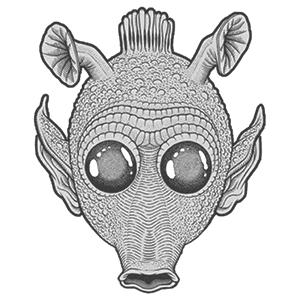
Florian Bertmer is a German illustrator from the hardcore punk, grindcore and metal scene.
His early works are reminiscent of fellow punk artist, Pushead, while later works have become more Art Nouveau influenced. He fronted the band Cheerleaders Of The Apocalypse.
Posted in Art |
Leave a Comment »
April 13, 2011

Pushead (Brian Schroeder) is an artist and record label owner within the hardcore punk and heavy metal field. He has created artwork for Metallica, Travis Barker, and The Misfits. His artwork is characterized by detailed skulls.
He designed skateboard graphics and advertisements for Zorlac Skateboards during the 80s and beginning of the 90s. He fronted the band Septic Death during the 1980s.
Posted in Art |
Leave a Comment »
April 13, 2011

Sala Keoku is a park featuring giant fantastic concrete sculptures inspired by Buddhism and Hinduism. It is located in Thailand, near the Thai-Lao border and the Mekong river. The park has been built by and reflects the personal vision of Thai spiritual leader and sculptor, Luang Pu Bunleua Sulilat and his followers (the construction started in 1978). It shares the style of Sulilat’s earlier creation, Buddha Park on the Lao side of Mekong, but is marked by even more extravagant fantasy and greater proportions.
Some of the Sala Keoku sculptures tower up to 25m in the sky. Those include a monumental depiction of Buddha meditating under the protection of a seven-headed Naga snake (Mucalinda). While the subject (based on a Buddhist legend) is one of the recurrent themes in the religious art of the region, Sulilat’s approach is highly unusual, with its naturalistic (even though stylized) representation of the snakes.
Posted in Art, Philosophy, World |
Leave a Comment »
April 13, 2011

Dichroic [dahy-kroh-ik] glass is glass containing multiple micro-layers of metal oxides which alter its optical properties. The invention of dichroic glass is often erroneously attributed to NASA and its contractors, who developed it for use in dichroic filters.
Dichroic glass dates back to at least the 4th century CE as seen in the Lycurgus cup, a Roman relic.
read more »
Posted in Art, Science, Technology |
2 Comments »
April 12, 2011


A bottle wall is a wall made out of glass bottles and binding material. A building construction style which usually uses 1l glass bottles (although mason jars or 1/2l glass jugs may be used as well) as masonry units and binds them using adobe, sand, cement, stucco, clay, plaster, mortar or any other joint compound to result in an intriguing stained-glass like wall.
read more »
Posted in Art, Money, Technology |
Leave a Comment »
April 12, 2011

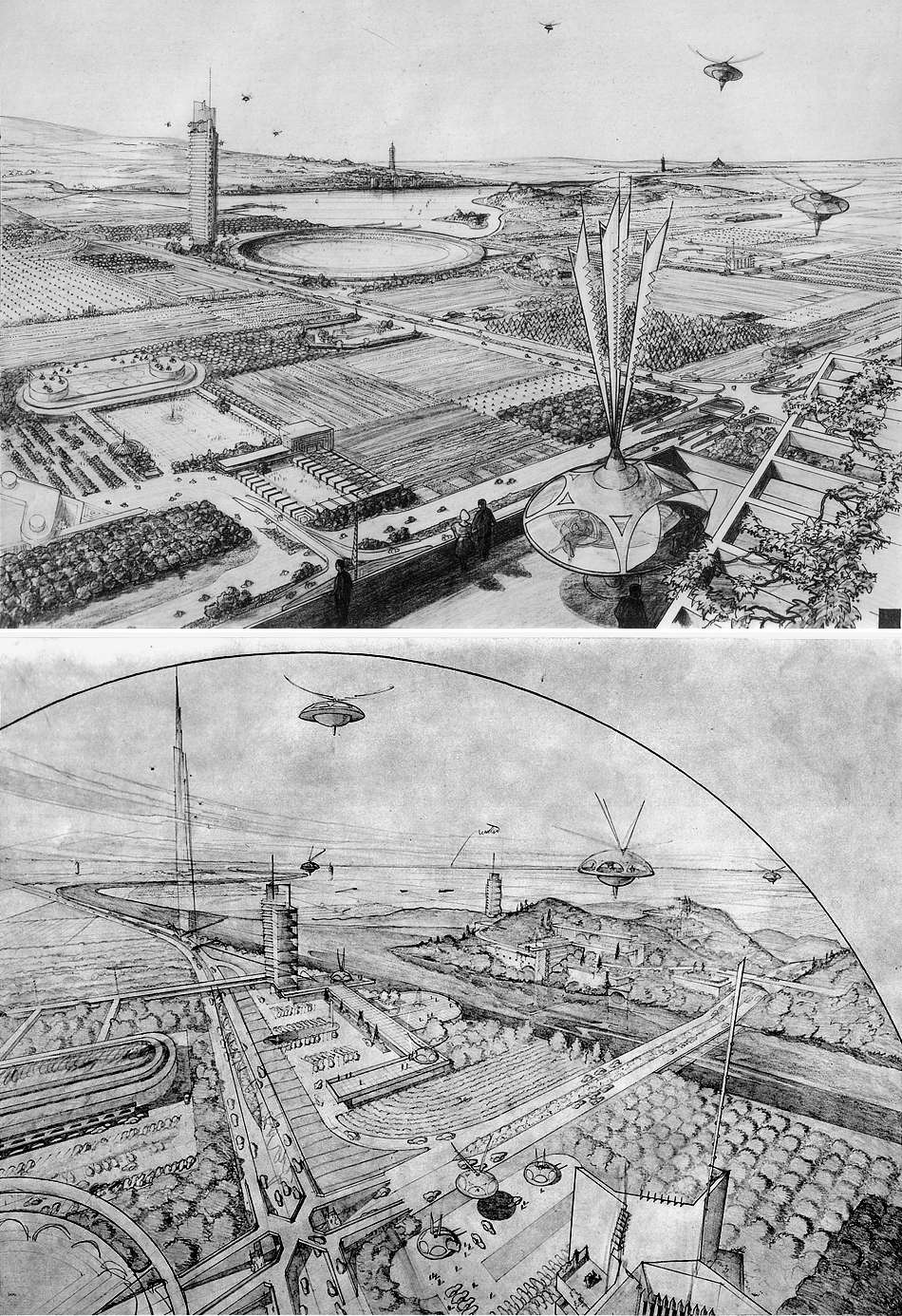
Broadacre City was an urban or suburban development concept proposed by Frank Lloyd Wright throughout most of his lifetime. He presented the idea in his book ‘The Disappearing City’ in 1932. A few years later he unveiled a very detailed twelve by twelve foot (3.7 by 3.7 m) scale model representing a hypothetical four square mile (10 km²) community. Wright would go on refining the concept in later books and in articles until his death in 1959.
Many of the building models in the concept were completely new designs by Wright, while others were refinements of old ones, some of which had been rarely seen. Broadacre City was the antithesis of a city and the apotheosis of the newly born suburbia, shaped through Wright’s particular vision. It was both a planning statement and a socio-political scheme by which each U.S. family would be given a one acre (4,000 m²) plot of land from the federal lands reserves, and a Wright-conceived community would be built anew from this. In a sense it was the exact opposite of transit-oriented development.
Posted in Money, Technology |
Leave a Comment »
April 12, 2011
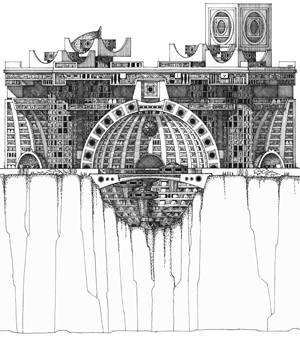
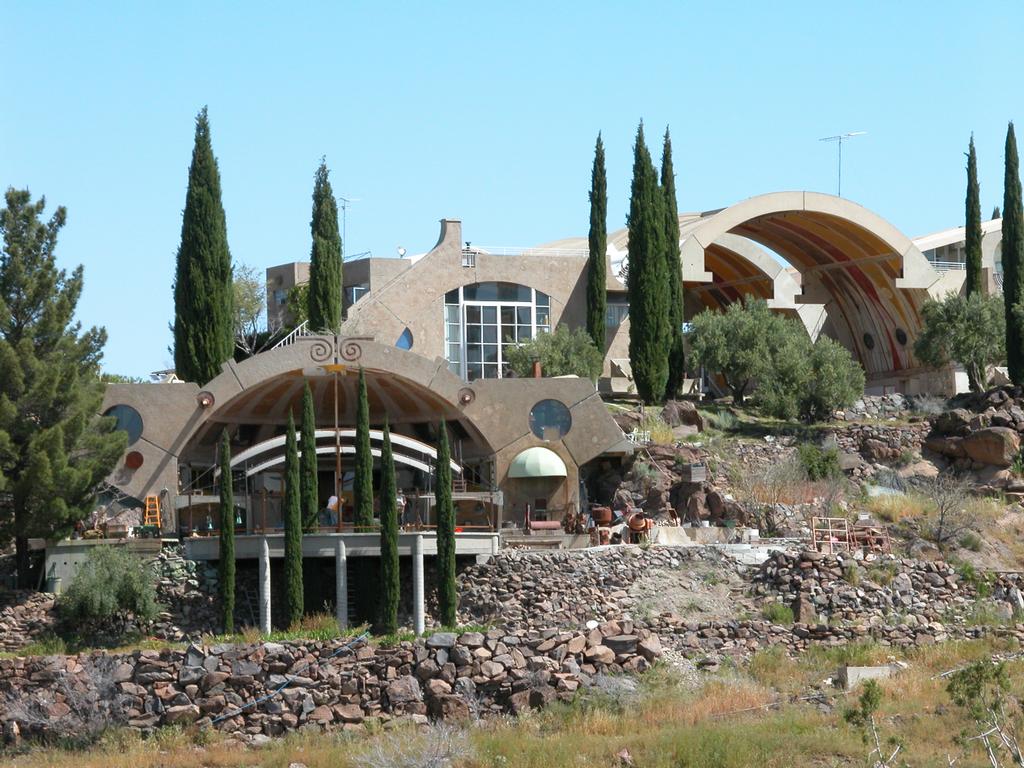
Arcosanti is an experimental town that began construction in 1970 in central Arizona, 70 mi (110 km) north of Phoenix, at an elevation of 3,732 feet (1,130 meters).
Architect Paolo Soleri, using a concept he calls arcology (a portmanteau of architecture and ecology), started the town to demonstrate how urban conditions could be improved while minimizing the destructive impact on the earth.
read more »
Posted in Money, Science, Technology |
Leave a Comment »
April 12, 2011
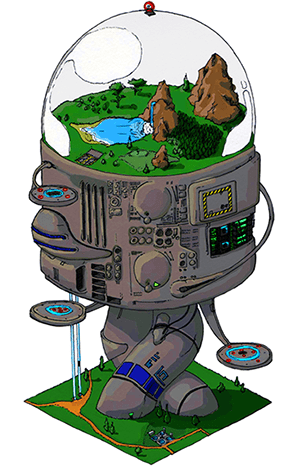
Arcology, a portmanteau of the words ‘architecture’ and ‘ecology,’ is a set of architectural design principles aimed toward the design of enormous habitats (hyperstructures) of extremely high human population density. These largely hypothetical structures would contain a variety of residential, commercial, and agricultural facilities and minimize individual human environmental impact.
They are often portrayed as self-contained or economically self-sufficient. The concept has been primarily popularized, and the term itself coined, by architect Italian-American architect, Paolo Soleri, and appears commonly in science fiction.
read more »
Posted in Money, Technology |
Leave a Comment »
April 12, 2011

The Anthropocene [an-thruh-poh-seen] is a proposed geological epoch that marks the impact of human activities on the Earth’s ecosystems. The term was coined in 2000 by the Nobel Prize-winning atmospheric chemist Paul Crutzen, who regards the influence of human behavior on the Earth’s atmosphere in recent centuries as so significant as to constitute a new geological era for its lithosphere (the rigid outermost shell of a rocky planet). As early as 1873, the Italian geologist Antonio Stoppani acknowledged the increasing power and impact of humanity on the Earth’s systems and referred to the ‘anthropozoic era’
The Anthropocene has no precise start date, but based on atmospheric evidence may be considered to start with the Industrial Revolution (late 18th century). Other scientists link it to earlier events, such as the rise of agriculture. Human influence on land use, ecosystems, biodiversity and species extinctions, may have begun as early as 10,000 years before present. This period (10,000 years to present) is usually referred to as the Holocene by geologists. For the majority of the Holocene, human populations were relatively low and their activities considerably muted relative to that of the last few centuries. Nonetheless, many of the processes currently altering the Earth’s environment were already occurring.
Posted in Language, Science, Technology |
Leave a Comment »







 The Daily Omnivore