June 30, 2011

‘100,000,000 Guinea Pigs: Dangers in Everyday Foods, Drugs, and Cosmetics’ is a book written by Arthur Kallet and F.J. Schlink first released in 1933. Its central argument propounds that the American population is being used as guinea pigs in a giant experiment undertaken by the American producers of food stuffs and patent medicines and the like. Kallet and Schlink premise the book as being ‘written in the interest of the consumer, who does not yet realize that he is being used as a guinea pig…’
The book’s key proposition is that a great deal of products sold to the public – particularly pharmaceuticals and food products – are released with little regard or knowledge of how these products adversely impact the consumer. Corporations, often knowingly, release products which either do not do what they purport to, or have dangerous side effects or defects. Furthermore, many officials and government departments, namely the U.S. Food and Drug Administration, have fallen victim to regulatory capture (control by industry it is charged with regulating).
read more »
Posted in Health, Money, Politics |
Leave a Comment »
June 30, 2011

The Other World Kingdom (OWK) was a large, commercial BDSM and femdom resort and micronation, which opened in 1996 using the buildings and grounds of a 16th century chateau located in Czech Republic. Although it was not recognized by any other country, it maintained its own currency, passports, police force, courts, state flag, and state hymn. The OWK was a matriarchy and the state’s goal was ‘to get as many male creatures under the unlimited rule of Superior Women on as much territory as possible.’
The OWK was ruled by Her Royal Majesty Queen Patricia I, an absolute monarch. The site was 7.4 acres with several buildings and a small lake. The main building was the Queen’s Palace, which was the residence of the monarch, and contained a banqueting hall, library, throne room, torture chamber, schoolroom, gym, and extensive basement prison, the cells of which could be rented.
read more »
Posted in Games, Sex, World |
Leave a Comment »
June 30, 2011

The last meal is a customary part of a condemned prisoner’s last day. The day before the appointed time of execution, the prisoner receives the meal, as well as religious rites, if they desire. As a general rule, inmates may not ask for an alcoholic drink. In many countries the prisoner may select what the last meal will be (within reason), and the authorities do their best to satisfy the request. Although the history of this tradition is difficult to trace, most modern governments that execute prisoners subscribe to it.
Serial killer, John Wayne Gacy, requested a dozen deep-fried shrimp, a bucket of original recipe chicken from KFC, French fries, and a pound of strawberries. Domestic terrorist, Timothy ate two pints of mint chocolate-chip ice cream as his last meal.
read more »
Posted in Death, Food, Politics |
Leave a Comment »
June 29, 2011
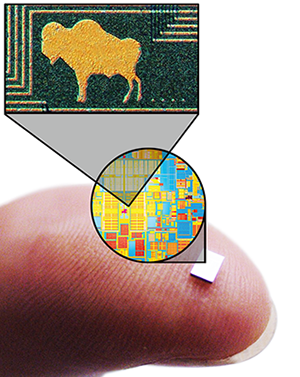
Chip art, also known as silicon art, chip graffiti or silicon doodling, refers to microscopic artwork built into integrated circuits, also called chips or ICs. Since ICs are printed by photolithography, not constructed a component at a time, there is no additional cost to include features in otherwise unused space on the chip.
Designers have used this freedom to put all sorts of artwork on the chips themselves, from designers’ simple initials to rather complex drawings. Given the small size of chips, these figures cannot be seen without a microscope. Chip graffiti is sometimes called the hardware version of software easter eggs (an intentional hidden message or feature).
read more »
Posted in Art, Humor, Technology |
Leave a Comment »
June 29, 2011
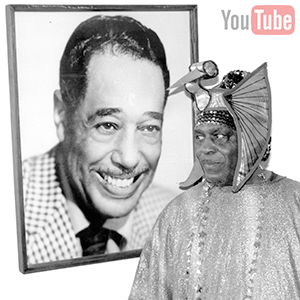
Sun Ra (1914 – 1993), born Herman Poole Blount, was a prolific jazz artist and philosopher known for his ‘cosmic’ music and philosophies. His eclectic music and unorthodox lifestyle made him controversial. Claiming that he was of the ‘Angel Race’ and not from Earth, but from Saturn, Sun Ra developed a complex persona using ‘cosmic’ philosophies and lyrical poetry that made him a pioneer of afrofuturism. He preached awareness and peace above all.
He abandoned his birth name and took on the name and persona of Sun Ra (Ra being the Egyptian God of the Sun), and used several other names throughout his career, including Le Sonra and Sonny Lee. Sun Ra denied any connection with his birth name, saying ‘That’s an imaginary person, never existed … Any name that I use other than Ra is a pseudonym.’
read more »
Posted in Art, Humor, Philosophy |
Leave a Comment »
June 29, 2011
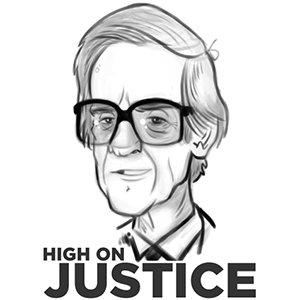

The ‘veil of ignorance‘ and the ‘original position’ (state of nature) are concepts introduced by Hungarian economist, John Harsanyi, and later appropriated by American Philosopher, John Rawls, in ‘A Theory of Justice.’
It is a method of determining the morality of a certain issue (e.g. slavery) based upon the following principle: imagine that societal roles were completely re-fashioned and redistributed, and that from behind the veil of ignorance, one does not know what role they will be reassigned. Only then can one truly consider the morality of an issue.
read more »
Posted in Philosophy, Politics |
1 Comment »
June 29, 2011

A ghost bike or ghostcycle is a bicycle set up as a roadside memorial in a place where a cyclist has been killed or severely injured (usually by a motor vehicle). Apart from being a memorial, it is usually intended as a reminder to passing motorists to share the road.
Ghost bikes are usually junk bicycles painted white, sometimes with a placard attached, and locked to a suitable object close to the scene of the accident. The original idea of painting bikes white reportedly goes back to Amsterdam in the 1960s as an anarchist project to liberate two-wheel transport—white bikes were free, help yourself and then leave it for someone else.
Posted in Death, Politics |
Leave a Comment »
June 29, 2011
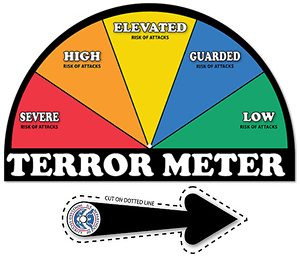
Hypervigilance is an enhanced state of sensory sensitivity accompanied by an exaggerated intensity of behaviors whose purpose is to detect threats. Hypervigilance is also accompanied by a state of increased anxiety which can cause exhaustion. Other symptoms include: abnormally increased arousal, a high responsiveness to stimuli and a constant scanning of the environment for threats. Hypervigilance can be a symptom of posttraumatic stress disorder (PTSD) and various types of anxiety disorder. It is distinguished from paranoid states, such as in schizophrenia, which can seem superficially similar, but are characteristically different.
Hypervigilance is differentiated from dysphoric hyperarousal in that the person remains cogent and aware of his or her surroundings. In dysphoric hyperarousal the PTSD victim may lose contact with reality and re-experience the traumatic event verbatim. Where there have been multiple traumas, a person may become hypervigilant and suffer severe anxiety attacks intense enough to induce a delusional state where the effect of the traumas overlap: e.g., one remembered firefight may seem too much like another for the person to maintain calm. This can result in the ‘thousand yard stare’ (a phrase originally coined to describe the limp, unfocused gaze of a battle-weary warrior).
Posted in Health, Language, War |
1 Comment »
June 29, 2011
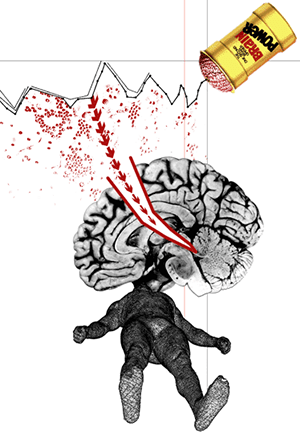
Latent inhibition (LI) is a technical term used in Classical conditioning (Pavlovian reinforcement) that refers to the natural tendency to tune out familiar stimuli. Individuals take longer to become aware of common stimuli than novel ones. It is ‘a measure of reduced learning about a stimulus to which there has been prior exposure without any consequence.’ Latent inhibition occurs when voluntarily trying to ignore an ongoing sound (like an air conditioner) or not hear the conversation of others.
This tendency to disregard or even inhibit formation of memory (by preventing associative learning of observed stimuli) is an unconscious response, and is assumed to prevent sensory and cognitive overload. Latent inhibition is observed in many species, and is believed to be an integral part of learning, enabling an organism to interact successfully in an environment.
read more »
Posted in Drugs, Health, Science |
Leave a Comment »
June 29, 2011
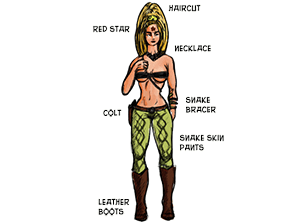
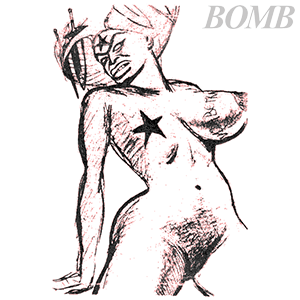
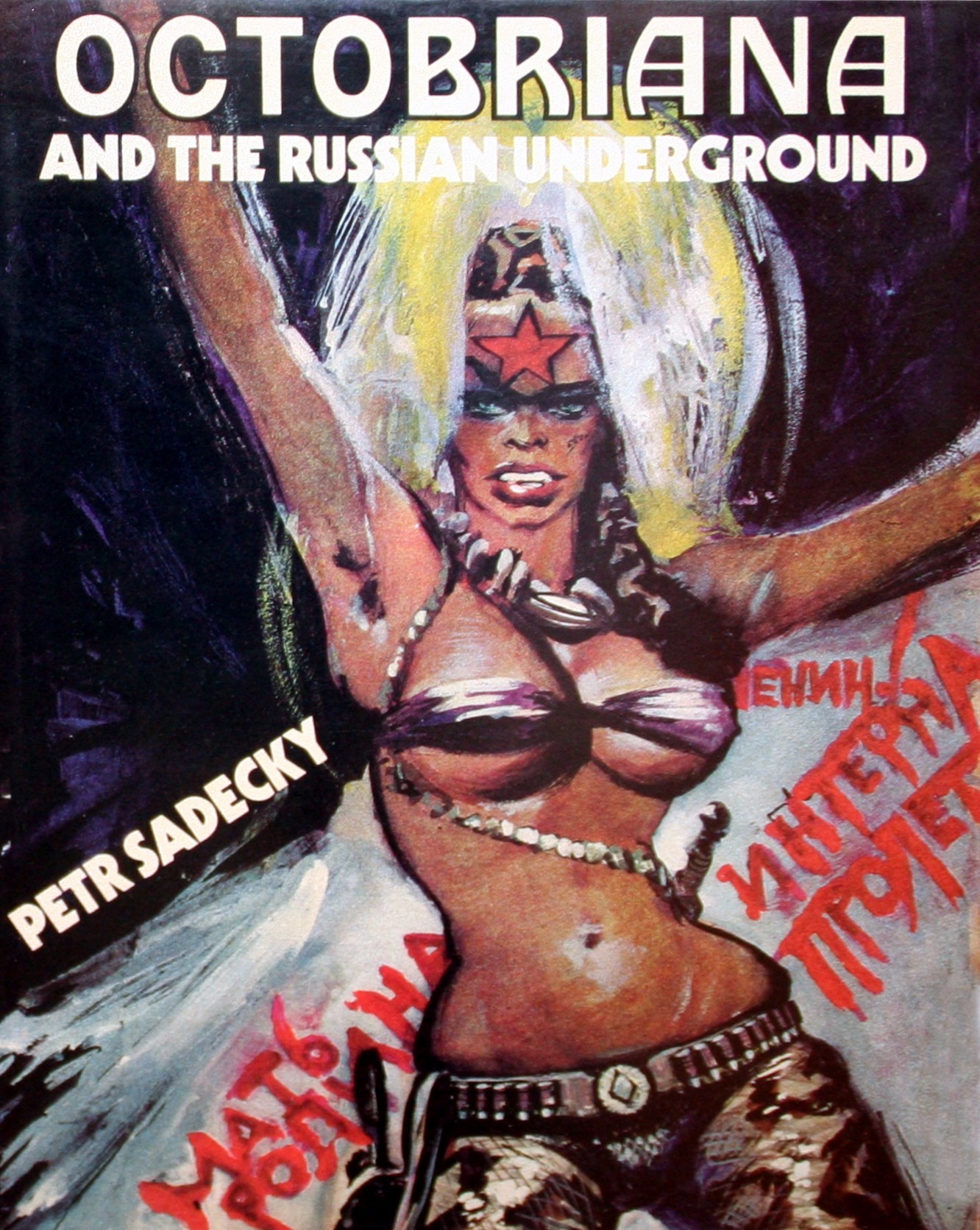
Octobriana is a comic superheroine originating from literary hoax by Czech artist Petr Sadecký. Sadecký wrote ‘Octobriana and the Russian Underground,’ a book that told the story of Octobriana, purported to be the creation of a group of Russian dissident artists calling themselves Progressive Political Pornography (PPP) in the 1960s. Octobriana was actually Sadecký’s own creation. While still in Prague, he enlisted the help of two Czech artists, Bohumil Konečný and Zdeněk Burian, in creating a comic centering around the character of ‘Amazona.’ Sadecký told the two that he had a buyer interested in the comic, and they worked together on writing and illustrating it.
However, Sadecký betrayed his friends by stealing the artwork and escaping to the West, where, in his efforts to market the Amazona comic, he changed the dialog, drew a red star on the character’s forehead, changed her name to Octobriana, and gave her a fake political backstory. Burian and Konečný sued Sadecký in a West German court, winning the case but never recovering all their stolen artwork. Since Octobriana is still widely thought to be the product of dissident cells within the U.S.S.R., she is not copyrighted, and has appeared in a variety of artistic incarnations.
Posted in Art, Money, World |
Leave a Comment »
June 29, 2011

Samizdat [sah-miz-daht] (Russian for ‘self-published’) was a key form of dissident activity across the Soviet bloc in which individuals reproduced censored publications by hand and passed the documents from reader to reader.
This grassroots practice to evade officially-imposed censorship was fraught with danger as harsh punishments were meted out to people caught possessing or copying censored materials.
read more »
Posted in Language, Politics, World |
Leave a Comment »
June 29, 2011

Musopen is an online music library of copyright-free (public domain) music. Musopen’s mission is to record or obtain recordings that have no copyrights so that its visitors may listen, re-use, or in any way enjoy music, and ‘to set music free.’ In 2008, Musopen released newly-commissioned recordings of the 32 Beethoven piano sonatas into the public domain.
In 2010, the site organized a fundraiser via Kickstarter to commission recordings of a larger repertoire. Musopen is a nonprofit charity, operating out of Palo Alto, California, created by Aaron Dunn in 2005.
Posted in Art, Money, Politics |
Leave a Comment »


 The Daily Omnivore