July 3, 2011

Manqué [mahng-key] (feminine, manquée) is a term used in reference to a person who has failed to live up to a specific expectation or ambition. It is usually used in combination with a profession: for example, a career civil servant with political prowess who nonetheless never attained political office might be described as a ‘politician manqué.’
It can also be used relative to a specific role model; a second-rate method actor might be referred to as a ‘Marlon Brando manqué.’ The term derives from the past participle of the French verb manquer (‘to miss’). In English, it is used in the manner of a French adjective: coming after the noun it is modifying instead of before.
Posted in Language, Politics, World |
Leave a Comment »
July 3, 2011

The Subservient Chicken is a 2004 advertising campaign created to promote international fast food restaurant chain Burger King’s TenderCrisp chicken sandwich and their ‘Have it Your Way’ campaign. On its website, a man in a chicken costume performs a wide range of actions based on a user’s input, showing pre-recorded footage and appearing like an interactive webcam. The site takes literally the advertising slogan ‘Get chicken just the way you like it.’
There are more than three hundred commands that the Subservient Chicken will respond to, including: Moonwalk, Riverdance, and pick your nose. When told to perform sex acts, take off his mask, or do anything the Subservient Chicken considers offensive, the chicken walks up to the camera and shakes a scolding chicken finger in disappointment.
Posted in Food, Humor, Money |
Leave a Comment »
July 3, 2011

Milk kinship, formed during nursing by a non-biological mother, was a form of fostering allegiance with fellow community members. In the early modern period, milk kinship was widely practiced in many Arab countries for both religious and strategic purposes. Like the Christian practice of godparenting, milk kinship established a second family that could take responsibility for a child whose biological parents came to harm. ‘Milk kinship in Islam thus appears to be a culturally distinctive, but by no means unique, institutional form of adoptive kinship.’ A child in one of these societies would be breastfed by a woman of a lower class, enabling the child’s biological mother to maintain her modesty.
The childhood of the prophet Muhammad illustrates the practice of traditional Arab milk kinship. In his early childhood, he was sent away to foster-parents amongst the Bedouin. By nursing him, Halimah bint Abdullah became his ‘milk-mother.’ The rest of her family was drawn into the relationship as well: her husband al-Harith became Muhammad’s ‘milk-father,’ and Muhammad was raised alongside their biological children as a ‘milk-brother.’ This case suggests that it was typical for a child’s wet nurse to be responsible for raising him.
read more »
Posted in Food, Philosophy, World |
Leave a Comment »
July 3, 2011

Almost 30 years after its release, the plot for the movie ‘Trading Places’ was part of the inspiration for new regulations on the financial markets. In March of 2010 Commodity Futures Trading Commission chief Gary Gensler stated, in testimony he gave to the 111th Congress, ‘We have recommended banning using misappropriated government information to trade in the commodity markets. In the movie, starring Eddie Murphy, the Duke brothers intended to profit from trades in frozen concentrated orange juice futures contracts using an illicitly obtained and not yet public Department of Agriculture orange crop report.
The ‘Eddie Murphy Rule,’ as it came to be known, later came into effect as part of the Wall Street Transparency and Accountability Act of the Dodd-Frank Wall Street Reform and Consumer Protection Act, which dealt with insider trading.
Posted in Humor, Money, Politics |
Leave a Comment »
July 3, 2011
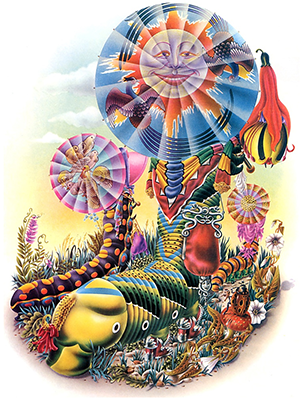
Alan Aldridge is a UK artist and illustrator based out of Los Angeles. Aldridge first worked as an illustrator at ‘The Sunday Times Magazine.’ He was hired in 1965 by Penguin’s chief editor Tony Godwin to become the art director of Penguin Books. Over the next two years as art director, he especially focused on science fiction book covers and introduced his style which resonated with the mood of the time. In 1968 he moved to his own graphic-design firm, INK, which became closely involved with graphic images for the Beatles and Apple Corps.
His work is characterized by a flowing, cartoony style and soft airbrushing – very much in step with the psychedelic styles of the times. In the theater, in 1969 he designed the graphics for controversial Jane Arden play ‘Vagina Rex and the Gas Oven.’ He is possibly best known, however, for the picture book ‘The Butterfly Ball and the Grasshopper Feast’ (1973), a series of illustrations of anthropomorphic insects and other creatures, which he created in collaboration with William Plomer, who wrote the accompanying verses. This was based on William Roscoe’s poem of the same name, but was inspired when Aldridge read that John Tenniel had told Lewis Carroll it was impossible to draw a ‘wasp in a wig’.
Posted in Art |
Leave a Comment »


 The Daily Omnivore