July 12, 2011


Richard Kelly (b. 1975) is an American film director and writer. He won a scholarship to the University of Southern California to study at the USC School of Cinema-Television. He made two short films, ‘The Goodbye Place’ and ‘Visceral Matter,’ before graduating in 1997. His first feature film, ‘Donnie Darko’ (2001), a psychological thriller, was given a budget of just $4.5 million, received major critical acclaim. His fourth film, and second feature, ‘Southland Tales,’ (2006) is a science fiction dark comedy-drama, which was unsuccessful critically and financially. His most recent feature, ‘The Box’ (2009), is a psychological horror film.
Although Richard Kelly’s films differ considerably in setting and characters (‘Donnie Darko’ is about a suburban teenager, ‘Southland Tales’ is an L.A. epic, and ‘The Box’ is about a married couple in Richmond, Virginia), they share similar themes of time travel, existentialism, and spirituality. Kelly’s style is composed of Steadicam based tracking shots and camera movement in general, satirical elements (as seen sparsely in ‘Donnie Darko’ and much more prominently in ‘Southland Tales’), comedy, drama, and enigmatic plots. Music also plays a large role in Richard Kelly’s films; for example, the closing segment of ‘Donnie Darko’ is a montage of several characters awakening from their lucid dreams to Gary Jules’s version of the Tears for Fears song ‘Mad World.’
Posted in Art, Money |
1 Comment »
July 12, 2011

Southland Tales is a 2006 science fiction dark comedy-drama film, written and directed by Richard Kelly. The title refers to the Southland, a name used by locals to refer to Southern California and Greater Los Angeles. Set in the then near future of an alternate history, the film is a portrait of Los Angeles and a comment on the military-industrial news-tainment complex. The film features an ensemble cast. Original music for the film was provided by Moby. The film was a critical and financial failure.
The film opens on El Paso and Abilene, Texas, both of which fall victim to twin nuclear attacks on July 4, 2005—a catastrophe of unimaginable proportions which launches America into World War III. The PATRIOT Act has extended authority to a new agency known as US-IDent, which keeps constant tabs on citizens and heavily censors the media and the Internet.
read more »
Posted in Art, Humor, Politics |
Leave a Comment »
July 12, 2011

Kaoru Betto (b. 1920) was a former Nippon Professional Baseball player. After playing for the Ōsaka Tigers for two years, Betto played for the Mainichi Orions from 1950 to 1957. In his first season with the Orions, Betto won the NPB’s first Pacific League MVP Award and helped lead the team to victory in the first Japan Series.
Actor Jeff Bridges can be seen wearing a Kaoru Betto shirt in several of his films.
Posted in Games, World |
Leave a Comment »
July 11, 2011

The Tamagotchi [tom-uh-gotchee] is a handheld digital pet, created in Japan by Akihiro Yokoi of WiZ and Aki Maita of Bandai. It was first sold by Bandai in 1996 in Japan. As of 2010, over 76 million Tamagotchis have been sold world-wide. Most Tamagotchis are housed in a small egg-shaped computer with an interface usually consisting of three buttons, although the number of buttons may vary for different variations. According to Bandai, the name is a portmanteau combining the Japanese word ‘tamago,’ which means ‘egg,’ and the English word ‘watch.’
Upon removing the tag of a Tamagotchi unit, an egg will appear on the screen. After setting the Tamagotchi unit’s clock, the Tamagotchi will hatch, after which the player will be told of its gender and will be given the opportunity to give it a name. From then on, the player is given the task of raising the Tamagotchi to good health throughout its life and attending to its needs, such as feeding it, playing games to make it happy, and keep it at a healthy weight, cleaning up its excrement, punishing or praising the Tamagotchi based on its actions, returning it to proper health with medicine if it gets sick, and shutting off the lights when it goes to bed.
read more »
Posted in Games, Technology, World |
Leave a Comment »
July 11, 2011

Cats feed on small prey, primarily birds and rodents. Feral cats and house cats that are free-fed tend to consume many small meals in a single day, although the frequency and size of meals varies between individuals. Cats use two hunting strategies, either stalking prey actively, or waiting in ambush until an animal comes close enough to be captured.
They often ambush outside burrows, but tend to actively stalk birds. Most breeds of cat have a noted fondness for settling in high places, or perching. In the wild, a higher place may serve as a concealed site from which to hunt; domestic cats may strike prey by pouncing from such a perch as a tree branch, as does a leopard.
read more »
Posted in Food, Science |
Leave a Comment »
July 11, 2011

A MiniDisc (MD) is a magneto-optical disc-based data storage device initially intended for storage of up to 74 minutes and, later, 80 minutes, of digitized audio. In the form of Hi-MD, it has also developed into a general-purpose storage medium. MiniDisc was released in 1992, first in Japan, and then in Europe and the U.S. The music format was originally based exclusively on ATRAC audio data compression, but the option of linear PCM recording was later introduced to attain audio quality comparable to that of a compact disc.
Sony’s MiniDisc was one of two rival digital systems introduced in 1992, that were both targeted as a replacement for the Philips analog cassette audio tape system: the other was Digital Compact Cassette (DCC), created by Philips and Matsushita. Sony had originally intended for Digital Audio Tape (DAT) to be the dominant home digital audio recording format, replacing the analog cassette. Unfortunately, due to technical delays, DAT was not launched until 1989, and by then, the U.S. dollar had fallen so far in relation to the yen, the introductory DAT machine Sony had intended to market for about $400 in the late 1980s now had to retail for $800 or even $1000 to break even, putting it out of reach for most users. Relegating DAT for pro use, Sony immediately set to work to come up with a simpler, more economical digital home format.
read more »
Posted in Money, Technology, World |
Leave a Comment »
July 11, 2011

The Chinese typewriter was invented and patented by Dr. Lin Yutang in 1946. One of Lin’s intentions was to help modernize China. The typewriter was called ‘MingKwai’ (‘clear and quick’). Lin had a prototype machine custom built by the Carl E. Krum Company, a small engineering-design consulting firm with an office in New York City. That multilingual typewriter was the size of a conventional office typewriter of the 1940s. The typefaces fit on a drum. A ‘magic eye’ was mounted in the center of the keyboard which magnifies and allows the typist to review a selected character. Character selection is accomplished by first pressing two keys to choose a desired character, which is arranged according to a system Lin devised for his dictionary of the Chinese language. The selected Chinese character appeared in the magic eye for preview, the typist then pressed a ‘master’ key, similar to today’s computer function key.
The typewriter could create 90,000 distinct characters using either one or two of six character-containing rollers, which in combination has 7000 full characters and 1,400 character radicals or partial characters. The inspired aspect of the typewriter was the system Lin devised for a Chinese alphabet. It had thirty geometric shapes or strokes (somewhat analogous to the elements of a glyph). These became ‘letters’ by which to alphabetize Chinese characters. He broke tradition with the long-standing system of radicals and stroke order writing and categorizing of Chinese characters, inventing a new way of seeing and categorizing. The typewriter was not produced commercially. According Lin’s daughter, the day she was to demonstrate the machine to executives of the Remington Typewriter Company, they could not make it work. Although they did get the machine fixed for a press conference the next day, it was to no avail.
Posted in Language, Technology, World |
Leave a Comment »
July 11, 2011

Hot pot, less commonly Chinese fondue or steamboat, refers to several East Asian varieties of stew, consisting of a simmering metal pot of stock at the center of the dining table. While the hot pot is kept simmering, ingredients are placed into the pot and are cooked at the table. Typical hot pot dishes include thinly sliced meat, leafy vegetables, mushrooms, wontons, egg dumplings, and seafood. The cooked food is usually eaten with a dipping sauce. In many areas, hot pot meals are often eaten in the winter.
The Chinese hot pot boasts a history of more than 1,000 years. While often called ‘Mongolian hot pot,’ it is unclear if the dish actually originates in Mongolia, though Mongolian warriors had been known to cook with their helmets, which they used to boil food. Hot pot cooking spread to northern China during the Tang Dynasty (618 – 906). Today in many modern homes, particularly in the big cities, the traditional coal-heated steamboat or hot pot has been replaced by electric, gas or induction cooker versions.
read more »
Posted in Food, World |
Leave a Comment »
July 11, 2011


Addiction medicine is a medical specialty that deals with the treatment of addiction. The specialty often crosses over into other areas, since various aspects of addiction fall within the fields of public health, psychology, social work, psychiatry, and internal medicine, among others. Incorporated within the specialty are the processes of detoxification, rehabilitation, harm reduction, abstinence-based treatment, individual and group therapies, oversight of halfway houses, treatment of withdrawal-related symptoms, acute intervention, and long term therapies designed to reduce likelihood of relapse. Some specialists, primarily those who also have expertise in family medicine or internal medicine, also provide treatment for disease states commonly associated with substance use, such as hepatitis and HIV infection.
Physicians specializing in the field are in general agreement concerning applicability of treatment to those with addiction to drugs, such as alcohol and heroin, and often also to gambling, which has similar characteristics and has been well described in the scientific literature. There is less agreement concerning definition or treatment of other so-called addictive behavior such as sexual addiction and internet addiction, such behaviors not being marked generally by physiologic tolerance or withdrawal.
Posted in Drugs, Health, Politics |
Leave a Comment »
July 11, 2011

Melanotan II, developed at the University of Arizona, is a synthetic analog of the naturally occurring melanocortin peptide hormone alpha-melanocyte stimulating hormone (α-MSH) that in usage has been shown to have melanogenesis (tanning) and aphrodisiac effects in preliminary studies and clinical trials.
No compound incorporating the melanotan II peptide has ever been approved for use by any governmental drug regulatory bodies outside of clinical trials. Unlicensed and untested powders sold as ‘melanotan II’ are found on the Internet and are reported to be used by thousands of members of the general public.
read more »
Posted in Drugs, Health, Sex |
2 Comments »
July 11, 2011
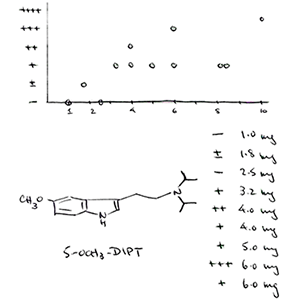
The Shulgin Rating Scale is a simple scale for reporting the subjective effect of psychoactive substances at a given dosage, and at a given time.
The system was developed for research purposes by the American biochemist Alexander Shulgin and detailed in his book ‘PiHKAL’ (‘Phenethylamines I Have Known And Loved: A Chemical Love Story’).
read more »
Posted in Drugs, Health, Science |
Leave a Comment »
July 11, 2011


Alexander Shulgin (b. 1925), known as Sasha, is an American pharmacologist. Shulgin is credited with the popularization of MDMA, commonly known as ecstasy, in the late 1970s and early 1980s, especially for psychopharmaceutical use and the treatment of depression and post-traumatic stress disorder. In subsequent years, Shulgin discovered, synthesized, and bioassayed over 230 psychoactive compounds.
In 1991 and 1997, he and his wife Ann Shulgin authored the books ‘PiHKAL’ and ‘TiHKAL’ on the topic of psychoactive drugs. Shulgin discovered many noteworthy phenethylamines including the 2C family. Additionally, Shulgin performed seminal work into the descriptive synthesis of compounds based on the organic compound tryptamine.
read more »
Posted in Drugs, Health, Politics |
1 Comment »




 The Daily Omnivore