October 25, 2011

Fringe theatre is theater that is not of the mainstream. The term comes from the Edinburgh Festival Fringe, which was named by Robert Kemp, who described the unofficial companies performing at the same time as the second Edinburgh International Festival (1948) as a ‘fringe,’ writing: ‘Round the fringe of official Festival drama, there seems to be more private enterprise than before.’ The term has since been adopted by the Edinburgh Festival Fringe and thence by alternative theaters and alternative theater festivals.
In London, the Fringe is the term given to small scale theatres, many of them located above pubs, and the equivalent to New York’s Off-Broadway or Off-Off-Broadway theatres. There are also many unjuried theater festivals which are often called fringe festivals. These festivals, such as the Edinburgh Festival Fringe and Adelaide Fringe Festival, permit artists to produce a wide variety of works.
read more »
Posted in Art, Language, Money |
Leave a Comment »
October 25, 2011

The Theatre of the Absurd is a designation for particular plays of absurdist fiction, written by a number of primarily European playwrights in the late 1940s, 1950s, and 1960s, as well as to the style of theater which has evolved from their work. Their work expressed the belief that, in a godless universe, human existence has no meaning or purpose and therefore all communication breaks down.
Logical construction and argument gives way to irrational and illogical speech and to its ultimate conclusion, silence. Plays within this group are absurd in that they focus not on logical acts, realistic occurrences, or traditional character development; they, instead, focus on human beings trapped in an incomprehensible world subject to any occurrence, no matter how illogical. The theme of incomprehensibility is coupled with the inadequacy of language to form meaningful human connections.
read more »
Posted in Art, Humor, Philosophy |
Leave a Comment »
October 25, 2011
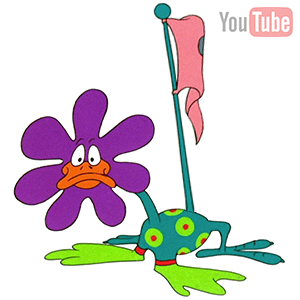
Duck Amuck is a surreal animated cartoon directed by Chuck Jones and produced by Warner Bros. Cartoons. The short was released in early 1953 by The Vitaphone Corporation, the short subject division of Warner Bros. Pictures, as part of the Merrie Melodies series. It stars Daffy Duck, who is tormented by a seemingly sadistic, initially unseen animator, who constantly changes Daffy’s locations, clothing, voice, physical appearance and even shape. Pandemonium reigns throughout the cartoon as Daffy attempts to steer the action back to some kind of normality, only for the animator to either ignore him or, more frequently, to over-literally interpret his increasingly frantic demands. Mel Blanc performed the voices. It was directed by Chuck Jones with a story by Michael Maltese. The film contains many examples of self-referential humor, breaking the fourth wall.
According to director Chuck Jones, this film demonstrated for the first time that animation can create characters with a recognizable personality, independent of their appearance, milieu, or voice. Although in the end, the animator is revealed to be Daffy’s rival Bugs Bunny (who famously declares ‘Ain’t I a stinker?’), according to Jones the ending is just for comedic value: Jones (the director) is speaking to the audience directly, asking ‘Who is Daffy Duck anyway? Would you recognize him if I did this to him? What if he didn’t live in the woods? Didn’t live anywhere? What if he had no voice? No face? What if he wasn’t even a duck anymore?’ In all cases, it is obvious that Daffy is still Daffy; not all cartoon characters can claim such distinctive personality.
Posted in Art, Humor |
1 Comment »
October 24, 2011

In professional wrestling, something that is kayfabe [kay-fayb] is not real, but rather ‘acted out.’ People who believe that kayfabe acts are real are called ‘marks,’ as opposed to ‘smarts.’ Those who know wrestling is scripted but still enjoy the storylines are known as’ smart-marks,’ ‘or smarks.’
Kayfabe in general is the portrayal of events within the industry as ‘real’ or ‘true.’ Specifically, the portrayal of professional wrestling, in particular the competition and rivalries between participants, as being genuine or not of a worked nature. Referring to events or interviews as being a ‘chore’ means that the event/interview has been ‘kayfabed’ or staged, or is part of a wrestling angle (fictional storyline) while being passed off as legitimate.
read more »
Posted in Games, Language, Money |
Leave a Comment »
October 24, 2011
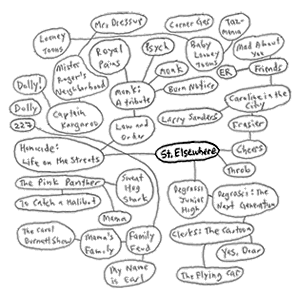
Tommy Westphall is a minor character from the drama television series ‘St. Elsewhere,’ which ran on NBC from 1982 to 1988. Westphall, who is autistic, took on major significance in the show’s final episode, where the common interpretation of that finale is that the entire St. Elsewhere storyline exists only within Westphall’s imagination. As characters from St. Elsewhere have appeared on other television shows and those shows’ characters appeared on more shows, a ‘Tommy Westphall Universe’ hypothesis was developed where a significant amount of fictional episodic television exists within Tommy Westphall’s imagined fictional universe.
The Tommy Westphall universe hypothesis, an idea discussed among some television fans, makes the claim that not only does ‘St. Elsewhere’ take place within Tommy’s mind, but so do numerous other television series which are directly and indirectly connected to ‘St. Elsewhere’ through fictional crossovers and spin-offs, resulting in a large fictional universe taking place entirely within Tommy’s mind. In 2002 writer Dwayne McDuffie wrote ‘Six Degrees of St. Elsewhere’ for the Slush Factory website, the earliest version of the hypothesis to be found online. In a 2003 article published on BBC News Online, ‘St. Elsewhere’ writer Tom Fontana was quoted as saying, ‘Someone did the math once… and something like 90 percent of all television took place in Tommy Westphall’s mind. God love him.’
read more »
Posted in Art, Humor, Language |
1 Comment »
October 24, 2011

A deus ex machina [dey-uhs-eks-mah-kuh-nuh] (Latin: ‘god out of the machine’) is a plot device whereby a seemingly inextricable problem is suddenly and abruptly solved with the contrived and unexpected intervention of some new event, character, ability, or object. The phrase comes to English usage from Horace’s ‘Ars Poetica,’ where he instructs poets that they must never resort to a god from the machine to solve their plots.
He refers to the conventions of Greek tragedy, where a crane (mekhane) was used to lower actors playing gods onto the stage. The machine referred to in the phrase could be either the crane employed in the task, a calque (loan translation) from the Greek ‘god from the machine,’ or the riser that brought a god up from a trap door. The idea is that the device of said god is entirely artificial or conceived by man.
read more »
Posted in Art, Language |
Leave a Comment »
October 24, 2011


A plot hole is a gap or inconsistency in a storyline that goes against the flow of logic established by the story’s plot, or constitutes a blatant omission of relevant information regarding the plot. These include such things as unlikely behavior or actions of characters, illogical or impossible events, events happening for no apparent reason, or statements/events that contradict earlier events in the storyline. While many stories have unanswered questions, unlikely events or chance occurrences, a plot hole is one that is essential to the story’s outcome. Plot holes are usually seen as weaknesses or flaws in a story, and writers usually try to avoid them to make their stories seem as realistic as possible. However, certain genres (and some media) which require or allow suspension of disbelief are more tolerant of plot holes.
Writers can deal with plot holes in different ways, from completely rewriting the story, to having characters acknowledge illogical or unintelligent actions, to having characters make vague statements that could be used to deflect accusations of plot holes (e.g. ‘I’ve tried everything I can think of…’ to keep critics from asking why a particular action was not taken). The nature of the plot hole and the developmental stage at which it is noticed usually determine the best course of action to take. For example, a motion picture that has already wrapped production would much more likely receive an added line of dialogue rather than an entire script rewrite.
Posted in Art, Humor, Language |
Leave a Comment »
October 24, 2011

Suspension of disbelief is a formula for justifying the use of fantastic or non-realistic elements in literary works of fiction. It was put forth in English by the poet and aesthetic philosopher Samuel Taylor Coleridge, who suggested that if a writer could infuse a ‘human interest and a semblance of truth’ into a fantastic tale, the reader would suspend judgment concerning the implausibility of the narrative. Cognitive estrangement in fiction involves using a person’s ignorance or lack of knowledge to promote suspension of disbelief.
The phrase ‘suspension of disbelief’ came to be used more loosely in the later 20th century, often used to imply that the onus was on the reader, rather than the writer, to achieve it. It might be used to refer to the willingness of the audience to overlook the limitations of a medium, so that these do not interfere with the acceptance of those premises. These fictional premises may also lend to the engagement of the mind and perhaps proposition of thoughts, ideas, art and theories.
read more »
Posted in Art, Language |
2 Comments »
October 23, 2011

The fourth wall is the imaginary ‘wall’ at the front of the stage in a traditional three-walled box set in a theater, through which the audience sees the action in the world of the play. The idea of the fourth wall was made explicit by philosopher and critic Denis Diderot and spread in nineteenth-century theater with the advent of theatrical realism, which extended the idea to the imaginary boundary between any fictional work and its audience. Speaking directly to or otherwise acknowledging the audience through the camera in a film or television program, or through this imaginary wall in a play, is referred to as ‘breaking the fourth wall’ and is considered a technique of metafiction, as it deconstructs the boundaries normally set up by works of fiction.
The presence of the fourth wall is an established convention of modern realistic theater, which has led some artists to draw direct attention to it for dramatic or comedic effect when this boundary is broken,’ for example by an actor onstage speaking to the audience directly. The acceptance of the transparency of the fourth wall is part of the suspension of disbelief between a fictional work and an audience, allowing them to enjoy the fiction as if they were observing real events. Postmodern art forms frequently either do away with it entirely, or make use of various framing devices to manipulate it in order to emphasize or de-emphasize certain aspects of the production, according to the artistic desires of the work’s creator. The term ‘fifth wall’ has been used as an extension of the fourth wall concept to refer to the wall between critics or readers and theater practitioners.
Posted in Art, Language |
Leave a Comment »
October 23, 2011


Self-reference occurs in natural or formal languages when a sentence or formula refers to itself. The reference may be expressed either directly—through some intermediate sentence or formula—or by means of some encoding. In philosophy, it also refers to the ability of a subject to speak of or refer to himself, herself, or itself: to have the kind of thought expressed by the first person pronoun, the word ‘I’ in English.
Self-reference is related to self-reflexivity and apperception. It is studied and has applications in mathematics, philosophy, computer programming, and linguistics. Self-referential statements sometimes have paradoxical behavior.
read more »
Posted in Art, Language |
Leave a Comment »
October 23, 2011


An innuendo [in-yoo-en-doh] is a baseless invention of thoughts or ideas. It can also be a remark or question, typically disparaging (also called insinuation), that works obliquely by allusion. In the latter sense, the intention is often to insult or accuse someone in such a way that one’s words, taken literally, are innocent. It is an indirect remark about somebody or something, usually suggesting something bad, mean or rude. The word is often used to express disapproval.
The term sexual innuendo has acquired a specific meaning, namely that of a ‘risque’ double entendre by playing on a possibly sexual interpretation of an otherwise innocent uttering. For example: ‘We need to go deeper’ can be seen as both a request for further inquiry on any given issue or a request to go deeper into an orifice. Alternatively the more simple changing the pronunciation of a word in order for it to sound vulgar e.g. innuendo to ‘in-your-endo.’
Posted in Humor, Language, Sex |
Leave a Comment »
October 23, 2011

Quiz machine is a term used in the UK for commercial coin-operated video quiz games that offer cash prizes for winning performances. These machines are usually found sited in pubs, bars and other places of entertainment. The term quiz machine is often used interchangeably with the trade term SWP (‘Skill With Prizes’) although not all SWP games are quiz based. The quiz machine first appeared on the scene in the UK in 1985.
The first such machine was called Quizmaster which was made by the Cardiff based now defunct Coinmaster Ltd. This was rapidly followed by quiz machines from other manufacturers. Over the following years quiz machines/SWP’s became a regular feature of the British pub. Leading SWP manufacturers of the 1980s and 1990s were: Coinmaster, JPM, Barcrest, Bell-Fruit, Maygay and Ace-Coin. The themes of many SWP games were (and still are) based on popular TV quiz shows, board games or other aspects of popular culture.
read more »
Posted in Games, Money, Politics |
Leave a Comment »


 The Daily Omnivore