October 23, 2011

A pub quiz is a quiz held in a public house (or pub for short). Origins of the pub quiz are unclear but there is little evidence of them existing before 1970 in the United Kingdom. Pub quizzes (also known as live trivia, or table quizzes) are often weekly events and will have an advertised start time, most often in the evening. While specific formats vary, most pub quizzes depend on answers being written in response to questions which may themselves be written or announced by a quizmaster.
Generally someone (either one of the bar staff or the person running the quiz) will come around with pens and quiz papers, which may contain questions or may just be blank sheets for writing the answers on. A mixture of both is common, in which case often only the blank sheet is to be handed in. Traditionally a member of the team hands the answers in for adjudication to the quiz master or to the next team along for marking when the answers are called.
read more »
Posted in Education, Games, Humor |
Leave a Comment »
October 23, 2011


A factoid [fak-toid] is a questionable or spurious (unverified, false, or fabricated) statement presented as a fact, but without supporting evidence. The word can also be used to describe a particularly insignificant or novel fact, in the absence of much relevant context. The word is defined as ‘an item of unreliable information that is repeated so often that it becomes accepted as fact.’
The term was coined by Norman Mailer in his 1973 biography of Marilyn Monroe. He described a factoid as ‘facts which have no existence before appearing in a magazine or newspaper,’ and created the word by combining ‘fact’ and the ending -‘oid’ to mean ‘similar but not the same.’ ‘The Washington Times’ described Mailer’s new word as referring to ‘something that looks like a fact, could be a fact, but in fact is not a fact.’
read more »
Posted in Education, Humor, Language |
1 Comment »
October 23, 2011

The Liberal Arts is a curriculum of seven subjects, the first three of which are called the trivia (grammar, rhetoric and logic). Its literal meaning in Latin could have been, ‘appropriate to the street corner, commonplace, vulgar.’
In medieval Latin, it came to refer to the lower division of the Liberal Arts (the other four were the quadrivium, namely arithmetic, geometry, music, and astronomy, which were more challenging). Hence, trivial in this sense would have meant ‘of interest only to an undergraduate.’ The meaning ‘trite, commonplace, unimportant, slight’ occurs from the late 16th century, notably in the works of Shakespeare.
read more »
Posted in Education, Games, Humor |
1 Comment »
October 23, 2011

The liberal arts (Artes Liberales) are a curriculum that imparts general knowledge and develops the student’s rational thought and intellectual capabilities, unlike the professional, vocational, and technical curricula emphasizing specialization. The contemporary liberal arts comprise studying literature, languages, philosophy, history, mathematics, and science.
However, in classical antiquity, it denoted the education worthy of a free person (Latin: liber, ‘free’). Contrary to popular belief, freeborn girls were as likely to receive formal education as boys, especially during the Roman Empire—unlike the lack-of-education, or purely manual/technical skills, proper to a slave. The ‘liberal arts’ or ‘liberal pursuits’ were already so called in formal education during the Roman Empire.
read more »
Posted in Education, Philosophy, Science |
Leave a Comment »
October 23, 2011

The Independent Investigations Group (IIG) is a volunteer-based organization founded by James Underdown in 2000 at the Center for Inquiry’s Los Angles branch, a non-profit, secular educational organization. The IIG investigates fringe science, paranormal and extraordinary claims from a rational, scientific viewpoint, and disseminates factual information about such inquiries to the public.
IIG offers a $50,000 prize to anyone who can show, under proper observing conditions, evidence of any paranormal, supernatural, or occult power or event. The IIG is involved in designing the test protocol, approving the conditions under which a test will take place, and in administering the actual test. All tests are designed with the participation and approval of the applicant. In most cases, the applicant is asked to perform a simple preliminary demonstration of the claimed ability, which if successful is followed by the formal test. Associates of the IIG usually conduct both tests and preliminary demonstrations at their location in Hollywood or affiliates.
read more »
Posted in Money, Philosophy, Science |
Leave a Comment »
October 23, 2011

The Center for Inquiry(CFI) is a non-profit educational organization with headquarters in the United States whose primary mission is to encourage evidence-based inquiry into paranormal and fringe science claims, alternative medicine and mental health practices, religion, secular ethics, and society.
CFI is dedicated to promoting and defending science, reason, and free inquiry in all aspects of human interest.
read more »
Posted in Health, Philosophy, Science |
Leave a Comment »
October 23, 2011


Secularism [sek-yuh-luh-riz-uhm] is the idea of something being not religious or not connected to a church. An example in government is the First Amendment (which guarantees, among other things, Separation of Church and State). This means that anyone can choose to practice or not practice any religion they want, and the government cannot make them be a part of a religion.
In one sense, secularism may assert the right to be free from religious rule and teachings, and the right to freedom from governmental imposition of religion upon the people within a state that is neutral on matters of belief. In another sense, it refers to the view that human activities and decisions, especially political ones, should be unbiased by religious influence.
read more »
Posted in Philosophy, Politics, World |
Leave a Comment »
October 23, 2011
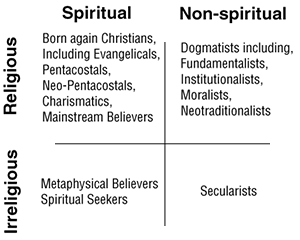

Spiritual But Not Religious (SBNR) is a popular phrase and acronym used to self-identify a life stance of spirituality that rejects traditional organized religion as the sole or most valuable means of furthering spiritual growth. The term is used worldwide, but seems most prominent in the United States.
Those that identify as SBNR vary in their individual spiritual philosophies and practices and theological references. While most reference some higher power or transcendent nature of reality, it is common to differ in their ideas of the existence of God as defined by the Abrahamic religions.
read more »
Posted in Language, Philosophy |
Leave a Comment »
October 21, 2011

Michael Manning is a fetish artist based in Los Angeles. NBM has published several collections of his work, including ‘Cathexis’ and ‘Lumenagerie,’ and a series of graphic novels, ‘The Spider Garden’ series. Born in Queens, New York, and raised on Massachusetts’ North Shore, Manning began self-publishing his black & white erotic comix in 1987 while working as an animator and director of short films, commercials, and music videos.
Early exposure to Japanese animation, fairy-tale book illustration, American and European comix, and mythology of many cultures has contributed to the formation of Manning’s style. Manning’s work draws heavily on Japanese influences, being somewhat stylized and almost exclusively black-and-white. His themes are notable, even amongst fetish artists, for depicting potentially taboo subjects such as zoophilia. Many of his images include beings that are mythological (such as centaurs) or at least biologically uncommon, such as hermaphrodites.
read more »
Posted in Art, Language, Sex |
Leave a Comment »
October 21, 2011

Action Comics #1 (June 1938) features the first appearance of Jerry Siegel/Joe Shuster creation Superman. Published on April 18, 1938 by National Allied Publications, a corporate predecessor of DC Comics, it is considered the first true superhero comic; and though today ‘Action Comics’ is a monthly title devoted to Superman, it began, like many early comics, as an anthology. Copies have sold at auction for $1.5 million.
The first issue had a print run of 200,000 copies. Jerry Siegel and Joe Shuster were paid $10 per page, for a total of $130 for their work on this issue. They effectively signed away millions in future rights and royalties payments. Starting in 1978, Siegel and Shuster were provided with a $20,000 a month annuity which was later raised to $30,000. Liebowitz would later say that selecting Superman to run in Action Comics #1 was ‘pure accident’ based on deadline pressure and that he selected a ‘thrilling’ cover, depicting Superman lifting a car over his head. It has been compared ‘Hercules Clubs the Hydra’ by Antonio del Pollaiolo.
read more »
Posted in Art, Language, Money |
Leave a Comment »
October 21, 2011

Blake Snyder (1957 – 2009) was an American screenwriter based in Los Angeles, who became one of the most popular writing mentors in the film industry. The author of three books on screenwriting and story structure, Snyder led international seminars and workshops for writers in various disciplines, as well as consultation sessions for some of Hollywood’s largest studios. His nonfiction book ‘Save the Cat!
The Last Book on Screenwriting You’ll Ever Need’ was written in a no-nonsense and conversational tone, which has resonated with both seasoned and novice screenwriters. The title is a term coined by Snyder and describes the scene where the audience meets the hero of a movie for the first time. The hero does something nice — e.g. saving a cat—that makes the audience like the hero and root for him. According to Snyder, it is a simple scene that helps the audience invest themselves in the character and the story, but is often lacking in many movies.
read more »
Posted in Art, Language, Money |
Leave a Comment »
October 21, 2011

In a monomyth, (the theory that all myths are the same story) the hero begins in the ordinary world, and receives a call to enter an unknown world of strange powers and events. The hero who accepts the call to enter this strange world must face tasks and trials, either alone or with assistance. In the most intense versions of the narrative, the hero must survive a severe challenge, often with help. If the hero survives, he may achieve a great gift or ‘boon.’ The hero must then decide whether to return to the ordinary world with this boon. If the hero does decide to return, he or she often faces challenges on the return journey. If the hero returns successfully, the boon or gift may be used to improve the world. The stories of Osiris, Prometheus, Moses, and Buddha, for example, follow this structure closely.
Campbell describes 17 stages or steps along this journey. Very few myths contain all 17 stages—some myths contain many of the stages, while others contain only a few; some myths may focus on only one of the stages, while other myths may deal with the stages in a somewhat different order. These 17 stages may be organized in a number of ways, including division into three sections: ‘Departure’ (sometimes called ‘Separation’), the hero’s adventure prior to the quest; ‘Initiation,’ the hero’s many adventures along the way; and ‘Return,’ the hero’s return home with knowledge and powers acquired on the journey.
read more »
Posted in Art, Language, Philosophy |
Leave a Comment »




 The Daily Omnivore