October 21, 2011
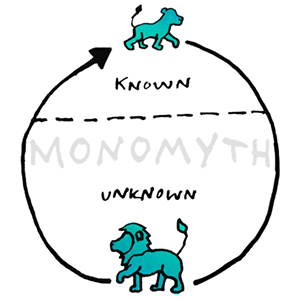
The Hero with a Thousand Faces (first published in 1949) is a non-fiction book, and seminal work of comparative mythology by Joseph Campbell. In this publication, Campbell discusses his theory of the journey of the archetypal hero found in world mythologies. Since publication, Campbell’s theory has been consciously applied by a wide variety of modern writers and artists. The best known is perhaps George Lucas, who has acknowledged a debt to Campbell regarding the stories of the ‘Star Wars’ films.
Campbell explores the theory that important myths from around the world which have survived for thousands of years all share a fundamental structure, which Campbell called the monomyth and ‘the hero’s journey. ‘In a well-known quote from the introduction to ‘The Hero with a Thousand Faces,’ Campbell summarized the monomyth: ‘A hero ventures forth from the world of common day into a region of supernatural wonder: fabulous forces are there encountered and a decisive victory is won: the hero comes back from this mysterious adventure with the power to bestow boons on his fellow man.’
read more »
Posted in Art, Language, Philosophy |
Leave a Comment »
October 21, 2011

Watership Down is a classic heroic fantasy novel, written by English author Richard Adams, about a small group of rabbits. Although the animals in the story live in their natural environment, they are anthropomorphized, possessing their own culture, language (Lapine), proverbs, poetry, and mythology. Evoking epic themes, the novel recounts the rabbits’ odyssey as they escape the destruction of their warren to seek a place in which to establish a new home, encountering perils and temptations along the way.
The novel takes its name from the rabbits’ destination, Watership Down, a hill in the north of Hampshire, England, near the area where Adams grew up. The story is based on a collection of tales that Adams told to his young children to pass the time on trips to the countryside.
read more »
Posted in Language |
1 Comment »
October 20, 2011

The SlutWalk protest marches began in 2011, in Toronto, Canada, and became a movement of rallies across the world. Participants protest against explaining or excusing rape by referring to any aspect of a woman’s appearance. The rallies began when Constable Michael Sanguinetti, a Toronto Police officer, suggested that to remain safe, ‘women should avoid dressing like sluts.’
The protest takes the form of a march, mainly by young women, where some dress in ordinary clothing and others dress provocatively, like ‘sluts.’ There are also speaker meetings and workshops. Some objectors have remarked that this approach is an example of women defining their sexuality in male terms.
read more »
Posted in Politics, Sex |
1 Comment »
October 20, 2011


Tactical frivolity is a form of public protest involving humor, often including peaceful non-compliance with authorities, carnival and whimsical antics. Humor has played a role in political protests at least as far back as the Classical period in ancient Greece. Yet it is only since the 1990s that the term tactical frivolity has gained common currency for describing the use of humor in opposing perceived political injustice.
There is no universally agreed definition as to which sorts of humorous protest count as tactical frivolity. Generally the term is used for a whimsical, non confrontational approach rather than aggressive mocking or cutting jokes.
read more »
Posted in Humor, Money, Politics |
1 Comment »
October 20, 2011

Occupy Wall Street (OWS) is an ongoing series of demonstrations in New York City based in Zuccotti Park in the Wall Street financial district. Initiated by the Canadian activist group Adbusters, the protests were inspired by the Arab Spring movement, especially Cairo’s Tahrir Square protests, and the Spanish Indignants. The participants’ slogan ‘We are the 99%’ refers to the difference in wealth between the top 1% and the other citizens of the United States.
They are mainly protesting social and economic inequality, corporate greed, and the power and influence of corporations, particularly from the financial service sector, and of lobbyists, over government. The protest began in September, and by October similar demonstrations were either ongoing or had been held in 70 major cities in the US. Internationally, other ‘Occupy’ protests have modeled themselves after Occupy Wall Street, in over 900 cities worldwide.
read more »
Posted in Money, Politics |
Leave a Comment »
October 20, 2011

We are the 99% is a political solidarity slogan and implicit economic claim that emerged from the ‘Occupy’ protests in 2011. It is a reference to the difference in wealth between the top 1% and all the remaining citizens of the United States. It started as a tumblr blog and became an Internet meme that went viral, showing a picture of a person holding a piece of paper with their story on it, ending with the phrase, ‘We are the 99%.’ New York times columnist Anne-Marie Slaughter described pictures on the ‘We are the 99’ website as as ‘page after page of testimonials from members of the middle class who took out loans to pay for education, took out mortgages to buy their houses and a piece of the American dream, worked hard at the jobs they could find, and ended up unemployed or radically underemployed and on the precipice of financial and social ruin.’
In 2006, filmmaker and Johnson & Johnson heir Jamie Johnson filmed a documentary called ‘The One Percent’ about the growing wealth gap between America’s wealthy elite compared to the overall citizenry. The film’s title referred to the top one percent of Americans in terms of wealth, who controlled 38% of the nation’s wealth in 2001. The 1% percent in the United States starts with household annual incomes of greater than $593,000.
Posted in Money, Politics |
Leave a Comment »
October 20, 2011


Corporatocracy [kawr-prit-tok-ruh-see], in social theories that focus on conflicts and opposing interests within society, denotes a system of government that serves the interest of, and may be run by, corporations and involves ties between government and business. Where corporations, conglomerates, and/or government entities with private components, control the direction and governance of a country, including carrying out economic planning (notwithstanding the ‘free market’ label).
The concept of corporatocracy is that corporations, to a significant extent, have power over governments, including those governments nominally elected by the people. They exercise their power via corporate monopolies and mergers, and through their subsequent capacity to leverage broad economic interests, which allows them the luxury of being declared ‘too big to fail’; this is accomplished by legal mechanisms (i.e., lobbyists, campaign contributions to office holders and candidates, threats to leave the state or country for another with less oversight and/or more personally beneficial subsidies, etc.), which renders them immune to vague accusations and prosecution.
Posted in Language, Money, Politics |
Leave a Comment »
October 20, 2011

The digerati [dij-uh-rah-tee] are people highly skilled in the processing and manipulation of digital information; wealthy or scholarly techno-geeks. They are the elite of the computer industry and online communities. The word is a portmanteau, derived from ‘digital’ and ‘literati,’ and reminiscent of the earlier coinage glitterati (wealthy or famous people who conspicuously or ostentatiously attend fashionable events). Famous computer scientists, tech magazine writers and well-known bloggers are included among the digerati. The word is used in several related but different ways. It can mean: Opinion leaders who, through their writings, promoted a vision of digital technology and the Internet as a transformational element in society; people regarded as celebrities within the Silicon Valley computer subculture, particularly during the dot-com boom years; and anyone regarded as influential within the digital technology community.
The first mention of the word Digerati on USENET occurred in 1992, and referred to an article by George Gilder in ‘Upside’ magazine. According to William Safire, the term was coined by New York Times editor Tim Race in a 1992. In Race’s words: ‘Actually the first use of ‘digerati’ was in a article, ‘Pools of Memory, Waves of Dispute,’ by John Markoff, into which I edited the term. The article was about a controversy engendered by a George Gilder article that had recently appeared in ‘Upside’ magazine.’
Posted in Language, Money, Technology |
Leave a Comment »
October 19, 2011

After Dark is a series of computer screensaver software introduced in 1989 by Berkeley Systems for the Macintosh, and later for Windows. Following the original, new editions were introduced including ‘More After Dark’ and ‘Before Dark,’ as well as editions themed around licensed properties such as ‘Star Trek,’ ‘The Simpsons,’ and Disney. The screensaver modules were often noted for their intertextuality, such as the flying toasters appearing in the Fish screensaver, and the cat from Boris screensaver appearing in the Bad Dog screensaver.
Of the screensaver modules included, the most famous is the iconic Flying Toasters which featured 1940s-style chrome toasters sporting bird-like wings, flying across the screen with pieces of toast. A slider enabled users to adjust the toast’s darkness and an updated Flying Toasters Pro module added a choice of music: Richard Wagner’s ‘Ride of the Valkyries’ or a flying toaster anthem with optional karaoke lyrics. Yet another version called ‘Flying Toasters!’ added bagels and pastries, baby toasters, and more elaborate toaster animation.
Posted in Humor, Technology |
1 Comment »
October 19, 2011

Birth control glasses, officially called GI glasses, are eyeglasses issued by the American military to its service members. At one time they were officially designated as ‘Regulation Prescription Glasses,’ or RPGs. This was commonly said to mean ‘Rape Prevention Glasses’ due to their unstylish appearance. The glasses are relatively thick frames made of brown translucent plastic, with a thin metal wire extending down the center of each of the earpieces.
The shape of the corrective lenses is nearly rectangular, with rounded edges, and a slight diagonal angle adjacent to the integrated nose pieces. This design reflects a specification for durability at the lowest possible cost. There are two designs available for female and male soldiers who require prescription eye wear.
read more »
Posted in Humor, Sex, War |
Leave a Comment »
October 19, 2011

Joshua Milton Blahyi (b. 1971), better known by his nom de guerre General Butt Naked, is a former leader for the Liberian warlord Roosevelt Johnson in the First Liberian Civil War known for his fierce, violent and eccentric measures in the first half of the 1990s. He was originally a tribal priest, and has returned to preaching after the war. Blahyi’s nom de guerre was appropriated for comical effect by the creators of the Broadway musical ‘The Book of Mormon’ as their fictional Ugandan warlord ‘General Butt Fucking Naked.’
Blahyi got his nickname, ‘General Butt Naked,’ from his nakedness which was supposedly demanded by the Devil. In his account of a typical battle Blahyi claimed, ‘So, before leading my troops into battle, we would get drunk and drugged up, sacrifice a local teenager, drink their blood, then strip down to our shoes and go into battle wearing colorful wigs and carrying dainty purses we’d looted from civilians. We’d slaughter anyone we saw, chop their heads off and use them as soccer balls. We were nude, fearless, drunk and homicidal. We killed hundreds of people – so many I lost count.’ Blahyi also purported that during that period he had ‘magical powers that made him invisible’ and a ‘special power’ to capture a town singlehandedly, then call in his troops afterwards to ‘clean up.’
read more »
Posted in Death, War, World |
1 Comment »
October 19, 2011

The Rapture is a dance-punk band based in New York City. The band mixes influences from many genres including post-punk, acid house, disco, electronic music, and rock, pioneering the post-punk revival genre. The Rapture formed in 1998 by keyboardist Chris Relyea, drummer Vito Roccoforte and guitarist/vocalist Luke Jenner. In 1999 the band released its debut ‘mini-album’, ‘Mirror.’ Following this release, the band relocated to New York. They were finally joined by Matt Safer having gone through five keyboard players and two bassists in an eighteen-month period. After touring extensively for two years, the band released the six-song EP ‘Out of the Races and Onto the Tracks’ on the Sub Pop label, with the lead track featuring in the film adaptation of the Bret Easton Ellis novel ‘The Rules Of Attraction.’
The Rapture were forerunners of the post-punk revival of the early 2000s, as they mixed their early post-punk sound with electronic and dance elements via their collaboration with the celebrated New York production team DFA. Multi-instrumentalist Gabriel Andruzzi joined the band in 2002. Their first full-length record, ‘Echoes,’ was released to critical acclaim in 2003. The Rapture released their second full-length album, ‘Pieces of the People We Love,’ on Universal Motown Records in 2006. Paul Epworth, Ewan Pearson and Danger Mouse produced the album.
Posted in Art |
Leave a Comment »



 The Daily Omnivore