October 19, 2011

Little Dragon is a Swedish electronic band, formed in Gothenburg in 1996. It consists of Swedish-Japanese singer Yukimi Nagano (vocals, percussion) and her close high school friends Erik Bodin (drums), Fredrik Källgren Wallin (bass) and Håkan Wirenstrand (keyboards). Little Dragon’s first release was the single ‘Twice/Test’ in 2006. The following year, the band signed with the larger British indie label Peacefrog Records and released their self-titled debut album. Their second album, ‘Machine Dreams,’ was released in 2009, followed by their third album, ‘Ritual Union,’ in 2011.
The band’s name was inspired by the ‘Little Dragon’ nickname Nagano earned due to the ‘fuming tantrums’ she used to throw while recording in the studio. ‘It’s a little exaggerated but there is some truth in it,’ Nagano said. ‘But we’ve grown up a bit and I realized you can’t have a fit every day because otherwise you won’t be able to stand each other.’
Posted in Art |
Leave a Comment »
October 18, 2011
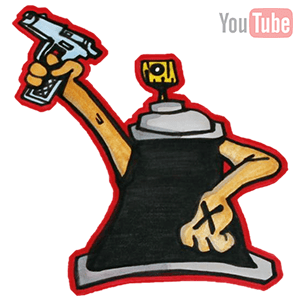
Cool “Disco” Dan is the pseudonym of graffiti artist Dan Hogg (b. 1969). His standard mark, a particularly styled rendering of his name, has proliferated in the Washington metropolitan area, notably on surfaces along the route of the Washington Metro Red Line.
He has been spraying his tag since 1984. Part of the Go-Go scene of the 80’s in Washington; he managed to avoid being jailed or killed unlike a lot of his contemporaries by devoting himself to graffiti rather than becoming involved with drugs or gangs. The pervasiveness of his mark was reported frequently in the local press.
Posted in Art, Politics |
Leave a Comment »
October 18, 2011


Borf was a graffiti campaign seen in and around Washington, D.C. during 2004 and 2005, carried out by John Tsombikos while studying at the Corcoran College of Art and Design. This four letter word was ubiquitous around the Northwest quadrant of Washington, and ranged from simple tagging to complete sentences to two-color stencils to the massive defacement on an overhead exit sign from the Theodore Roosevelt Bridge to Constitution Avenue. Tsombikos was arrested after tips led police to his latest tag.
The campaign attracted widespread attention without first explaining its motivations. According to Tsombikos and subsequent Borf communiqués, both the nickname ‘Borf’ and the Borf face belonged to Bobby Fisher, a close friend of Tsombikos’ who had committed suicide. In a video shown in 2006, the Borf Brigade – the group claiming responsibility for the graffiti spree – asserted that capitalism and the culture of aesthetics created alienation and feelings of worthlessness that contributed to the 16-year-old’s suicide. The group said that they used other peoples’ property to commemorate and pay homage to their deceased friend. The graffiti usually had overtones of anti-authority sentiments and youth liberation.
read more »
Posted in Art, Politics |
Leave a Comment »
October 18, 2011
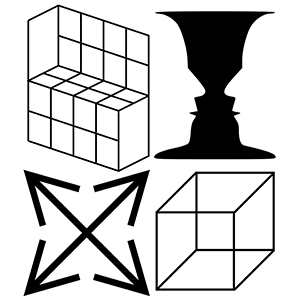
Multistable perceptual phenomena are a form of perceptual phenomena in which there are unpredictable sequences of spontaneous subjective changes. While usually associated with visual perception, such phenomena can be found for auditory and olfactory percepts. Perceptual multistability can be evoked by visual patterns that are too ambiguous for the human visual system to recognise with one unique interpretation.
Famous examples include the ‘Necker cube,’ ‘structure from motion,’ ‘monocular rivalry’ (two different images, optically superimposed), and ‘binocular rivalry’ (perception alternates between different images presented to each eye), but many more visually ambiguous patterns are known. Since most of these images lead to an alternation between two mutually exclusive perceptual states, they are sometimes also referred to as bistable perception.
read more »
Posted in Art, Language, Science |
Leave a Comment »
October 18, 2011

Pseudorealism is an artistic and a dramatic technique in which an apparently unreal matter is presented in a fashion that makes it appear real. Though use of pseudorealism has been in practice for sometime in theater, film, fashion, textiles and literature, as an art genre, it was initiated in Indian art in early 21st century by Devajyoti Ray.
The idea that something unreal can still give the impression of the real has a parallel in mathematical field of representation theory. The idea has also often been used to describe certain set of movies, TV programs, and video games where special effects, computer generated imagery and 3D animation are used to create a fantasy but which has the impact of a reality based image. However in this context the word has a negative connotation.
Posted in Art, Language, Technology |
Leave a Comment »
October 18, 2011
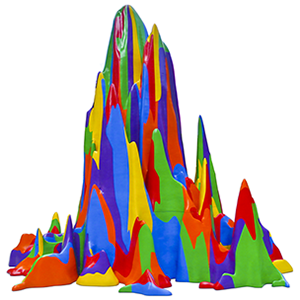
Plop art (or Plonk art) is a pejorative slang term for public art (usually large, abstract, modernist or contemporary sculpture) made for government or corporate plazas, spaces in front of office buildings, skyscraper atriums, parks, and other public venues. The term connotes that the work is unattractive or inappropriate to its surroundings – that is, it has been thoughtlessly ‘plopped’ where it lies.
The very word ‘plop’ suggested something falling wetly and heavily in the manner of excrement — extruded, as it were, from the fundament of the art world, and often at public expense. Plop art is a play on the term pop art. The term was coined by architect James Wines in 1969. Wines was critical of the failure of much public art to take an environmentally-oriented approach to the relationship between public art and architecture.
Posted in Art, Humor, Language |
Leave a Comment »
October 18, 2011
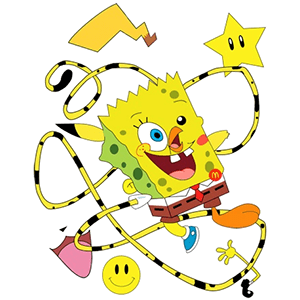
A digital mashup refers to digital media content (e.g. text, graphics, audio, video, animation) drawn from pre-existing sources, to create a new derivative work. Digital media have made it easier for potential mashup creators to create derivative works than was the case in the past, when significant technical equipment and knowledge was required to manipulate analog content. Mashups raise significant questions of intellectual property and copyright. While questioning the law, mashups are also questioning the very act of creation. Are the artists creating when they use other individuals’ work? How will artists prove their creative input?
A major contributing factor to the spread of digital mashups is the World Wide Web, which provides channels both for acquiring source material and for distributing derivative works, both often at negligible cost. Web or cloud computing based applications are a combination of separate parts brought together with the use of the open architecture of public Application Programming Interfaces (API). For example, a mashup between Google Maps and Weather.com could be made available as an iphone application, where the content and context of that content are drawn from outside sources through the published API.
Posted in Art, Money, Technology |
1 Comment »
October 17, 2011
Shabazz Palaces are a Seattle-based hip-hop collective, led by Ishmael Butler aka ‘Palaceer Lazaro’ (once ‘Butterfly’ of jazz-rap group Digable Planets) and multi-instrumentalist Tendai Maraire, son of Mbira master Dumisani Maraire.
The group anonymously self-released two EPs, ‘Eagles Soar, Oil Flows’ and ‘The Seven New’ (often referred to simply as ‘Shabazz Palaces and Of Light’) in 2009 before becoming the first hip-hop act to be signed to the Sub Pop label and releasing their debut full-length album, ‘Black Up,’ in 2011.
Posted in Art |
Leave a Comment »
October 17, 2011

The Spamhaus Project is an international organization (founded by Steve Linford in 1998) to track e-mail spammers and spam-related activity. It is named for the anti-spam jargon term coined by Linford, ‘spamhaus,’ a pseudo-German expression for an ISP or other firm which spams or willingly provides service to spammers.
Spamhaus is responsible for a number of very widely used anti-spam DNS-based Blocklists (DNSBLs) and Whitelists (DNSWLs). Many internet service providers and Internet networks use these services to reduce the amount of spam they take on. The Spamhaus blocks 80 billion spam emails per day globally on the internet (almost 1 million spams per second). Like all DNSBLs, their use is considered controversial by some.
read more »
Posted in Money, Politics, Technology |
Leave a Comment »
October 16, 2011
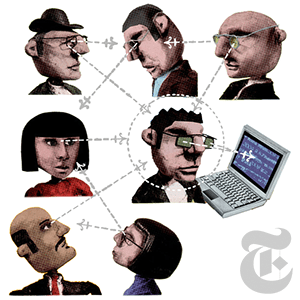
A Keynesian beauty contest [keyn-zee-uhn] is a concept developed by economist John Maynard Keynes in 1936 to explain price fluctuations in equity markets. Keynes described the action of rational agents in a market using an analogy based on a fictional newspaper contest, in which entrants are asked to choose a set of six faces from photographs of women that are the ‘most beautiful.’ Those who picked the most popular face are then eligible for a prize.
Keynes said: ‘It is not a case of choosing those [faces] that, to the best of one’s judgment, are really the prettiest, nor even those that average opinion genuinely thinks the prettiest. We have reached the third degree where we devote our intelligences to anticipating what average opinion expects the average opinion to be. And there are some, I believe, who practice the fourth, fifth and higher degrees.’ Keynes believed that similar behavior was at work within the stock market. This would have people pricing shares not based on what they think their fundamental value is, but rather on what they think everyone else thinks their value is, or what everybody else would predict the average assessment of value is.
Posted in Games, Language, Money |
Leave a Comment »
October 16, 2011

The Thomas theorem is a theory of sociology which was formulated in 1928 by W. I. Thomas (1863–1947): ‘If men define situations as real, they are real in their consequences.’ In other words, the interpretation of a situation causes the action. This interpretation is not objective. Actions are affected by subjective perceptions of situations. Whether there even is an objectively correct interpretation is not important for the purposes of helping guide individuals’ behavior. In 1923, Thomas stated more precisely that any definition of a situation will influence the present. Not only that, but—after a series of definitions in which an individual is involved—such a definition also ‘gradually [influences] a whole life-policy and the personality of the individual himself.’ Consequently, Thomas stressed societal problems such as intimacy, family, or education as fundamental to the role of the situation when detecting a social world ‘in which subjective impressions can be projected on to life and thereby become real to projectors.’
The 1973 oil crisis resulted in the so-called ‘toilet paper panic.’ The rumor of an expected shortage of toilet paper—resulting from a decline in the importation of oil—caused people to stockpile supplies of toilet paper and this caused a shortage. This shortage, seeming to validate the rumor, is also an example of a self-fulfilling prophecy. The Beauty Contest Theory, developed by John Maynard Keynes, justifies why the price of a share of stock does not necessarily develop according to rational expectations. He acts on the assumption that many investors make their decisions not according to their own computations of an asset’s worth but by predicting the conclusions of other market participants.
Posted in Money, Science |
Leave a Comment »
October 16, 2011

The Tinkerbell effect is a term describing things that are thought to exist only because people believe in them. The effect is named for Tinker Bell, the fairy in the play Peter Pan who is revived from near death by the belief of the audience.
Claimed cases include: private property; the value of a nation’s money in a fiat system; the value of gold; civil society; and the ‘rule of law.’
Posted in Humor, Money, Politics |
Leave a Comment »


 The Daily Omnivore