October 13, 2011

Symptoms described as ‘brain zaps,’ ‘brain shocks,’ ‘brain shivers,’ or ‘cranial zings’ are a withdrawal symptom experienced during discontinuation (or reduction of dose) of antidepressant drugs. The symptoms are widely variable in description and of unknown etiology; common descriptions include dizziness, electric shock-like sensations, sweating, nausea, insomnia, tremor, confusion, nightmares, and vertigo.
The ‘preferred term’ for coding these types of symptoms in adverse drug reaction reports is ‘paraesthesia’ (more generally known as the feeling of ‘pins and needles’).
Posted in Drugs, Health, Language |
Leave a Comment »
October 13, 2011

Exploding head syndrome is a parasomnia condition (sleep disorder) that causes the sufferer occasionally to experience a tremendously loud noise as originating from within his or her own head, usually described as the sound of an explosion, roar, gunshot, loud voices or screams, a ringing noise, or the sound of electrical arcing (buzzing). This noise usually occurs within an hour or two of falling asleep, but is not necessarily the result of a dream and can happen while awake as well. While the sound is perceived as extremely loud, it is usually not accompanied by pain. In some cases an instant flash of what is perceived as video ‘static’ is reported.
Attacks appear to change in number over time, with several attacks occurring in a space of days or weeks followed by months of remission. Sufferers often feel a sense of fear and anxiety after an attack, accompanied by elevated heart rate. Attacks are also often accompanied by perceived flashes of light (when perceived on their own, known as a ‘visual sleep start’) or difficulty in breathing. The condition is also known as ‘auditory sleep starts.’ It is not thought to be dangerous, although it is sometimes distressing to experience. Sufferers may experience an inability to vocalize any sound, or mild forms of sleep paralysis during an attack.
read more »
Posted in Health |
Leave a Comment »
October 13, 2011

A life review is a phenomenon widely reported as occurring during near-death experiences, in which a person rapidly sees much or the totality of his or her life history in chronological sequence and in extreme detail. It is often referred to by people having experienced this phenomenon as having their life ‘flash before their eyes.’
A reformatory purpose seems commonly implicit in accounts, though not necessarily for earthly purpose, since return from a near-death experience may reportedly entail individual choice. While individuals sometimes report reviews took place in the company of otherworldly beings who shared the observation, they also say they felt unjudged during the process, leaving themselves their own strongest critics.
read more »
Posted in Death, Health, Philosophy |
Leave a Comment »
October 13, 2011

An out-of-body experience (OBE) is an experience that typically involves a sensation of floating outside of one’s body and, in some cases, perceiving one’s physical body from a place outside one’s body (autoscopy). The term was introduced in 1943 by G.N.M Tyrrell in his book ‘Apparitions,’ and adopted as a bias-free alternative to belief-centric labels such as ‘astral projection,’ ‘soul travel,’ or ‘spirit walking.’
Though the term usefully distances researchers from scientifically problematic concepts such as the soul, scientists still know little about the phenomenon. Some researchers believe they have managed to recreate OBE in a laboratory setup by stimulating a part in the human brain. One in ten people has an out-of-body experience once, or more commonly, several times in their life. OBEs are often part of the near-death experience. Those who have experienced OBEs sometimes claim to have observed details which were unknown to them beforehand.
read more »
Posted in Death, Health, Philosophy |
Leave a Comment »
October 13, 2011

Binaural [bahy-nawr-uhl] beats or binaural tones are auditory processing artifacts, or apparent sounds, the perception of which arises in the brain for specific physical stimuli. This effect was discovered in 1839 by Heinrich Wilhelm Dove, and earned greater public awareness in the late 20th century based on claims that binaural beats could help induce relaxation, meditation, creativity and other desirable mental states. The effect on the brainwaves depends on the difference in frequencies of each tone, for example, if 300 Hz was played in one ear and 310 in the other, then the Binaural beat would have a frequency of 10 Hz.
The brain produces a phenomenon resulting in low-frequency pulsations in the amplitude and sound localization of a perceived sound when two tones at slightly different frequencies are presented separately, one to each of a subject’s ears, using stereo headphones. A beating tone will be perceived, as if the two tones mixed naturally, out of the brain. The frequencies of the tones must be below 1,000 hertz for the beating to be noticeable. The difference between the two frequencies must be small (less than or equal to 30 Hz) for the effect to occur; otherwise, the two tones will be heard separately and no beat will be perceived. Binaural beats reportedly influence the brain in more subtle ways through the entrainment of brainwaves and have been claimed to reduce anxiety and provide other health benefits such as control over pain.
read more »
Posted in Health, Science, Technology |
1 Comment »
October 13, 2011

A mind machine (or psychowalkman) uses pulsing rhythmic sound and/or flashing light to alter the brainwave frequency of the user. Mind machines are said to induce deep states of relaxation, concentration, and in some cases altered states of consciousness that have been compared to those obtained from meditation and shamanic rituals. The process applied by these machines is also known as brainwave synchronization or entrainment. Mind machines typically consist of a control unit, a pair of headphones and/or strobe light goggles. The unit controls the sessions and drives the LEDs in the goggles. Professionally, they are usually referred to as Auditory Visual Stimulation devices (AVS). Sessions will typically aim at directing the average brainwave frequency from a high level to a lower level by ramping down in several sequences. Target frequencies typically correspond to delta (1-3 hertz), theta (4–7 Hz), alpha (8–12 Hz) or beta brain waves (13–40 Hz), and can be adjusted by the user based on the desired effects.
There have been a number of claims regarding binaural beats (auditory processing artifacts or apparent sounds), among them that they may help people memorize and learn, stop smoking, tackle erectile dysfunction and improve athletic performance. However, research into binaural beats is very limited. No conclusive studies have been released to support marketing claims for binaural beat systems. Mind machines are often used together with biofeedback or neurofeedback equipment in order to adjust the frequency on the fly. Modern mind machines can connect to the Internet to update the software and download new sessions. When sessions are used in conjunction with meditation, neurofeedback, etc. the effect can be amplified. Rapidly flashing lights may be dangerous for people with photosensitive epilepsy or other nervous disorders. It is thought that one out of 10,000 adults will experience a seizure while viewing such a device; about twice as many children will have a similar ill effect.
Posted in Health, Money, Technology |
Leave a Comment »
October 13, 2011

The Zihuatanejo Project was an intentional community created during the summers of 1962 and 1963 by Timothy Leary and Richard Alpert under the umbrella of their nonprofit group, the International Federation for Internal Freedom (IFIF). The community was located in Zihuatanejo, Mexico, and took up residence at the Catalina Hotel. The idea for the community was based on the fictional story from Aldous Huxley’s 1962 novel, ‘Island.’ Immigration officials were tipped off to the project when the Mexican media began reporting stories about an ‘LSD Paradise.’ In the summer of 1963, after only six weeks the Mexican authorities shut the community down.
More than 5,000 people applied to the IFIF in the hopes of joining the project in Zihuatanejo. Out of this pool of applicants, a small, select group of people were chosen. Amenities cost $200 a month per person, including food and lodging in bungalows near a secluded beach. Fishermen supplied a bounty of fresh fish from the bay. Leary and 35 guests rented the Catalina Hotel for a month using the ‘Tibetan Book of the Dead’ as a guide book for LSD sessions, while Ralph Metzner and Richard Alpert helped manage the group. Group LSD sessions began in the morning with the consumption of liquid LSD, with a dosage of 100 to 500 micrograms ingested by participating individuals; the experience would usually last until late afternoon.
Posted in Drugs, Philosophy, Politics |
1 Comment »
October 13, 2011

The term ‘psychedelic experience‘ is vague – characterized by polyvalence or ambiguity due to its nature – however in modern psychopharmacological science as well as philosophical, psychological, neurological, spiritual-religious and most other ideological discourses it is understood as an altered state of awareness often distinct to, and induced by the consumption of certain psychotropics.
In particular hallucinogens, many entheogens and specifically psychedelic compounds are known to cause this change in mental state.
read more »
Posted in Drugs, Health, Philosophy |
Leave a Comment »
October 13, 2011
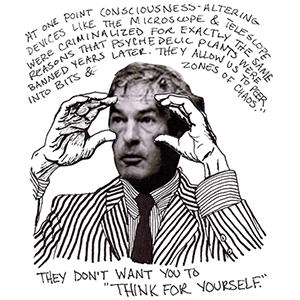
Psychonautics [sahy-kuh-naw-tiks] (Greek: psyche ‘soul/spirit/mind’ and naut ‘sailor/navigator’) refers both to a methodology for describing and explaining the subjective effects of altered states of consciousness, including those induced by mind altering substances, and to a research framework for voluntarily immersing oneself into an altered state by means of such techniques, to explore human experience and existence.
The term has been applied diversely, to cover all activities by which altered states are induced and utilized for spiritual purposes or the exploration of the human condition, including shamanism, lamas of the Tibetan Buddhist tradition, sensory deprivation, and archaic/modern drug users who use entheogenic substances in order to gain deeper insights and spiritual experiences.
read more »
Posted in Drugs, Philosophy, Science |
Leave a Comment »
October 11, 2011

A Friendly Artificial Intelligence or FAI is an artificial intelligence (AI) that has a positive rather than negative effect on humanity. Friendly AI also refers to the field of knowledge required to build such an AI. This term particularly applies to AIs which have the potential to significantly impact humanity, such as those with intelligence comparable to or exceeding that of humans (e.g. superintelligence, strong AI, technological singularity).
This specific term was coined by Eliezer Yudkowsky of the Singularity Institute for Artificial Intelligence as a technical term distinct from the everyday meaning of the word ‘friendly,’ however, the concern is much older.
read more »
Posted in Politics, Technology |
Leave a Comment »
October 11, 2011

Humans United Against Robots (often abbreviated as HUAR) is a semi-tongue-in-cheek organization designed to unify the human race and prepare them for a futuristic robotic uprising. HUAR was created by humorist Keith Malley.
‘HUAR was designed to educate and awaken the citizenry of the world to the impending attack that computers and robots will put into effect against humans. It is a collection of human beings that spread the word of this impending doom as well as doing what they can to help minimize the threat. Between computer programs that can identify human speech and match that up with their computerized dictionaries in order to understand our weaknesses to jokester scientists building robots specifically made to breathe fire from their mouths and shoot lasers from their eyes, it is evident that a task force had to be formed of members that take being at the top of the food chain seriously. Robots will uprise. HUAR will be there.’
Posted in Humor, Technology, War |
Leave a Comment »
October 11, 2011
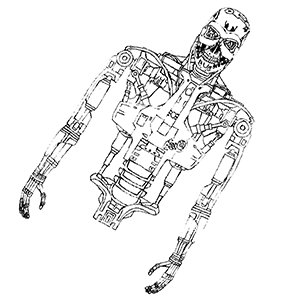
Cybernetic revolt is a scenario in which an artificial intelligence (either a single supercomputer, a computer network, or sometimes a ‘race’ of intelligent machines) decide that humans (and/or organic non-humans) are a threat (either to the machines or to themselves), are inferior, or are oppressors and try to destroy or to enslave them potentially leading to machine rule. In this fictional scenario, humans are often depicted to prevail using ‘human’ qualities, for example using emotions, illogic, inefficiency, duplicity, unpredictability, or exploiting the supposedly rigid, rules-based thinking and lack of innovation of the computer’s black/white mind.
Fear of humanity being made obsolete by technology taps into some of modern humans’ deepest fears. This can be shown to have been the case even before the computer became prominent, as in Karel Capek’s 1921 play ‘R.U.R.’ (Rossum’s Universal Robots). However, even as they were slowly being displaced from most physical tasks, humans have always prided themselves on their brains, taking the mechanistic ‘thoughts’ of early computers as proof that they would not be overtaken by their ‘Frankenstein’ creations.
read more »
Posted in Technology, War |
Leave a Comment »


 The Daily Omnivore