November 21, 2011
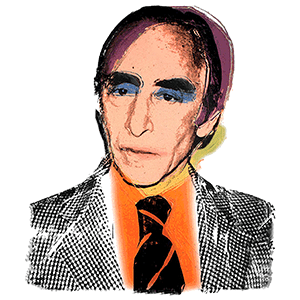
Leo Castelli (1907 – 1999), born Leo Krausz, was an American art dealer whose gallery showcased cutting edge Contemporary art for five decades. Castelli showed Surrealism, Abstract Expressionism, Neo-Dada, Pop Art, Op Art, Color field painting, Hard-edge painting, Lyrical Abstraction, Minimal Art, Conceptual Art, and Neo-expressionism, among other movements. Leo Castelli was born at Trieste, of Italian and Austro-Hungarian Jewish origin. Castelli’s first American curatorial effort was the famous Ninth Street Show of 1951, a seminal event of Abstract Expressionism.
In 1957, he opened the Leo Castelli Gallery in a townhouse on 77th Street between Madison and Fifth Avenues. Initially the gallery showcased European Surrealism, Wassily Kandinsky, and other European artists. However the gallery also exhibited American Abstract Expressionism. Jackson Pollock and Willem de Kooning were some artists who were included in group shows. In 1958, Robert Rauschenberg and Jasper Johns joined the gallery, signaling a turning away from Abstract Expressionism, towards Pop Art, Minimalism and Conceptual Art. From the early 1960s through the late 70s, Frank Stella, Roy Lichtenstein, Andy Warhol, and Ed Ruscha joined the stable of Castelli artists.
Posted in Art, Money |
Leave a Comment »
November 20, 2011

Famous for being famous, in popular culture terminology, refers to someone who attains celebrity status for no particular identifiable reason, or who achieves fame through association with a celebrity. The term is a pejorative, suggesting that the individual has no particular talents or abilities. Even when their fame arises from a particular talent or action on their part, the term will sometimes still apply if their fame is perceived as disproportionate to what they earned through their own talent or work.
The term originates from an analysis of the media dominated world called ‘The Image: A Guide to Pseudo-events in America’ (1961), by historian and social theorist Daniel J. Boorstin. In it, he defined the celebrity as ‘a person who is known for his well-knownness.’ He further argued that the graphic revolution in journalism and other forms of communication had severed fame from greatness, and that this severance hastened the decay of fame into mere notoriety. Over the years, the phrase has been glossed as ‘a celebrity is someone who is famous for being famous’.
read more »
Posted in Humor, Language, Money |
1 Comment »
November 20, 2011
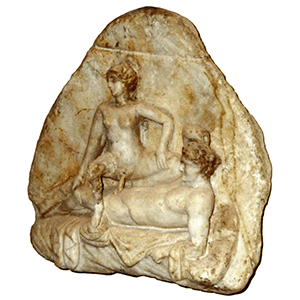
The term Secret Museum (Gabinetto Segreto) principally refers to the collection of erotic or sexually explicit finds from Pompeii, held in separate galleries in the Naples National Archaeological Museum, the former Museo Borbonico. The British Museum also contained secret rooms containing erotica. Throughout ancient Pompeii, erotic frescoes, depictions of the god Priapus, sexually explicit symbols, inscriptions, and even household items (such as phallic oil lamps) were found.
Ancient Roman culture had a different sense of shame for sexuality, and viewed sexually explicit material very differently to most present-day cultures. Ideas about obscenity developed from the 18th century to the present day into a modern concept of pornography.
read more »
Posted in Art, Sex, World |
Leave a Comment »
November 20, 2011

Rick Strassman (b. 1952) is psychiatrist and psychopharmacology researcher, and the first person in the US after twenty years of intermission to embark in human research with psychedelic, hallucinogenic, or entheogenic substances. During the intermission period, research was restricted by law to animals studies only.
Dr Strassman’s studies aimed to investigate the effects of DMT (dimethyltryptamine), a powerful psychedelic, that he hypothesizes is produced by the human brain in the pineal gland. DMT is found naturally in various natural sources, and is related to human neurotransmitters such as serotonin and melatonin.
read more »
Posted in Drugs, Health, Science |
Leave a Comment »
November 20, 2011

Car Talk is a radio talk show broadcast weekly on National Public Radio stations throughout the United States and elsewhere. The hosts are brothers Tom and Ray Magliozzi, also known as Click and Clack, the Tappet Brothers. Car Talk is structured as a call-in radio show: listeners call with questions related to motor vehicle maintenance and repair. Most of the advice sought is diagnostic, with callers describing symptoms and demonstrating sounds of an ailing vehicle while the Magliozzis make an attempt at identifying the malfunction.
While the hosts pepper their call-in sessions with jokes directed at both the caller and at themselves, the depth and breadth of their knowledge of automobiles is extensive, and they are usually able to arrive at a diagnosis and give helpful advice. Also, if a caller has an unusual name, they will inquire about the spelling, pronunciation, and/or origin of their name. They may also comment about the caller’s hometown.
read more »
Posted in Humor, Language, Technology |
Leave a Comment »
November 19, 2011
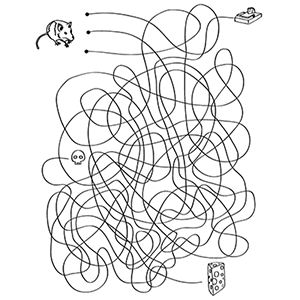
Rat running or cut-through driving refers to the use of secondary roads or residential side streets instead of the intended main roads in urban or suburban areas in order to avoid heavy traffic, lengthy traffic signals, or other obstacles lengthening a journey, even though traffic calming measures may be in place to discourage them and there may be laws against taking certain routes. Rat runs are frequently taken by motorists who are familiar with the local geography. They will often take such short cuts to avoid busy main roads and junctions (intersections).
The associations with ‘beating the crowd,’ the rush hour, and the rat race may have given rise to the term, or perhaps similarities were observed between the patterns of rat running driving routes and a rat running a maze.
read more »
Posted in Humor, Language, World |
Leave a Comment »
November 19, 2011

The term shunpiking comes from the word shun, meaning ‘to avoid,’ and pike, a term referring to turnpikes, which are roads that require payment of a toll to travel on them. People who often avoid toll roads sometimes call themselves shunpikers. Shunpiking has also come to mean an avoidance of major highways (regardless of tolls) in preference for bucolic and scenic interludes along lightly traveled country roads.
The word ‘shunpike’ may have its origins in post-colonial New Hampshire: When the ‘Turnpike’ was built, around 1810 or so, by the Hampton Causeway Turnpike Corporation, a toll was charged to cross it at Taylor’s River. Not content with the payment of a toll, some of the residents got together and built a slight bridge called the ‘Shunpike’ across the River, some distance west of the Turnpike bridge, where travelers and teamsters could cross without charge. This continued on until 1826, when the toll on the Turnpike was discontinued and has remained a free road to this day
read more »
Posted in Language, Money, World |
Leave a Comment »
November 19, 2011

Truck nuts, also known as truck balls, BumperNuts, BumperBalls, or Trucksticles, are accessories for pickup trucks and other vehicles. This trend began in the United States in 1998 and first sold on the internet in 1999. Truck nuts are used as a statement by the car, truck, ATV, and/or motorcycle owner to boast/amuse/shock him/her self and others. Truck nuts are installed to hang under the bumper area of the vehicle so they are conspicuous to those viewing the vehicle from the rear. Manufacturers use HDPE, ABS, and PVC plastics to create truck nuts, though hollow aluminum and solid brass can also be found. They can be many different colors, as well as metallic chrome coating and a brass-colored reflective metallic coating.
In 2007, a proposal was made in Maryland to ‘prohibit motorists from displaying anything resembling or depicting ‘anatomically correct’ or ‘less than completely and opaquely covered’ human or animal genitals, human buttocks or female breasts.’ The bill’s sponsor, delegate LeRoy E. Myers Jr., referred to the testicles as ‘vulgar and immoral,’ and stated that his proposal was made at the request of a constituent who was offended by the accessories. Similar legislature is being advocated in several other states including Virginia, South Carolina, and Florida.
Posted in Humor, Politics, Sex |
Leave a Comment »
November 19, 2011
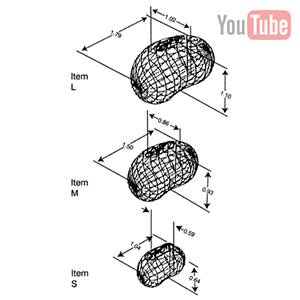
Neuticles are prosthetic testicular implants for neutered dogs and other domestic animals. Creator Gregg Miller won the 2005 Ig Nobel Prize in Medicine, a parody of the real Nobel Prize, for his invention. As of 2007, more than 240,000 pairs of the patented product had been sold, in all 50 U.S. states and 49 countries. Miller developed the idea for Neuticles in 1993, after his bloodhound Buck caught the scent of a bitch in heat, disappeared and turned up days later 30 miles away. Miller had Buck neutered to stop his wandering. Following the procedure, when Buck went to clean himself, he realized something was wrong and acted ‘extremely depressed’ for three days.
The first commercial Neuticles were implanted in 1995. Neuticles are made from Food and Drug Administration–approved materials and are designed to replicate the weight and feel of the animal’s natural testicles. They are made of solid silicone and are not gel-filled and therefore cannot leak. Several companies have tried to copy the patented prosthetic. CTI Corporation, which manufactures Neuticles, cited an investigation revealing that companies in New York and California were pirating Neuticles. CTI warned of health risks to the animals getting the pirate product.
Posted in Humor, Money, Sex |
1 Comment »
November 19, 2011
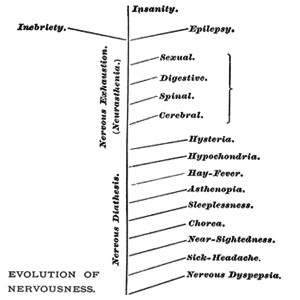
Neurasthenia [noor-uhs-thee-nee-uh] is a psycho-pathological term first used by American neurologist George Miller Beard in 1869 to denote a condition with symptoms of fatigue, anxiety, headache, neuralgia (pain of the nerves) and depressed mood. It is currently a diagnosis in the World Health Organization’s International Classification of Diseases (and in the Chinese Classification of Mental Disorders).
However, it is no longer included as a diagnosis in the American Psychiatric Association’s Diagnostic and Statistical Manual of Mental Disorders. Americans were supposed to be particularly prone to neurasthenia, which resulted in the nickname ‘Americanitis’ (popularized by American psychologist William James). Today, the condition is still commonly diagnosed in Asia.
read more »
Posted in Drugs, Health, World |
Leave a Comment »
November 19, 2011
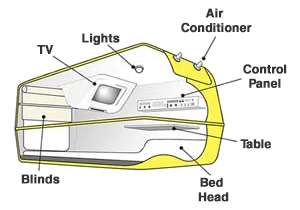

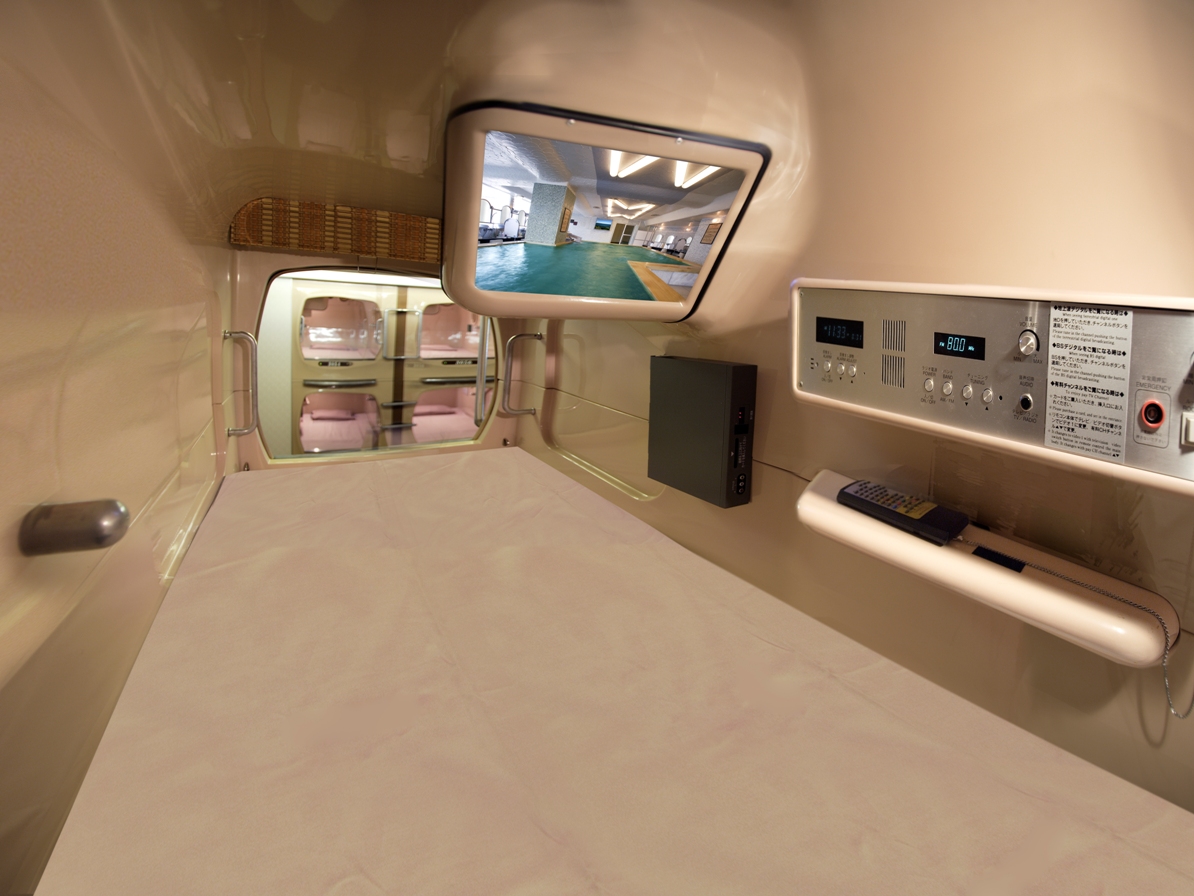
A capsule hotel is a type of hotel with a large number of extremely small ‘rooms’ (capsules) intended to provide cheap and basic overnight accommodation for guests not requiring the services offered by more conventional hotels. The guest space is reduced in size to a modular plastic or fiberglass block roughly 2 m by 1 m by 1.25 m. Most include a television, an electronic console, and wireless internet connection. Capsules are stacked side by side and two units top to bottom, with steps providing access to the second level rooms. Luggage is stored in a locker. Privacy is ensured by a curtain or a fiberglass door at the open end of the capsule. Washrooms are communal and some hotels include restaurants (or at least vending machines), pools, and other entertainment facilities.
This style of hotel accommodation was developed in Japan and has not gained popularity outside of the country, although Western variants known as ‘Pod hotels’ with larger accommodations and often private baths are being developed. Guests are asked not to smoke or eat in the capsules. Capsule hotels vary widely in size, some having only fifty or so capsules and others over 700. Many are used primarily by men. There are also capsule hotels with separate male and female sleeping quarters. Clothes and shoes are sometimes exchanged for a yukata (a casual summer kimono) and slippers on entry. A towel may also be provided. The benefit of these hotels is convenience and price, usually around ¥2000-4000 (US$26–52) a night.
Posted in Money, Technology, World |
Leave a Comment »
November 19, 2011
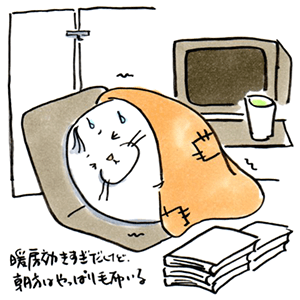
Net cafe refugees, also known as cyber-homeless, is a term for a growing class of people in Japan who do not own or rent a residence and thus have no permanent address and sleep in 24 hour Internet or manga cafés. Goods and services offered at these establishments has grown to include food, undergarments and other personal items, and showers. They are often used by commuters who miss the last train, but a growing number of people use net cafes as a temporary shelter. The fee of 1400-2400 yen (US $18-31) for a night—which may include free soft drinks, TV, comics and internet access—is less than for capsule hotels. Some cyber-homeless may also be freeters, a Japanese expression for people between the ages of 15 and 34 who lack full time employment or are unemployed, excluding housewives and students.
According to a Japanese government survey, those staying have little interest in manga or the Internet, and are instead using the place because of the low price relative to any of the competition for temporary housing, business hotels, capsule hotels, hostels, or any other option besides sleeping on the street. It was also estimated that about half of those staying have no job, while the other half work in low-paid temporary jobs, which paid around 100,000 yen ($1000) per month – lower than what is needed to rent an apartment and pay for transportation in a city like Tokyo.
Posted in Money, Technology, World |
Leave a Comment »




 The Daily Omnivore