Ester Hernandez (b. 1944) is a Chicana visual artist known for her pastels, paintings and prints primarily depicting Chicanas/Latinas. Her artwork captures time, and makes sense of the complex world we live in. She aspires to create a visual dialogue for women’s role in this new multi-cultural millennium. Her work reflects the political, social, ecological, and spiritual themes born from community pride, a commitment to political action, and an abiding sense of humor.
As a solo artist and member of Las Mujeres Muralistas, an influential San Francisco Mission district Latina women mural group in the early seventies, her career has marked her as a pioneer in the Chicana/Chicano civil rights art movement.
Ester was born and raised in California, on the western slopes of the Sierra Nevadas in central San Joaquin Valley, known for its natural beauty and paradoxically the ongoing struggle of farm workers. One of six children of farm worker parents, she developed her great respect for, and interest in, the arts through family and community involvement. Both her mother and her grandmother continued the family tradition of embroidery from their birthplace in North Central Mexico. Her grandfather was a master carpenter who made religious sculptures in his spare time, and her father was an amateur photographer and visual artist. The combination of this rich cultural and creative background of her childhood and the politically charged world of U.C. Berkeley in the early 70’s helped Ester develop her socio-political artistic identity and her consistent commitment to political activism.
Hernandez has said that creating art is the most important thing she does. From early childhood, she explored the organic materials surrounding her. Her first artistic impressions came after playing in the soft clay and sandy earth. She was amazed by its plasticity and ability to capture a moment in time.
Hernandez explores and works with a variety of mediums. She allows the subject matter to determine whether the work is public or is personal. The use of painting and pastels reflect her more personal work that allows her to explore ideas and materials freely and more directly. In the words of art critic, Amalia Mesa Baines: ‘In the 1980’s, Hernandez begun to develop a counterpoint to her screen printing tradition, using the medium of the pastel to create a more narrative and naturalistic rendering of characters influential within her own life. The pastel work almost serves as a pleasurable respite from the demands of a cultural critique in its joyful celebration of community.’
Continues Mesa Baines, ‘As with her artwork of her close friend and artistic madrina (godmother) the late legendary Tejana singer Lydia Mendoza, she subverts, re-contextualizes, and transforms culturally traditional images into a series of feminist icons, elevating their status to that of role models.’
She has drawn inspiration from the political prints of Guadalupe Posada and Francisco Goya, the drama of German Expressionism, and in particular, the colors, perspective, line and use of space by Japanese artists.
As integral to her art as the mediums in which she works is the geopolitical contexts in which she lives. Her art is her way to contextualize the world around her and her subject matter: ‘In many ways my artwork has always been a futile attempt to capture time, to create beauty, and most importantly, to make sense of the complex, ever changing, globalized world we live in. So many things separate us. I hope I will see a time when we will all unite, regardless of race, size, age, economic status, ability, gender or any other ism that exists to separate us. I aspire to create artwork that helps to bridge that dialogue.
Hernandez often chooses the medium of screen printing when she has a socio-political image that she wants to disseminate to the four directions and to make artwork that is affordable. She states that she enjoys the concept of positive and negative and the magical surprises of delicate textures and sensuous bold areas of color she can create through the print process.
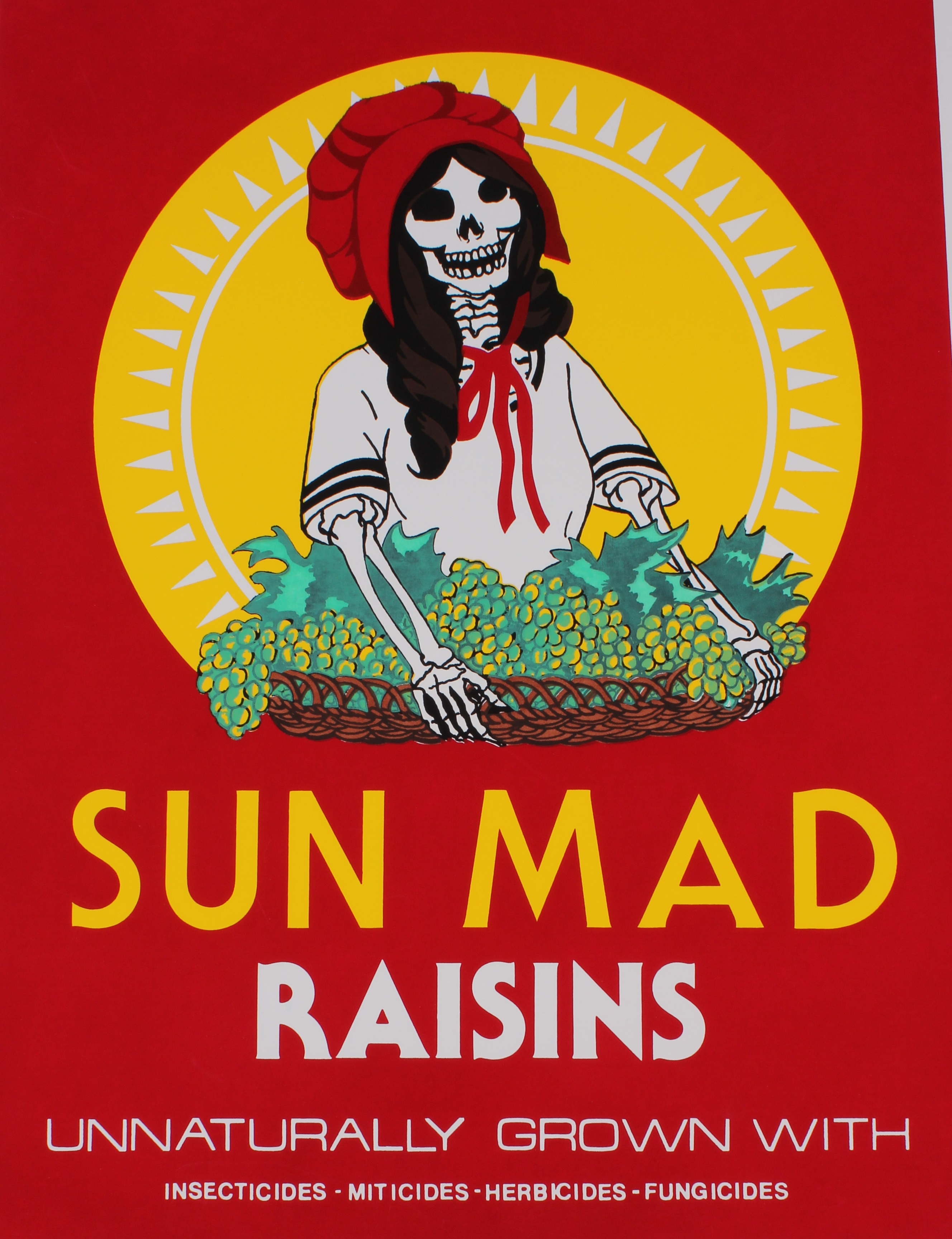
Take, for instance, her iconic (and much censored by California’s agribusiness) screen print ‘Sun Mad.’ From an insider’s perspective, she illustrates the deadly impact of pesticides on farm workers, consumers and the environment. From a socio-political perspective, Hernandez brings a particularly American flavor to the Latin American protest poster. Her participation in the ‘Latin American Posters: Public Aesthetics and Mass Politics’ retrospective ‘traces four decades of Latin American social and political history during a time of widespread crisis and unrest.’


 The Daily Omnivore