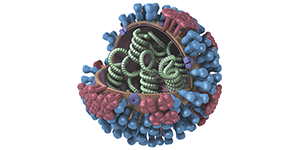
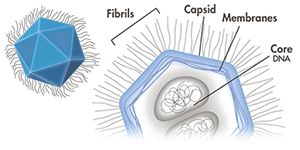
Non-cellular life is life that exists without a cellular structure. This term presumes the phylogenetic (evolutionary relatedness) scientific classification of viruses as lifeforms. Hypothesized artificial life, self-replicating machines, and most simple molecules capable of self-replication, such as crystals, are not usually considered living. Some biologists refer to wholly syncytial (containing multiple cell nuclei) organisms (such as many fungi) as ‘acellular’ because their bodies contain multiple nuclei which are not separated by cell walls, but they do contain cells. Viral self-assembly has implications for the study of the origin of life, as it lends further credence to the hypothesis that life could have started as self-assembling organic molecules.
The issue of life without cellular structure came again to the fore with the 2003 discovery that the large and complex Mimivirus can make some proteins. This discovery suggests that some viruses may have evolved from earlier forms that could produce proteins independent of a host cell. If so, there may at one time have been a viral domain of life. It is not clear that all small viruses have originated from more complex viruses by means of genome size reduction. A viral domain of life may only be relevant to certain large viruses such as nucleocytoplasmic large DNA viruses like the Mimivirus.


 The Daily Omnivore
Leave a comment