January 19, 2012

Carbon chauvinism is a neologism meant to disparage the assumption that the chemical processes of hypothetical extraterrestrial life must be constructed primarily from carbon (organic compounds), as carbon’s chemical and thermodynamic properties render it far superior to all other elements.
The term was used as early as 1973, when scientist Carl Sagan described it and other human chauvinisms that limit imagination of possible extraterrestrial life. It suggests that human beings, as carbon-based life forms who have never encountered any life that has evolved outside the Earth’s environment, may find it difficult to envision radically different biochemistries.
read more »
Posted in Science |
Leave a Comment »
January 19, 2012

Artificial life (alife) is a field of study and an associated art form which examine systems related to life, its processes, and its evolution through simulations using computer models, robotics, and biochemistry. The discipline was named by Christopher Langton, an American computer scientist, in 1986.
There are three main kinds of alife, named for their approaches: soft, from software; hard, from hardware; and wet, from biochemistry. Artificial life imitates traditional biology by trying to recreate biological phenomena, such as sexual reproduction and response to stimuli. The term ‘artificial life’ is often used to specifically refer to soft alife.
read more »
Posted in Games, Science, Technology |
Leave a Comment »
January 19, 2012
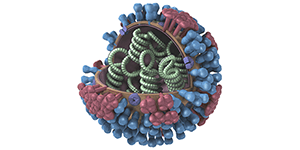
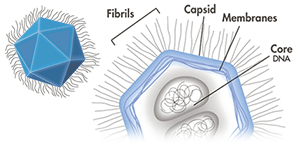
Non-cellular life is life that exists without a cellular structure. This term presumes the phylogenetic (evolutionary relatedness) scientific classification of viruses as lifeforms. Hypothesized artificial life, self-replicating machines, and most simple molecules capable of self-replication, such as crystals, are not usually considered living. Some biologists refer to wholly syncytial (containing multiple cell nuclei) organisms (such as many fungi) as ‘acellular’ because their bodies contain multiple nuclei which are not separated by cell walls, but they do contain cells. Viral self-assembly has implications for the study of the origin of life, as it lends further credence to the hypothesis that life could have started as self-assembling organic molecules.
The issue of life without cellular structure came again to the fore with the 2003 discovery that the large and complex Mimivirus can make some proteins. This discovery suggests that some viruses may have evolved from earlier forms that could produce proteins independent of a host cell. If so, there may at one time have been a viral domain of life. It is not clear that all small viruses have originated from more complex viruses by means of genome size reduction. A viral domain of life may only be relevant to certain large viruses such as nucleocytoplasmic large DNA viruses like the Mimivirus.
Posted in Health, Science |
Leave a Comment »
January 19, 2012
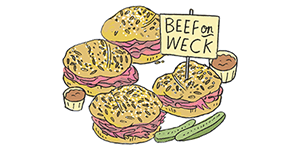

Au jus [oh joos] is French for ‘with [its own] juice.’ In American cuisine, the term is mostly used to refer to a light sauce for beef recipes, which may be served with the food or placed on the side for dipping. In French cuisine, jus is a natural way to enhance the flavor of dishes, mainly chicken, veal and lamb. ‘Jus’ means the natural juices given off by the food. To prepare a natural jus, the cook may simply skim off the fat from the juices left after cooking and bring the remaining meat stock and water to a boil.
Often prepared in the United States is a seasoned sauce with several additional flavorings. American recipes au jus often use soy sauce, Worcestershire sauce, salt, pepper, white or brown sugar, garlic, onion, or other ingredients to make something more like a gravy. So-called jus is sometimes prepared separately, rather than being produced naturally by the food being cooked. An example could be a beef jus made by reducing beef stock to a concentrated form, to accompany a meat dish.
Posted in Food, Language, World |
1 Comment »
January 19, 2012
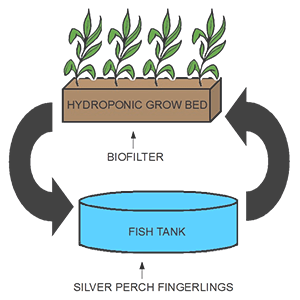
Aquaponics [ak-wuh-pon-iks] is a sustainable food production system that combines a traditional aquaculture (raising aquatic animals such as fish, crayfish or prawns in tanks) with hydroponics (cultivating plants in water) in a symbiotic environment. In the aquaculture, effluents accumulate in the water, increasing toxicity for the fish. This water is led to a hydroponic system where the by-products from the aquaculture are filtered out by the plants as vital nutrients, after which the cleansed water is recirculated back to the animals.
Aquaponic systems vary in size from small indoor or outdoor units to large commercial units, using the same technology. The systems usually contain fresh water, but salt water systems are plausible depending on the type of aquatic animal and which plants.
read more »
Posted in Food, Money, Technology |
Leave a Comment »
January 17, 2012


FreedomBox is a community project to develop, design and promote personal servers running free software for distributed social networking, email and audio/video communications. The project was announced by Columbia Law professor Eben Moglen at an ISOC (Internet Society) meeting in 2010.
The project currently describes a FreedomBox as, ‘a personal server running a free software operating system, with free applications designed to create and preserve personal privacy.’ The project aims to develop a software stack that can run on plug computers (small computers the size of a wall wart) that can easily be located in individual residences or offices. By promoting a decentralized deployment of hardware, the project hopes that FreedomBoxes will ‘provide privacy in normal life, and safe communications for people seeking to preserve their freedom in oppressive regimes.’
Posted in Money, Politics, Technology |
Leave a Comment »
January 17, 2012
The word ‘bolide‘ [boh-lahyd] comes from the Greek ‘bolis,’ which can mean ‘missile’ or ‘to flash.’ The International Astronomical Union (IAU) has no official definition of ‘bolide,’ and generally considers the term synonymous with ‘fireball,’ a brighter-than-usual meteor. The IAU defines a fireball as ‘a meteor brighter than any of the planets’ (magnitude −4 or greater). Astronomers tend to use ‘bolide’ to identify an exceptionally bright fireball (magnitude −14 or brighter), particularly one that explodes (sometimes called a detonating fireball).
It may also be used to mean a fireball which creates audible sounds. If the magnitude of a bolide reaches −17 or brighter it is known as a ‘superbolide.’ Geologists use the term ‘bolide’ more often than astronomers do: in geology it indicates a very large impactor. For example, the U.S. Geological Survey uses the term to mean a generic large crater-forming projectile ‘to imply that we do not know the precise nature of the impacting body … whether it is a rocky or metallic asteroid, or an icy comet, for example.’
Posted in Language, Science |
Leave a Comment »
January 17, 2012
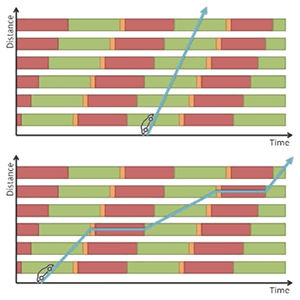
A green wave is an intentionally induced phenomenon in which a series of traffic lights (usually three or more) are coordinated to allow continuous traffic flow over several intersections in one main direction. Any vehicle travelling along with the green wave (at an approximate speed decided upon by the traffic engineers) will see a progressive cascade of green lights, and not have to stop at intersections. This allows higher traffic loads, and reduces noise and energy use (because less acceleration and braking is needed).
In practical use, only a group of cars (known as a ‘platoon,’ the size of which is defined by the signal times) can use the green wave before the time band is interrupted to give way to other traffic flows. The coordination of the signals is sometimes done dynamically, according to sensor data of currently existing traffic flows – otherwise it is done statically, by the use of timers.
read more »
Posted in Technology |
1 Comment »
January 17, 2012
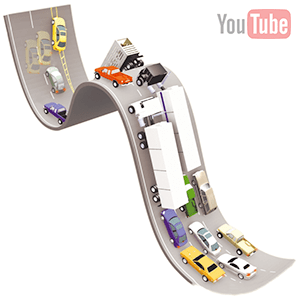
Traffic waves, also called stop waves or traffic shocks, are travelling disturbances in the distribution of cars on a highway. Traffic waves usually travel backwards in relation to the motion of the cars themselves, or ‘upstream.’ The waves can also travel downstream, however, more commonly become ‘pinned’ to a single spot on the road, as a soliton (solitary wave). Traffic waves are a type of traffic jam. A deeper understanding of traffic waves is a goal of the physical study of traffic flow, in which traffic itself can often be seen using techniques similar to those used in fluid dynamics.
It has been said that by knowing how traffic waves are created, drivers can sometimes reduce their effects by increasing vehicle headways and reducing the use of brakes, ultimately alleviating traffic congestion for everyone in the area.
Posted in Science |
Leave a Comment »
January 16, 2012

Wakamaru is a Japanese domestic robot made by Mitsubishi Heavy Industries, primarily intended to provide companionship to elderly and disabled people. The robot is yellow, 1m tall, and weighs 30 kilograms. It has two arms and its flat, circular base has a diameter of 45 cm. The first hundred went on sale in 2005, for USD $14,000. Wakamaru runs a Linux operating system on multiple microprocessors.
It can connect to the Internet, and has limited speech (in both male and female voices) and speech recognition abilities. Functions include reminding the user to take medicine on time, and calling for help if it suspects something is wrong. Wakamaru was the childhood name of Minamoto no Yoshitsune, a 12th century Japanese general.
Posted in Health, Technology, World |
1 Comment »
January 16, 2012

Paro is a therapeutic robot baby harp seal, intended to be very cute and to have a calming effect on and elicit emotional responses in patients of hospitals and nursing homes, similar to Animal-Assisted Therapy. It was designed by Takanori Shibata of the Intelligent System Research Institute of Japan’s AIST beginning in 1993. It was first exhibited to the public in late 2001 and handmade versions have been sold commercially since 2004.
Paro is based on harp seals Shibata saw in Canada, where he also recorded their cries that Paro uses. The robot has tactile sensors and responds to petting by moving its tail and opening and closing its eyes. It also responds to sounds and can learn a name. It can show emotions such as surprise, happiness and anger. It produces sounds similar to a real baby seal and (unlike a real baby seal) is active during the day and goes to sleep at night.
Posted in Health, Technology, World |
Leave a Comment »
January 16, 2012

Dustbot is a robot that collects garbage from homes. It can be summoned by phone call or SMS, and uses GPS to automatically make its way to the customer, collect the rubbish, and take it to a dustbin. In addition, the Dustbots carry environmental sensors to monitor the pollution levels over, for example, a pedestrian area.
Prototypes have been tested in Italy and Sweden and Ireland. The Dustbot project is funded by the European Commission. The Dustbot system, consisting of the DustCart and the DustClean robots, is designed to work in tight urban areas where large trucks find it difficult to operate, such as old European cities.
Posted in Technology, World |
1 Comment »


 The Daily Omnivore