January 15, 2012
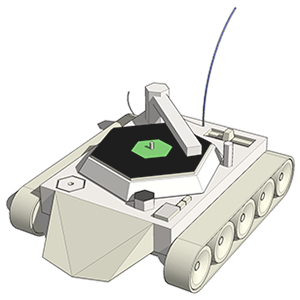
Sonic and ultrasonic weapons (USW) are weapons of various types that use sound to injure, incapacitate, or kill an opponent. Some sonic weapons are currently in limited use or in research and development by military and police forces. Others exist only in the realm of science fiction.
Some of these weapons have been described as sonic bullets, sonic grenades, sonic mines, or sonic cannons. Some make a focused beam of sound or ultrasound; some make an area field of sound. Although many real sonic and ultrasonic weapons are described as ‘non-lethal,’ they can still kill under certain conditions.
read more »
Posted in Technology, War |
1 Comment »
January 15, 2012

A hoodie is a sweatshirt with a hood. They often include a muff sewn onto the lower front, and a drawstring to adjust the hood opening, and may have a vertical zipper down the center similar to a windbreaker style jacket.
The garment’s style and form can be traced back to Medieval Europe when the formal wear for monks included a long, decorative hood called cowl worn a tunic or robes. The modern clothing style was first produced by Champion in the 1930s and marketed to laborers who endured freezing temperatures in upstate New York.
read more »
Posted in Money, Politics, World |
Leave a Comment »
January 15, 2012


Hashish [ha-sheesh] is a cannabis preparation composed of compressed stalked resin glands, called trichomes, collected from the unfertilized buds of the cannabis plant. It contains the same active ingredients but in higher concentrations than unsifted buds or leaves.
Hashish is often a paste-like substance with varying hardness and pliability, its color most commonly light to dark brown but varying toward green, yellow, black or red. Hashish is heated in a pipe, hookah, bong, bubbler, vaporizer, hot knife, smoked in joints mixed with cannabis buds or tobacco, or cooked in foods.
read more »
Posted in Drugs |
Leave a Comment »
January 15, 2012

Tenacious D is an American rock band that was formed in Los Angeles in 1994. Composed of lead vocalist and guitarist Jack Black and lead guitarist and vocalist Kyle Gass, the band has released two albums – ‘Tenacious D’ (2001) and ‘The Pick of Destiny’ (2006). The band’s studio releases and live performances feature a full band lineup, including such musicians as guitarist John Konesky, bassist John Spiker and Bad Religion drummer Brooks Wackerman.
The band originally performed as an acoustic duo, which gained popularity in 1999 when they starred in their eponymous television series and began to support large rock acts. Tenacious D’s music showcases Black’s theatrical vocal delivery and Gass’s acoustic guitar playing abilities. Critics have described their fusion of vulgar absurdist comedy with rock music as ‘mock rock.’ Their songs discuss the duo’s purported musical and sexual prowess, as well as their friendship and cannabis usage in a style that music critics have compared with the storyteller-style lyrics of rock opera.
read more »
Posted in Art, Humor |
Leave a Comment »
January 15, 2012

Burning Man is a week-long annual event held in the Black Rock Desert in northern Nevada. The event starts on the Monday before Labor Day, and ends on the holiday itself. It takes its name from the ritual burning of a large wooden effigy on Saturday evening. The event is described by many participants as an experiment in community, radical self-expression, and radical self-reliance.
Burning Man is organized by Black Rock City, LLC. In 2010, 51,515 people attended Burning Man. In 2011, attendance was capped at 50,000 participants. In 2011, Larry Harvey announced that the Org had begun the process of transitioning management of the festival over to a new non-profit called the ‘Burningman Project.’
read more »
Posted in Art, Money |
Leave a Comment »
January 15, 2012

Preved is a term used in Russian Internet slang (Padonkaffsky jargon); it is a meme which developed out of a heavily-circulated picture, and consists of choosing alternative spellings for words for comic effect. The picture, a modified version of John Lurie’s watercolor ‘Bear Surprise,’ features a man and a woman having sex in the clearing of a forest, being surprised by a bear calling ‘Surprise!’ with its paws raised. In later Russian adaptations, the bear shouts ‘Preved!’ (a deliberate misspelling of ‘privet,’ ‘hi!’).
The word and the bear image have found their way into the mainstream mass media, such as a poster for the Russian edition of ‘Newsweek.’ In 2006 at an online conference, Vladimir Putin was asked: ‘PREVED, Vladimir Vladimirovich! How do you regard MEDVED?’ No answer was given, but the Associated Press, informing on the questions collection process, reportedly interpreted it as a reference to then-vice-prime-minister Dmitry Medvedev. It was the most popular question asked at the conference (the third most popular question was ‘How does one patch KDE2 under FreeBSD?’).
Posted in Humor, Sex, World |
Leave a Comment »
January 15, 2012
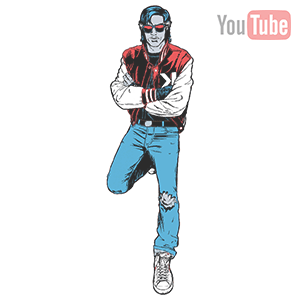
Kavinsky, real name Vincent Belorgey (b. 1977), is a French electro house artist, and has released three EPs on the Record Makers label: ‘Teddy Boy’ in 2006, ‘1986’ a year later, and ‘Nightcall’ in 2010. His work has been remixed by SebastiAn and others. In addition to his music career he has also appeared in several films including ‘Steak,’ directed by longtime friend Mr. Oizo. The SebastiAn remix of ‘Testarossa Autodrive’ off the ‘1986’ EP is featured in the video game ‘Grand Theft Auto IV.’
Kavinsky’s fellow producer Surkin once jokingly claimed in an interview that Kavinsky was his father. There has been a long running joke since. Kavinsky’s production style is very reminiscent of film soundtracks of the 1980s. He has also been compared to many similar French house artists including Daft Punk and Danger. Kavinsky’s single ‘Nightcall’ was featured in the opening credits of the film ‘Drive.’
Posted in Art |
Leave a Comment »
January 15, 2012

Kode9 (born Steve Goodman) is a London-based electronic music artist, DJ, and owner of the Hyperdub record label. MC, The Spaceape, is a frequent collaborator. Initially inspired by what he calls the ‘hardcore continuum,’ he also draws on dub reggae, and was one of the founding members of the early dubstep scene (which he views as a continuation of developments originally stemming from UK Hardcore).
He has released two full-length albums: ‘Memories of the Future’ and ‘Black Sun’ (both featuring the Spaceape). Kode9 has a Ph.D. in philosophy from the University of Warwick. In 2009, MIT Press published his book, ‘Sonic Warfare: Sound, Affect, and the Ecology of Fear,’ exploring the uses of acoustic force and how sound can be deployed to set moods of dread and fear, how sound can be used as torture, as a weapon and as a threat.’
Posted in Art, Language, Technology |
Leave a Comment »
January 14, 2012

Larry Levan (1954 – 1992) was a DJ best known for his decade-long residency at the New York City night club Paradise Garage, which has been described as the prototype of the modern dance club. He developed a cult following who referred to his sets as ‘Saturday Mass.’ Influential US DJ François Kevorkian credits Levan with introducing the dub aesthetic into dance music. Along with Kevorkian, Levan experimented with drum machines and synthesizers in his productions and live sets, ushering in an electronic, post-disco sound that presaged the ascendence of house music.
Born, Lawrence Philpot, Levan was openly gay and got his start alongside DJ Frankie Knuckles at the Continental Baths, as a replacement for the DJ from The Gallery, Nicky Siano. Levan’s DJing style was influenced by Siano’s eclectic style, and by The Loft’s David Mancuso, who briefly dated Levan in the early 1970s. As Knuckles was still trying to make his way in the New York club scene, Levan became a popular attraction perhaps due to his ‘diva persona,’ which he developed in the city’s notoriously competitive black drag ‘houses.’
read more »
Posted in Art |
Leave a Comment »
January 14, 2012
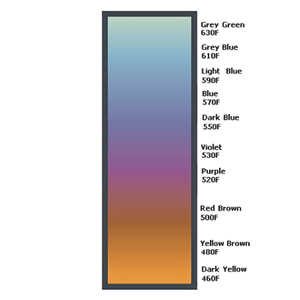
Bluing is a passivation process (‘passive’ in relation to being less affected by environmental factors such as air or water) in which steel is partially protected against rust, and is named after the blue-black appearance of the resulting protective finish. It is the result of an oxidizing chemical reaction with iron on the surface selectively forming magnetite (Fe3O4), the black oxide of iron. By comparison, rust is the red oxide of iron (Fe2O3). Bluing is most commonly used by gunsmiths to improve the cosmetic appearance of, and provide a measure of corrosion resistance to, their firearms.
Bluing also helps to maintain the metal finish by resisting tangential scratching, and also helps to reduce glare to the eyes of the shooter when looking down the barrel of the gun. All blued parts still need to be properly oiled to prevent rust. Bluing, being a chemical conversion coating, is not as robust against wear and corrosion resistance as plated coatings, and is typically no thicker than 2.5 micrometers (0.0001 inches). For this reason, it is considered not to add any appreciable thickness to precisely-machined gun parts. It is also used for providing coloring for steel parts of fine clocks and other fine metalwork, such as by machinists, who protected and beautified tools made for their own use.
Posted in Science, Technology |
Leave a Comment »
January 12, 2012


Generation X, commonly abbreviated to Gen X, is the generation born after the baby boom ended. While there is no universally agreed upon time frame, the term generally includes people born from the early 1960s through the early 1980s, usually no later than 1981 or 1982. The term had also been used in different times and places for various subcultures or countercultures since the 1950s.
The term Generation X was coined by the Magnum photographer Robert Capa in the early 1950s. He would use it later as a title for a photo-essay about young men and women growing up immediately after the Second World War. The project first appeared in ‘Picture Post’ (UK) and ‘Holiday’ (US) in 1953. Describing his intention, Capa said ‘We named this unknown generation, The Generation X, and even in our first enthusiasm we realized that we had something far bigger than our talents and pockets could cope with.’
read more »
Posted in Language, Politics, World |
Leave a Comment »
January 12, 2012
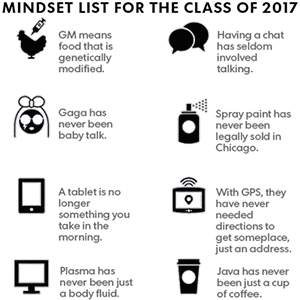
Generation Y, also known as Millennials, describes the demographic cohort following Generation X. While there is no universally agreed upon time frame, the term generally includes people born in the late 1980s, early to middle 1990s, or as late as the early 2000s. One segment of this age-group is often called the ‘eighties babies’ generation. Members of this generation are called Echo Boomers because many of them are children of baby boomers. The 20th century trend toward smaller families in developed countries continued, so the relative impact of the ‘baby boom echo’ was generally less pronounced than the original boom.
Characteristics of the generation vary by region, depending on social and economic conditions. However, it is generally marked by an increased use and familiarity with communications, media, and digital technologies. In most parts of the world its upbringing was marked by an increase in a neoliberal approach to politics and economics; the effects of this environment are disputed. Today, there are approximately 80 million Echo Boomers.
read more »
Posted in Politics, World |
Leave a Comment »


 The Daily Omnivore