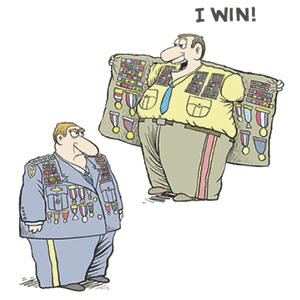
One-upmanship is the art or practice of successively outdoing a competitor. The term originated as the title of a book by Stephen Potter, published in 1952 as a follow-up to ‘The Theory and Practice of Gamesmanship (or the Art of Winning Games without Actually Cheating)’ (1947) and ‘Lifemanship’ titles in his series of tongue-in-cheek self-help books, and film and television derivatives, that teach various ‘ploys’ to achieve this. In that context, the term refers to a satiric course in the gambits required for the systematic and conscious practice of ‘creative intimidation,’ making one’s associates feel inferior and thereby gaining the status of being ‘one-up’ on them.
This satire of self-help style guides manipulates traditional stuffy British conventions for the gamester, all life being a game, who understands that if you’re not one-up, you’re one-down. Potter’s unprincipled principles apply to almost any possession, experience or situation, deriving maximum undeserved rewards and discomforting the opposition. Viewed seriously, it is a phenomenon of group dynamics that can have significant effects in the management field: for instance, manifesting in office politics. The term has been extended to a generic, often punning, extension upmanship used for any assertion of superiority: for instance, Native Upmanship.


 The Daily Omnivore