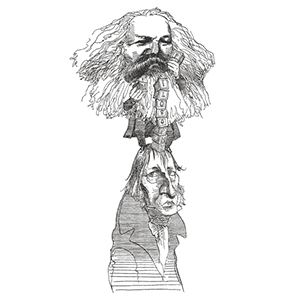
Historicism is doctrine that emphasizes the importance of history. It is a mode of thinking that assigns a central and basic significance to a specific context, such as historical period, geographical place and local culture. As such it is in contrast to individualist theories of knowledge such as empiricism and rationalism, which often discount the role of traditions. Historicism therefore tends to be hermeneutical (investigative of interpretations), because it places great importance on cautious, rigorous and contextualized interpretation of information and/or relativist (in support of the theory that knowledge is always relative to limitations of the mind), because it rejects notions of universal, fundamental and immutable interpretations.
The term has developed different and divergent, though loosely related, meanings. Elements of historicism appear in the writings of Italian philosopher G. B. Vico and French essayist Michel de Montaigne, and became fully developed with the dialectic of G. W. F. Hegel, influential in 19th-century Europe. The writings of Karl Marx, influenced by Hegel, also contain historicism. The term is also associated with the empirical social sciences and the work of Franz Boas. Historicism may be contrasted with reductionist theories, which suppose that all developments can be explained by fundamental principles (such as in economic determinism), or theories that posit historical changes as result of random chance. The theological use of the word denotes the interpretation of biblical prophecy as being related to church history. Post-structuralism uses the term New Historicism, which has some connections to both anthropology and Hegelianism.


 The Daily Omnivore