February 7, 2012

The phrase snake oil is as a derogatory term used to describe quackery, the promotion of fraudulent or unproven medical practices. The expression is also applied metaphorically to any product with questionable and/or unverifiable quality or benefit. By extension, the term ‘snake oil salesman’ may be applied to someone who sells fraudulent goods, or who is a fraud himself.
The phrase originates with a topical preparation made from the Chinese Water Snake. Chinese laborers on railroad gangs involved in building the First Transcontinental Railroad first gave snake oil to Europeans with joint pain. When rubbed on the skin at the painful site, snake oil was claimed to bring relief. This claim was ridiculed by rival medicine salesmen, and in time, snake oil became a generic name for many compounds marketed as panaceas or miraculous remedies whose ingredients were usually secret, unidentified, or mis-characterized and mostly inert or ineffective.
read more »
Posted in Drugs, Health, Politics |
Leave a Comment »
February 7, 2012

Bile bears or battery bears are Asiatic black bears kept in captivity in China and Vietnam to harvest bile, a digestive juice produced by the liver and stored in the gall bladder. When extracted, the bile is a valuable commodity for sale as an ingredient in traditional Chinese medicine (TCM).
The bears are also known as moon bears because of the cream-colored crescent moon shape on their chest. The Asiatic black bear, the one most commonly used on bear farms, is listed as vulnerable on the World Conservation Union’s (IUCN’s) Red List of Threatened Animals.
read more »
Posted in Health, Politics, World |
Leave a Comment »
February 7, 2012

A bible for screenwriters is a reference document used for information on a story’s characters, settings and other elements. Show bibles are commonly used in television series; new writers and freelancers are often referred to it when writing scripts for the show to ensure continuity with previous episodes; they’re also used by individual writers for books and movies to keep track of details.
However, according to writer and producer Jane Espenson, ‘Show bibles … just aren’t as important as you might think to the daily life of the [writing] staff. The truth is that once you’re living inside a show, you’re swimming as fast as you can from one island to the next, and there is neither the time nor the need to record decisions that have been made (these are in the scripts), or that are in the process of being made (these are in the notes taken in the room as the writers work).’
read more »
Posted in Art, Language, Money |
Leave a Comment »
February 6, 2012

False consciousness is the Marxist thesis that material and institutional processes in capitalist society are misleading to the proletariat, and to other classes. These processes betray the true relations of forces between those classes, and the real state of affairs regarding the development of pre-socialist society (relative to the secular development of human society in general).
In Marxist theory, false consciousness is essentially a result of ideological control which the proletariat either do not know they are under or which they disregard with a view to their own POUM (probability/possibility of upward mobility). POUM or something like it is required in economics with its presumption of rational agency; otherwise wage laborers would be the conscious supporters of social relations antithetical to their own interests, violating that presumption.
read more »
Posted in Money, Politics |
1 Comment »
February 6, 2012

A sleeper hit refers to a film, book, single, album, TV show, or video game that gains unexpected success or recognition. Sleeper hits often grow in popularity over time. Some sleeper hits achieve unexpected success at the box office immediately upon their initial theatrical release, but this is not typical. Because these films are not expected to do particularly well they often receive little promotion or advertising and take time to register with the public.
Typically the sleeper hit relies instead on positive ‘word of mouth’ as well as the publicity generated by awards and good reviews. Two good examples of these are Mike Judge’s ‘Office Space’ and ‘Idiocracy,’ both of which quickly became cult classics. The movie ‘Caddyshack’ is another good example.
read more »
Posted in Art, Language, Money |
1 Comment »
February 6, 2012

New sincerity is a term that has been used in music, aesthetics, film criticism, poetry, literary criticism and philosophy, generally to describe art or concepts that run against prevailing modes of postmodernist irony or cynicism. ‘New Sincerity’ was used as a collective name for a loose group of alternative rock bands, centered in Austin, Texas in the years from about 1985 to 1990, who were perceived as reacting to the ironic outlook of then-prominent music movements like punk rock and New Wave.
The use of ‘New Sincerity’ in connection with these bands began with an off-handed comment by Austin punk rocker/author Jesse Sublett to his friend, local music writer Margaret Moser: ‘All those new sincerity bands, they’re crap.’
read more »
Posted in Art, Humor, Language |
Leave a Comment »
February 6, 2012


A cult following is a group of fans who are highly dedicated to a specific area of pop culture. A film, book, band, or video game, among other things, will be said to have a cult following when it has a small but very passionate fan base. A common component of cult followings is the emotional attachment fans have with the object of the cult following, often identifying themselves and other fans as members of a community.
Cult followings are also commonly associated with niche markets. Cult media are often associated with underground culture, and are considered too eccentric, bizarre, controversial or anti-establishment to be appreciated by the general public.
read more »
Posted in Art, Language, Money |
Leave a Comment »
February 6, 2012

A cult film, also commonly referred to as a cult classic, is a film that has acquired a highly devoted but specific group of fans. Often, cult movies have failed to achieve fame outside the small fanbases; however, there have been exceptions that have managed to gain fame among mainstream audiences. Many cult movies have gone on to transcend their original cult status and have become recognized as classics; others are of the ‘so bad it’s good’ variety and are destined to remain in obscurity.
Cult films often become the source of a thriving, obsessive, and elaborate subculture of fandom, hence the analogy to cults. However, not every film with a devoted fanbase is necessarily a cult film. Usually, cult films have limited but very special, noted appeal. Cult films are often known to be eccentric, often do not follow traditional standards of popular cinema and usually explore topics not considered in any way mainstream—yet there are examples that are relatively normal. Many are often considered controversial because they step outside standard narrative and technical conventions.
read more »
Posted in Art, Language, Money |
1 Comment »
February 6, 2012
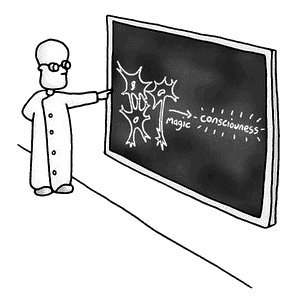
The explanatory gap is the difficulty that physicalist theories have in explaining how physical properties give rise to the way things feel when they are experienced. It is the claim that consciousness and human experiences such as qualia (individual instances of subjective, conscious experience) cannot be fully explained just by identifying the corresponding physical (neural) processes.
Bridging this gap is known as ‘the hard problem.’ The explanatory gap has vexed and intrigued philosophers and AI researchers alike for decades and caused considerable debate.
read more »
Posted in Education, Philosophy, Science |
1 Comment »
February 6, 2012

Qualia [kwah-lee-uh], singular ‘quale’ [kwah-lee], from a Latin word meaning for ‘what sort’ or ‘what kind,’ is a term used in philosophy to refer to subjective conscious experiences as ‘raw feels.’ Examples of qualia are the pain of a headache, the taste of wine, the experience of taking a recreational drug, or the perceived redness of an evening sky.
American philosopher Daniel Dennett writes that qualia is ‘an unfamiliar term for something that could not be more familiar to each of us: the ways things seem to us.’ Erwin Schrödinger, the famous physicist, had this counter-materialist take: ‘The sensation of color cannot be accounted for by the physicist’s objective picture of light-waves. Could the physiologist account for it, if he had fuller knowledge than he has of the processes in the retina and the nervous processes set up by them in the optical nerve bundles and in the brain? I do not think so.’
read more »
Posted in Language, Philosophy, Science |
1 Comment »
February 6, 2012

Mary’s room (also known as Mary the super-scientist) is a philosophical thought experiment proposed by Frank Jackson in his article ‘Epiphenomenal Qualia’ (1982) and extended in ‘What Mary Didn’t Know'(1986).
The argument is intended to motivate what is often called the ‘Knowledge Argument’ against physicalism — the view that the universe, including all that is mental, is entirely physical. The debate that emerged following its publication became the subject of an edited volume — ‘There’s Something About Mary’ (2004) — which includes replies from such philosophers as Daniel Dennett, David Lewis, and Paul Churchland.
read more »
Posted in Philosophy, Science |
Leave a Comment »
February 6, 2012

A video mashup is the combination of multiple sources of video—which usually have no relation with each other—into a derivative work, often lampooning its component sources or another text.
Many mashup videos are humorous movie trailer parodies, a later genre of mashups gaining much popularity. To the extent that mashups are ‘transformative’ of original content, they may find protection from copyright claims under the ‘fair use’ doctrine of copyright law.
Posted in Art, Humor, Technology |
Leave a Comment »



 The Daily Omnivore