April 7, 2012

Geoffrey Barrow (b. 1971) is an English producer, composer, disc jockey, and is the instrumentalist for the band Portishead. Portishead—formed in 1991—was named after the small town near Bristol where Barrow grew up. On his intentions in forming Portishead, he has stated, ‘I just wanted to make interesting music, proper songs with a proper life span and a decent place in people’s record collections.’ After being involved in many local rock bands, playing drums and DJing in hip hop groups, Barrow got his first job at the Coach House Studios as a tape operator soon after it opened in 1989.
In 1991, while he was assisting on Massive Attack’s breakthrough album ‘Blue Lines,’ the band allowed him spare studio time to get his own ideas on tape. A few years later, when the Portishead project had been assembled, the group came back to record ‘Sour Times’ in that same studio. At the dawn of the ’90s, Barrow was making a name for himself as a remixer, working with such artists as Primal Scream, Paul Weller, Gabrielle, and Depeche Mode. In addition, Barrow had produced a track for Tricky and written songs for Neneh Cherry.
Posted in Art |
Leave a Comment »
April 6, 2012

Squidward Tentacles is a fictional character on the television cartoon series ‘SpongeBob SquarePants.’ He is voiced by Rodger Bumpass. Squidward appears in 270 episodes of the series, second only to SpongeBob’s 305. Unlike most characters in the series, Squidward is generally grumpy, tactless, short-tempered, sarcastic, and narcissistic. He dislikes many things, including his consistently annoying neighbors SpongeBob and Patrick, his job at the Krusty Krab, and is constantly aloof towards the citizens of Bikini Bottom. He is very open about his dissatisfaction with his job, and has frequently displayed unprofessional behavior such as sleeping at his counter, failing to clean his workplace, and reading art magazines instead of attending to customers.
Squidward enjoys playing his clarinet (at an elementary level with frequent missed notes and poor intonation, though Squidward considers himself a brilliant musical prodigy), modern dance, abstract art, relaxing, public radio, select television programs, and just about anything else that he considers ‘fancy.’ He does not like anyone, except his mother. Although Squidward likes to consider himself as above the mundane and often immature activities of his peers, he has constantly exhibited an unhealthy obsession with and dedication to such activities when exposed to them.
Posted in Art, Humor |
Leave a Comment »
April 6, 2012

Artists and repertoire (A&R) is the division of a record label that is responsible for talent scouting and overseeing the artistic development of recording artists. It also acts as a liaison between artists and the record label; every activity involving artists to the point of album release is generally considered under the purview of, and responsibility of, A&R. The A&R division is responsible for discovering new recording artists and bringing them to the record company.
They are expected to understand the current tastes of the market and to be able to find artists that will be commercially successful. For this reason, A&R people are often young and many are musicians, music journalists or record producers. An A&R executive is authorized to offer a record contract, often in the form of a ‘deal memo’: a short informal document that establishes a business relationship between the recording artist and the record company. The actual contract negotiations will typically be carried out by rival entertainment lawyers hired by the musician’s manager and the record company.
read more »
Posted in Art, Money |
Leave a Comment »
April 6, 2012

The Troubadour is a nightclub located in West Hollywood, founded in 1957 by Doug Weston. It was a major center for folk music in the 1960s, and subsequently for singer-songwriters and rock.
The Troubadour played an important role in the careers of Elton John, Linda Ronstadt, Hoyt Axton, the Eagles, The Byrds, Joni Mitchell, James Taylor, Carole King, Bonnie Raitt, J.D. Souther, Jackson Browne, Van Morrison, Buffalo Springfield and other prominent and successful performers, who played performances there establishing their future fame.
read more »
Posted in Art, Humor, Money |
Leave a Comment »
April 6, 2012

Clinamen [klyn-ah-mun] is the Latin name Roman philosopher Lucretius gave to the unpredictable swerve of atoms, in order to defend the atomistic doctrine of ancient Greek philosopher Epicurus. According to Lucretius, the unpredictable swerve occurs ‘at no fixed place or time’:
‘When atoms move straight down through the void by their own weight, they deflect a bit in space at a quite uncertain time and in uncertain places, just enough that you could say that their motion has changed. But if they were not in the habit of swerving, they would all fall straight down through the depths of the void, like drops of rain, and no collision would occur, nor would any blow be produced among the atoms. In that case, nature would never have produced anything.’
read more »
Posted in Language, Philosophy |
Leave a Comment »
April 6, 2012

‘Minnie the Moocher‘ is a jazz song first recorded in 1931 by Cab Calloway and His Orchestra, famous for its nonsensical ad libbed (‘scat’) lyrics. In performances, Calloway would have the audience participate by repeating each scat phrase in a form of call and response. Eventually Calloway’s phrases would become so long and complex that the audience would laugh at their own failed attempts to repeat them. The song is based both musically and lyrically on Frankie ‘Half-Pint’ Jaxon’s 1927 ‘Willie the Weeper’ (Bette Davis sings this version in ‘The Cabin in the Cotton’).
The lyrics are heavily laden with drug references. The character ‘Smokey’ is described as ‘cokey’ meaning a user of cocaine; the phrase ‘kicking the gong around’ was a slang reference to smoking opium. It was followed two years later by Lonnie Johnson’s ‘Winnie the Wailer.’
read more »
Posted in Art, Drugs |
Leave a Comment »
April 6, 2012

Bromo-DragonFLY is a psychedelic hallucinogenic drug related to phenethylamine (a chemical found in chocolate, which like amphetamine, causes the release of norepinephrine and dopamine in the brain). It is considered an extremely potent hallucinogen, only slightly less potent than LSD, with a normal dose in the region of 200 μg to 800 μg, and it has an extremely long duration (up to several days).
It is explicitly illegal only in Finland, Sweden, Norway, and Denmark, although it may be considered a controlled substance analogue under US and Australian drug laws. The compound was first synthesized in the lab of American pharmacologist David E. Nichols in 1998. As with the earlier and less potent dihydrofuran series of compounds nicknamed FLY, Bromo-DragonFLY was named after its superficial structural resemblance to a dragonfly.
read more »
Posted in Drugs, Health, Politics |
Leave a Comment »
April 6, 2012

Erowid is an online library of information about psychoactive plants and chemicals and other topics on altered states of consciousness such as meditation and lucid dreaming. It provides information about legal and illegal substances, including their desired and adverse effects. The site is organized by substance, ranging from well-known substances like alcohol, to obscure ones such as Bromo-DragonFLY (a hallacuinogen only slightly less potent than LSD, but which lasts for several days).
The information on the site is gathered from diverse sources including published literature, experts in related fields, and the experiences of the general public. Erowid acts as a publisher of new information as well as a library for the collection of documents and images published elsewhere.
read more »
Posted in Drugs, Health, Politics |
Leave a Comment »
April 4, 2012


Gun fu, a portmanteau of ‘gun’ and ‘kung fu,’ is the style of sophisticated close-quarters gunplay seen in Hong Kong action cinema and in Western films influenced by it. It often resembles a martial arts battle played out with firearms instead of traditional weapons. It may also be described by other terms such as ‘bullet ballet,’ ‘gun kata,’ or ‘gymnastic gunplay.’
The focus of gun fu is both style and the usage of firearms in ways that they were not designed to be used. Shooting a gun from each hand, shots from behind the back, as well as the use of guns as melee weapons are all common. Other moves can involve shotguns, Uzis, rocket launchers, and just about anything else that can be worked into a cinematic shot. It is often mixed with hand-to-hand combat maneuvers. Gun fu has become a staple factor in modern action films due to its visually appealing nature (regardless of its actual practicality in a real-life combat situation). This is a contrast to American action movies of the 1980s which focused more on heavy weaponry and outright brute-force in firearm-based combat.
read more »
Posted in Art, Death |
Leave a Comment »
April 4, 2012

The Male Gaze is a feminist theory that was first developed by British feminist film theorist Laura Muvley in 1975. The male gaze occurs when the audience, or viewer, is put into the perspective of a heterosexual man. Mulvey stressed that the dominant male gaze in mainstream Hollywood films reflects and satisfies the male unconscious: most filmmakers are male, thus the voyeuristic gaze of the camera is male. Male characters in the film’s narratives make women the objects of their gaze.
When feminism characterizes the ‘male gaze’ certain themes appear such as, voyeurism, objectification, fetishism, scopophilia (pleasure from looking), and women as the object of male pleasure. Mary Anne Doane at Brown University gives an example of how voyeurism can be seen in the male gaze: ‘The early silent cinema, through its insistent inscription of scenarios of voyeurism, conceives of its spectator’s viewing pleasure in terms of the peeping tom, behind the screen, reduplicating the spectator’s position in relation to the woman on the screen.’
read more »
Posted in Money, Politics, Sex |
2 Comments »
April 4, 2012

Girls with guns is a sub-genre of action films and animation, often Asian films and anime, that portray a strong female protagonist who makes use of firearms to defend against or attack a group of antagonists. The genre may typically involves gunplay, stunts and martial arts action. The genre started in the late 1950s and early 1960s in Asia. Suzuki Seijun’s 1958 film ‘Underworld Beauty’ is an early example from Japan.
In the 1966, Hong Kong actress Cheng Pei-pei starred in the Shaw Brothers Studio film ‘Come Drink with Me,’ an early Chinese film of the genre. Rival Hong Kong studio, Golden Harvest Studios, had their own female fighter, Angela Mao Ying, who also helped popularize the trend in Asia.
read more »
Posted in Art, Death, Sex |
1 Comment »
April 4, 2012
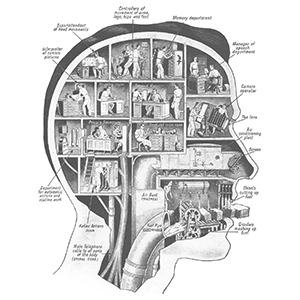
The ‘ghost in the machine‘ is British philosopher Gilbert Ryle’s description of René Descartes’ mind-body dualism. The phrase was introduced in Ryle’s book ‘The Concept of Mind’ (1949) to highlight the perceived absurdity of dualist systems like Descartes’ where mental activity carries on in parallel to physical action, but where their means of interaction are unknown or, at best, speculative.
Arthur Koestler’s wrote ‘The Ghost in the Machine,’ in 1967, focusing on mankind’s movement towards self-destruction, particularly in the nuclear arms arena. The book is particularly critical of B. F. Skinner’s behaviorist theory. One of Koestler’s central concepts is that as the human brain has grown, it has built upon earlier, more primitive brain structures, and that this is the ‘ghost in the machine’ of the title. Koestler’s theory is that at times these structures can overpower higher logical functions, and are responsible for hate, anger and other such destructive impulses.
read more »
Posted in Language, Philosophy, Science |
1 Comment »


 The Daily Omnivore