April 2, 2012
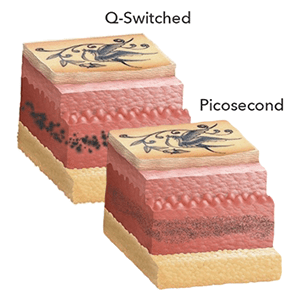
InfinitInk is a tattoo ink, which allows for easier tattoo removal, with removal up to three times faster than conventional inks. It is produced by Freedom2, Inc., and is available as of 2009 in limited release in the United States. It is currently only available in black and red, with other colors planned. The initial ink formulation consisted of inert plastic beads, containing bioremovable dyes. Laser application ruptures the beads, allowing the ink to leak out and be removed by the body.
The concept for this ink arose initially from potential medical uses, such as in reconstructive surgery and in radiation oncology. However, it was clear that a permanent and safe, yet more removable ink would also find use by some artists for decorative tattooing.
Posted in Money, Technology |
Leave a Comment »
April 2, 2012

Seven generation sustainability is an ecological concept that urges the current generation of humans to live sustainably and work for the benefit of the seventh generation into the future.
It originated with the Iroquois – Great Law of the Iroquois – which holds appropriate to think seven generations ahead (a couple hundred years into the future) and decide whether the decisions they make today would benefit their children seven generations into the future. ‘In every deliberation, we must consider the impact on the seventh generation… even if it requires having skin as thick as the bark of a pine.’
Posted in Money, Politics, World |
Leave a Comment »
April 2, 2012
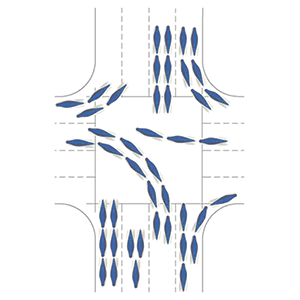
Grouping vehicles into platoons is a method of increasing the capacity of roads. An automated highway system is a proposed technology for doing this. Platoons decrease the distances between cars using electronic, and possibly mechanical, coupling. This capability would allow many cars to accelerate or brake simultaneously. Instead of waiting after a traffic light changes to green for drivers ahead to react, a synchronized platoon would move as one, allowing up to a fivefold increase in traffic throughput.
This system also allows for a closer headway between vehicles by eliminating reacting distance needed for human reaction. Platoon capability might require buying new cars, or it may be something that can be retrofitted. Drivers would probably need a special license endorsement on account of the new skills required and the added responsibility when driving in the lead. Smart cars with artificial intelligence could automatically join and leave platoons. In the automated highway system proposal, cars organize themselves into platoons of eight to twenty-five.
Posted in Technology |
Leave a Comment »
April 2, 2012


A concept vehicle or show vehicle is a car made to showcase new styling and or new technology. They are often shown at motor shows to gauge customer reaction to new and radical designs which may or may not have a chance of being produced. General Motors designer Harley Earl is generally credited with inventing the concept car, and did much to popularize it through its traveling Motorama shows of the 1950s.
Concept cars never go into production directly; in modern times all would have to undergo many changes before the design is finalized for the sake of practicality, safety and cost. A ‘production-intent’ vehicle, as opposed to a concept vehicle, serves this purpose.
read more »
Posted in Money, Technology |
Leave a Comment »
April 2, 2012

The Nissan NV200 is a light commercial vehicle first shown as a concept car at the 2007 Tokyo Motor Show. Though it is an alternative to the Nissan Vanette, it is only available as a van model. ‘NV’ stands for New generation Vehicle, or sometimes ‘New Vanette’ by fans.
It was launched in Japan in 2009. The NV200 was one of three finalists (alongside the Karsan V-1 and Ford Transit Connect) for New York City’s Taxi of Tomorrow competition. The Nissan was announced as the winner in 2011 and is expected to be awarded a 10-year contract to provide the city exclusively with some 13,000 yellow cabs, starting in 2013. A fully electric version of the Nissan NV200 may be available by 2017 for the NYC Taxi fleet.
Posted in Money, Technology |
1 Comment »
April 2, 2012

The Orange Catholic Bible (abbreviated to O. C. Bible or OCB) is a fictional book from the ‘Dune’ universe created by Frank Herbert. Created in the wake of the crusade against thinking machines known as the Butlerian Jihad, the Orange Catholic Bible is the key religious text in the Dune universe and is described thus in the glossary of the 1965 novel:
‘ORANGE CATHOLIC BIBLE: the ‘Accumulated Book,’ the religious text produced by the Commission of Ecumenical Translators. It contains elements of most ancient religions, including the Maometh Saari, Mahayana Christianity, Zensunni Catholicism, and Buddislamic traditions. Its supreme commandment is considered to be: ‘Thou shalt not disfigure the soul,’ followed by ‘Thou shalt not make a machine in the likeness of a human mind.’
read more »
Posted in Art, Language, Philosophy |
Leave a Comment »
April 2, 2012

Syncretism [sing-kri-tiz-uhm] is the combining of different (often contradictory) beliefs, often while melding practices of various schools of thought. Syncretism may involve the merger and analogizing of several originally discrete traditions, especially in the theology and mythology of religion, thus asserting an underlying unity and allowing for an inclusive approach to other faiths. Syncretism also occurs commonly in expressions of arts and culture (known as eclecticism) as well as politics (syncretic politics).
The word entered the English language in 1618; it derives from Latin ‘syncretismus,’ drawing on Greek (‘synkretismos’), meaning ‘Cretan federation.’ The Greek word occurs in Plutarch’s (1st century) essay on ‘Fraternal Love’ in his ‘Moralia.’ He cites the example of the Cretans, who compromised and reconciled their differences and came together in alliance when faced with external dangers. ‘And that is their so-called Syncretism.’
read more »
Posted in Language, Philosophy, World |
2 Comments »
April 1, 2012
Congener [kon-juh-ner] (from Latin for ‘of the same race or kind’) has several different meanings depending on the field in which it is used. Colloquially, it is used to mean a person or thing like another, in character or action. In biology, congeners are organisms within the same genus. In chemistry, congeners are related chemicals, e.g., elements in the same group of the periodic table, or derivatives thereof. In genetics, congenic organisms are those with very similar genomes, except for a small fraction. For example, recombinant congenic mice strains are produced in laboratories as a tool to study genetic disease.
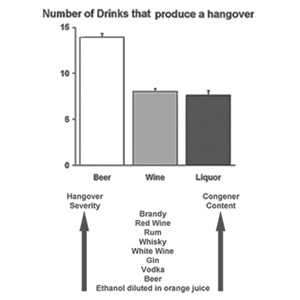
In the alcoholic beverages industry, congeners, also known as fusel oils, are substances produced during fermentation. These substances include small amounts of chemicals such as acetone, acetaldehyde, and other higher alcohols, esters, and aldehydes (e.g. propanol, glycols, ethyl acetate). Congeners are responsible for most of the taste and aroma of distilled alcoholic beverages, and contribute to the taste of non-distilled drinks. It has been suggested that these substances contribute to the symptoms of a hangover.
Posted in Drugs, Health, Science |
Leave a Comment »
April 1, 2012

A hangover is the experience of various unpleasant physiological effects following heavy consumption of alcoholic beverages. An alcohol hangover is associated with a variety of symptoms that may include dehydration, fatigue, headache, body aches, vomiting, diarrhea, flatulence, weakness, elevated body temperature and heart rate, hypersalivation, difficulty concentrating, sweating, anxiety, dysphoria, irritability, sensitivity to light and noise, erratic motor functions (including tremor), trouble sleeping, severe hunger, halitosis, and lack of depth perception. Many people will also be repulsed by the thought, taste or smell of alcohol during a hangover.
While a hangover can be experienced at any time, generally speaking it is experienced the morning after a night of heavy drinking. Hypoglycemia, dehydration, acetaldehyde intoxication, and glutamine rebound are all theorized causes of hangover symptoms. Hangover symptoms may persist for several days after alcohol was last consumed. Approximately 25-30% of drinkers may be resistant to hangover symptoms.
read more »
Posted in Drugs, Health, Science |
Leave a Comment »


 The Daily Omnivore