April 11, 2012

‘Free Culture: How Big Media Uses Technology and the Law to Lock Down Culture and Control Creativity’ is a 2004 book by law professor Lawrence Lessig that was released on the Internet under the Creative Commons Attribution/Non-commercial license.
The book documents how copyright power has expanded substantially since 1974 in five critical dimensions: duration (from 32 to 95 years), scope (from publishers to virtually everyone), reach (to every view on a computer), control (including “derivative works” defined so broadly that virtually any new content could be sued by some copyright holder as a ‘derivative work’ of something), and concentration and integration of the media industry.
read more »
Posted in Money, Politics, Technology |
Leave a Comment »
April 11, 2012

Remix culture is a term used to describe a society which allows and encourages derivative works. Remix is defined as combining or editing existing materials to produce a new product. A Remix Culture would be, by default, permissive of efforts to improve upon, change, integrate, or otherwise remix the work of copyright holders.
In his 2008 book, ‘Remix,’ Lawrence Lessig presents this as a desirable ideal and argues, among other things, that the health, progress, and wealth creation of a culture is fundamentally tied to this participatory remix process.
read more »
Posted in Money, Politics, Technology |
Leave a Comment »
April 11, 2012

ccMixter.org is a community music site that promotes remix culture and makes samples, remixes, and a cappella tracks licensed under Creative Commons available for download and re-use in creative works. Visitors are able to listen to, sample, mash-up, or interact with music in a variety of ways including the download and use of tracks and samples in their own remixes.
Most sampling or mash-up web sites on the Internet stipulate that users forgo their rights to the new song once it is created. By contrast, the material on ccMixter.org is generally licensed to be used in any arena, not just the ccMixter site or a specific contest. The ccMixter site contains over 10,000 samples from a wide range of recording artists, including high profile artists such as Beastie Boys and David Byrne.
read more »
Posted in Art, Money, Politics |
Leave a Comment »
April 11, 2012

WhoSampled is a website and database of information about sample-based music founded in London. WhoSampled compares original songs with covered songs or songs that ‘borrowed’ samples, it serves as a historical line of where songs have come from and where they’re going. Registered users can submit information about a sample, remix or cover and subject, waiting for moderator’s approval that will let the entry to be published on the site.
The visitor of the site gets a comprehensive list of who that artist has sampled and how, and how that artist him/herself has been sampled. The comparison of original song and the song that sampled, covered or remixed it, is done side by side with embedded tracks or videos. All audio and video clips shown on the site are embedded links to content hosted by third party services, such as YouTube or DailyMotion. The process and idea of the site of being a tool for research and music discovery, is similar to another project called Music Genome Project, both wanting to ‘explore the DNA of music.’
Posted in Art, Money, Politics |
Leave a Comment »
April 11, 2012


A remix is an alternative version of a recorded song, made from an original version. Sometimes this term is also used for alterations of media or recreation other than song (film, literature, beverages etc.). In remixing, a person (often a recording engineer or record producer) takes a familiar song, splits it into different parts called tracks, and changes the song’s music, instruments, layout, and or vocals to create a new version of the same song.
It is called remixing due to mixing being the putting together of all the parts of a song, and remixing being the putting together of the parts of the song differently than the original. Remixers, that is, people who remix, are musicians who use a variety of tools, primarily electronic, to create the new song versions. Remixing can be simply moving song parts around; it can also be creating new music for an old song lyric. The most popular types of remixing are production remixing, where new instruments are used with the old song vocal, and mashups, in which two old songs are mixed together.
read more »
Posted in Art, Money, Politics |
1 Comment »
April 10, 2012

Dr. Horrible’s Sing-Along Blog is a 2008 musical tragicomedy miniseries in three acts, produced exclusively for Internet distribution. Filmed and set in Los Angeles, the show tells the story of Dr. Horrible (played by Neil Patrick Harris), an aspiring supervillain; Captain Hammer (Nathan Fillion), his nemesis; and Penny (Felicia Day), their shared love interest.
The movie was written by writer/director Joss Whedon, his brothers Zack Whedon (a television writer) and Jed Whedon (a composer), and Jed’s wife, actress Maurissa Tancharoen. The team wrote the musical during the 2007–2008 Writers Guild of America strike. The idea was to create something small and inexpensive, yet professionally done, in a way that would circumvent the issues that were being protested during the strike.
Posted in Art, Humor, Money |
1 Comment »
April 10, 2012

The Second City is an improvisational comedy enterprise which originated in Chicago’s Old Town neighborhood. The Second City Theatre opened in late 1959 and has since expanded its presence to several other cities, including Toronto and Los Angeles.
The Second City has produced television programs in both the United States and Canada including ‘SCTV,’ ‘Second City Presents’, and ‘Next Comedy Legend,’ as well as being heavily involved in the creation of the satirical 1969 science fiction film ‘The Monitors.’ Since its debut, the Second City has consistently been a starting point for comedians, award winning actors, directors, and others in show business.
read more »
Posted in Art, Games, Humor |
Leave a Comment »
April 10, 2012

The Compass Players (or Compass Theater) was a cabaret revue show started by alumni, dropouts and hangers-on from the University of Chicago from 1955-1958 in Chicago and St. Louis. Several of the members went on to form The Second City Theater in 1959. Founded by David Shepherd, the original idea was to produce a new play derived through improvisation from outlines (in the tradition of the Italian commedia dell’arte) or scenarios written by members of the ensemble.
Shepherd turned to director Paul Sills to head this venture based on his experience working with Sills on an earlier Chicago theater effort. He noticed that Sills in rehearsal employed theater games, structures designed to create spontaneous theatrical play between actors that had been developed and named by Sills’ mother, Viola Spolin (who would later author the ‘bible’ of theater games, ‘Improvisation for the Theatre’).
read more »
Posted in Art, Games, Humor |
Leave a Comment »
April 10, 2012

Viola Spolin (1906 — 1994) was an important innovator of the American theater in the 20th century. She created directorial techniques to help actors to be focused in the present moment and to find choices improvisationally, as if in real life. These acting exercises she later called ‘Theater Games’ and formed the first body of work that enabled other directors and actors to create improvisational theater.
Her book, ‘Improvisation for the Theater,’ which published these techniques, includes her philosophy, as well as her teaching and coaching methods and is considered the ‘bible of improvisational theater.’ Spolin’s contributions were seminal to the improvisational theater movement in the U.S. She is considered to be the mother of Improvisational theater. Her work has influenced American theater, television and film by providing new tools and techniques that are now used by actors, directors and writers.
read more »
Posted in Art, Games, Humor |
Leave a Comment »
April 10, 2012


The Groundlings are an improvisational comedy troupe based in Los Angeles formed by Gary Austin in 1974. It uses an improv format influenced by Viola Spolin to produce sketches and improvised scenes. Its name is taken from ‘Hamlet’: ‘…to split the ears of the groundlings, who for the most part are capable of nothing but inexplicable dumbshows and noise.’ The Groundlings School holds new sessions every six weeks with over 300 students per session, with over 2,000 students per year going through the program. The competitive program consists of 4 levels (Basic, Intermediate, Writing Lab and Advanced).
Participants must be successfully advanced from each level by the instructor. After completing the Advanced level, one may be voted into the Sunday Company, which performs every Sunday at 7:30pm. Members of the Main Company are selected from members of the Sunday Company. The Main Company (now capped at no more than 30 members at any time) collectively acts as the organization’s artistic director, democratically making business and creative decisions as a group. Notable alumni include: Adam Carolla, Abby Elliott, Jimmy Fallon, Will Ferrell, Will Forte, Ana Gasteyer, Kathy Griffin, Rachael Harris, Phil Hartman, Cheryl Hines, Chris Kattan, Lisa Kudrow, Jon Lovitz, Pat Morita, Conan O’Brien, Cheri Oteri, Paul Reubens, Maya Rudolph, Dax Shepard, and Kristen Wiig.
Posted in Art, Humor, Language |
Leave a Comment »
April 10, 2012

Q is a fictional character in the James Bond novels and films. Q (standing for Quartermaster), like M, is a job title rather than a name. He is the head of Q Branch (or later Q Division), the fictional research and development division of the British Secret Service.
The character actually appears only fleetingly in Ian Fleming’s novels, but comes into his own in the successful Bond film series; he is also mentioned in the continuation novels of John Gardner and Raymond Benson. Q has appeared in 20 of 23 Eon Bond films; all except ‘Live and Let Die,’ ‘Casino Royale,’ and ‘Quantum of Solace.’ The character was also featured in the non-official Bond films ‘Casino Royale’ (1967) and ‘Never Say Never Again.’
read more »
Posted in Language, Technology, War |
Leave a Comment »
April 10, 2012
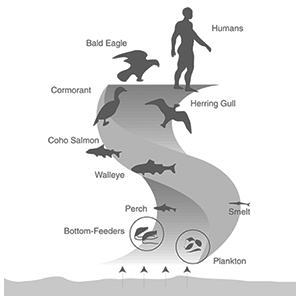
Bioaccumulation refers to the accumulation of substances, such as pesticides, or other organic chemicals in an organism. Bioaccumulation occurs when an organism absorbs a toxic substance at a rate greater than that at which the substance is lost. Thus, the longer the biological half-life of the substance the greater the risk of chronic poisoning, even if environmental levels of the toxin are not very high.
Bioconcentration is a related but more specific term, referring to uptake and accumulation of a substance from water alone. By contrast, bioaccumulation refers to uptake from all sources combined (e.g. water, food, air, etc.).
read more »
Posted in Food, Health, Politics |
Leave a Comment »


 The Daily Omnivore