May 16, 2012

Vernors Ginger Soda is America’s oldest surviving soft drink. It was created in 1866 by James Vernor, a Detroit pharmacist. According to company legend, prior to the start of the American Civil War, while a clerk at the Higby & Sterns drugstore in Detroit, James Vernor experimented with flavors in an attempt to duplicate a popular ginger ale imported from Ireland.
When Vernor was called off to serve in the war, he stored the syrup base of 19 ingredients, including ginger, vanilla, and other natural flavorings, in an oak cask. Vernor joined the Michigan Cavalry in 1862 as a hospital steward. After returning from battle four years later, he opened the keg and found the drink inside had been changed by the aging process in the wood. It was like nothing else he had ever tasted, and he purportedly declared it ‘Deliciously different,’ which remains the drink’s motto to this day.
read more »
Posted in Food |
Leave a Comment »
May 16, 2012
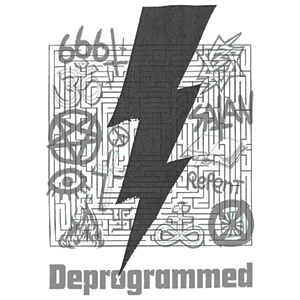
The anti-cult movement (ACM) refers to groups and individuals who oppose cults and new religious movements (NRM). Sociologists David G. Bromley and Anson Shupe initially defined the ACM in 1981 as a collection of groups embracing brainwashing-theory, but later observed a significant shift in ideology towards a ‘medicalization’ of the memberships of new religious movements.
This countermovement has reportedly recruited from family members of ‘cultists’; former cult members, (or apostates); church groups; and associations of health professionals. A significant minority opinion suggests that analysis should treat the secular anti-cult movement separately from the religiously motivated (mainly Christian) groups. The anti-cult movement might be divided into four classes: secular counter-cult groups; Christian evangelical counter-cult groups; groups formed to counter a specific cult; and organizations that offer some form of exit counseling.
read more »
Posted in Philosophy, Politics |
Leave a Comment »
May 15, 2012

One of B.F. Skinner’s experiments examined the formation of superstition in one of his favorite experimental animals, the pigeon. Skinner placed a series of hungry pigeons in a cage attached to an automatic mechanism that delivered food to the pigeon ‘at regular intervals with no reference whatsoever to the bird’s behavior.’ He discovered that the pigeons associated the delivery of the food with whatever chance actions they had been performing as it was delivered, and that they subsequently continued to perform these same actions.
‘One bird was conditioned to turn counter-clockwise about the cage, making two or three turns between reinforcements. Another repeatedly thrust its head into one of the upper corners of the cage. A third developed a ‘tossing’ response, as if placing its head beneath an invisible bar and lifting it repeatedly. Two birds developed a pendulum motion of the head and body, in which the head was extended forward and swung from right to left with a sharp movement followed by a somewhat slower return.’
read more »
Posted in Philosophy, Science |
Leave a Comment »
May 15, 2012

Acid Western is a sub-genre of the Western film that emerged in the 1960s and 1970s that combines the metaphorical ambitions of top-shelf Westerns, like ‘Shane’ and ‘The Searchers,’ with the excesses of the Spaghetti Westerns and the outlook of the counter-culture. Acid Westerns subvert many of the conventions of earlier Westerns to ‘conjure up a crazed version of autodestructive white America at its most solipsistic, hankering after its own lost origins.’
The term ‘Acid Western’ was coined in 1996 by Jonathan Rosenbaum in a review of Jim Jarmusch’s film, ‘Dead Man.’ Rosenbaum expanded upon the idea in a subsequent interview with Jarmusch for ‘Cineaste’ and later in the book ‘Dead Man’ from BFI Modern Classics. In the book, Rosenbaum illuminates several aspects of this re-revisionist Western: from Neil Young’s haunting score to the role of tobacco, to Johnny Depp’s performance, to the film’s place in the acid-Western genre.
read more »
Posted in Art, Drugs |
Leave a Comment »
May 15, 2012

Psychomagic is a therapeutic practice used by Chilean-French filmmaker and spiritual guru Alejandro Jodorowsky. The technique is alleged to be useful in psychotherapy. It combines art, Eastern philosophies (particularly Zen Buddhism), mysticism and modern psychotherapy to allegedly heal patients with emotional problems.
The principle relies on the belief that the unconscious mind takes a symbolic act as a fact. So a symbolic act could accordingly help solve some types of non rational conflicts. These acts are prescribed by the therapist after having studied the patient’s personality and family tree (Psychogenealogy).
Posted in Health, Philosophy |
Leave a Comment »
May 15, 2012
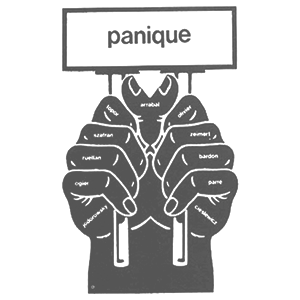
Panic Movement (‘Mouvement panique’) was a collective formed by Fernando Arrabal, Alejandro Jodorowsky, and Roland Topor in Paris in 1962. Inspired by and named after Pan (Greek god of the wild), and influenced by Luis Buñuel and Antonin Artaud’s ‘Theatre of Cruelty,’ the group concentrated on chaotic and surreal performance art, as a response to surrealism becoming petite bourgeoisie.
The movement’s violent theatrical events were designed to be shocking, and to release destructive energies in search of peace and beauty. One four-hour performance known as ‘Sacramental Melodrama’ was staged in 1965 at the Paris Festival of Free Expression. The ‘happening’ starred Jodorowsky dressed in motorcyclist leather and featured him slitting the throats of two geese, taping two snakes to his chest and having himself stripped and whipped. Other scenes included ‘naked women covered in honey, a crucified chicken, the staged murder of a rabbi, a giant vagina, the throwing of live turtles into the audience, and canned apricots.’
Posted in Art, Philosophy |
Leave a Comment »
May 15, 2012
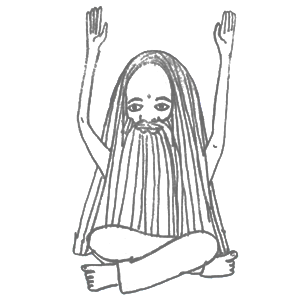
Alejandro [ali-hahn-dro] Jodorowsky [ho-dor-row-ski] (b. 1929) is a Chilean-French filmmaker and spiritual guru. Best known for his avant-garde films, he has been ‘venerated by cult cinema enthusiasts’ for his work which ‘is filled with violently surreal images and a hybrid blend of mysticism and religious provocation.’
Dropping out of college, he became involved in theater and in particular mime, working as a clown before founding his own theater troupe in 1947. After moving to Paris in the early 1950s he turned to cinema, directing the short film ‘Les têtes interverties’ in 1957. From 1960 he divided his time between Paris and Mexico City, in the former becoming a founding member of the anarchistic avant-garde Panic Movement of performance artists.
read more »
Posted in Art, Philosophy |
Leave a Comment »
May 14, 2012
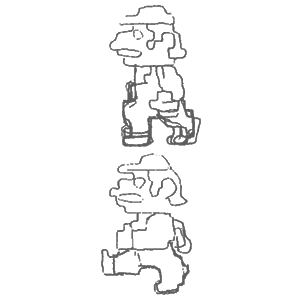
Shigeru Miyamoto [she-gay-roo mee-yah-moe-toe] (b. 1952) is a Japanese game designer and creator of ‘Donkey Kong,’ ‘Mario,’ and ‘The Legend of Zelda’ series for Nintendo. He is one of the most famous game designers in the world and is often called the father of modern video gaming.
His games give players many ways to play and explore, which was unique at the time. Miyamoto started working with Nintendo in 1977 as an artist when it was still a toy and playing-card company. In 1980, he designed ‘Donkey Kong,’ which was a big success. Miyamoto was born and raised in Kyoto Prefecture; the natural surroundings of Kyoto inspired much of his later work. His other creations for Nintendo include ‘Star Fox,’ ‘F-Zero,’ and ‘Pikmin.’
read more »
Posted in Games, Money, World |
Leave a Comment »
May 14, 2012
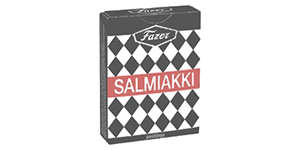

Liquorice [lik-uh-rish] or licorice is the root of Glycyrrhiza glabra (a legume) from which a somewhat sweet flavor can be extracted. It is native to southern Europe and parts of Asia, and is not related to anise, star anise, or fennel, which are the sources of similar-tasting compounds. The word ‘liquorice’ is derived from the Greek ‘glukurrhiza’ (‘sweet root’).
The flavor of liquorice comes mainly from a sweet-tasting compound called anethole, an aromatic, unsaturated ether compound also found in anise, fennel, and several other herbs. Much of the sweetness in liquorice comes from glycyrrhizin, a compound 30 to 50 times sweeter than sucrose (table sugar).
read more »
Posted in Drugs, Food, Health |
Leave a Comment »
May 14, 2012

Thief in law, a ‘thief who operates within the law’ or ‘a criminal who obeys The Thieves’ Code”) is a criminal who is respected, has authority and a high ranking status within the criminal underworld in the old Soviet Union, Russia and the republics that formed the former Soviet Union. Thieves in law are the elite of the Russian world of organized crime.
According to various Russian news sources there exist hundreds of organized units which retain independence in their actions. Estimates concerning the number of ‘Vory’ throughout the world range from several hundred to over 10,000. Many of thieves in law are no longer exclusively ethnic Russians but are drawn from other nationalities, including those living in other former Soviet states or former Warsaw pact nations such as Poland, the Czech Republic, and Bulgaria.
read more »
Posted in Death, Politics, World |
Leave a Comment »
May 14, 2012

Tattoos are commonly used among criminals to show gang membership and record the wearer’s personal history—such as his or her skills, specialties, accomplishments, and convictions. They are also used as a means of personal expression. Certain designs have developed recognized coded meanings. The code systems can be quite complex and because of the nature of what they encode, the tattoos are not widely recognized.
Tattooing is forbidden in most prisons. It is therefore done in secret, with makeshift equipment. For example, tattoos done in a Russian prison often have a distinct bluish color (due to being made with ink from a ballpoint pen) and usually appear somewhat blurred because of the lack of instruments to draw fine lines. The ink is often created from burning the heel of a shoe and mixing the soot with urine (for sterilization), and injected into the skin utilizing a sharpened guitar string attached to an electric shaver.
read more »
Posted in Art, Politics, World |
2 Comments »
May 14, 2012

Prison tattoos often signal gang membership, form a code, or have hidden meanings. However, due to the lack of proper equipment and sterile environments in prison, the practice poses health risks.
Tattooing in prison is illegal in the U.S., but inmates find ways to create their own tattooing devices out of their belongings. Improvised equipment is assembled from mechanical pencils, magnets, radio transistors, staples, paper clips, guitar strings, and other common items.
read more »
Posted in Art, Health, Politics |
6 Comments »


 The Daily Omnivore