May 10, 2012

Jumping the shark is an idiom created by American radio personality Jon Hein to describe the moment in the evolution of a television show when it begins a decline in quality that is beyond recovery. The phrase is also used to refer to a particular scene, episode or aspect of a show in which the writers use some type of ‘gimmick’ in a desperate attempt to keep viewers’ interest.
The phrase refers to a scene in the fifth season premiere of ‘Happy Days in 1977: the gang visits Los Angeles, where a waterskiing Fonzie, wearing swim trunks and his trademark leather jacket, jumps over a confined shark, in response to a challenge. For a show that in its early seasons depicted universally relatable experiences against a backdrop of 1950s nostalgia, this marked an audacious, cartoonish turn towards attention-seeking gimmickry and continued the faddish lionization of an increasingly superhuman Fonzie.
Posted in Humor, Language |
Leave a Comment »
May 10, 2012

A canary trap is a method for exposing an information leak, which involves giving different versions of a sensitive document to each of several suspects and seeing which version gets leaked. The term was coined by Tom Clancy in his novel ‘Patriot Games,’ though Clancy did not invent the technique. The actual method (usually referred to as a ‘Barium meal test’ in espionage circles) has been used by intelligence agencies for many years. The fictional character Jack Ryan describes the technique he devised for identifying the sources of leaked classified documents:
‘Each summary paragraph has six different versions, and the mixture of those paragraphs is unique to each numbered copy of the paper. There are over a thousand possible permutations, but only ninety-six numbered copies of the actual document. The reason the summary paragraphs are so lurid is to entice a reporter to quote them verbatim in the public media. If he quotes something from two or three of those paragraphs, we know which copy he saw and, therefore, who leaked it.’ A refinement of this technique uses a thesaurus program to shuffle through synonyms, thus making every copy of the document unique.
Posted in Politics, War, World |
Leave a Comment »
May 9, 2012

MC Skat Kat is an animated cat who appeared with Paula Abdul in the video for her song ‘Opposites Attract’ in 1989. The idea of Skat Kat came from the Gene Kelly movie ‘Anchors Aweigh,’ in which Kelly’s character dances with Jerry, the mouse from the ‘Tom and Jerry’ cartoon series. According to Virgin Records’ media information, Skat Kat is a ‘street philosopher with an alley Kat point of view.’ He likes to dance, is interested in the ladies, and ‘remains on the smooth tip with an old school rap influence which adds the street to his new school hip hop.’
The character was animated by members of the Disney animation team, working outside the studio between major projects, under the direction of Chris Bailey. He was created by Michael Patterson and performed by The Wild Pair duo of Bruce DeShazer and Marv Gunn. He was also voiced by Romany Malco for the first rap of the song and by Derrick ‘Delite’ Stevens for the second rap, the latter of whom would provide vocals for the character in the MC Skat Kat solo album. The character released an album entitled ‘The Adventures of MC Skat Kat and the Stray Mob’ in 1991, but it flopped instantly.
Posted in Art, Humor |
Leave a Comment »
May 9, 2012

The concept of geoengineering (or climate intervention) refers to the deliberate large-scale engineering and manipulation of the planetary environment to combat or counteract anthropogenic changes in atmospheric chemistry. The Intergovernmental Panel on Climate Change concluded in 2007 that geoengineering options, such as ocean fertilization to remove CO2 from the atmosphere, remained largely unproven. It was judged that reliable cost estimates for geoengineering had not yet been published.
Geoengineering accompanies Mitigation and Adaptation to form a three-stranded ‘MAG’ approach to tackling global warming, notably advocated by the Institution of Mechanical Engineers. Some geoengineering techniques are based on carbon dioxide removal (CDR), including direct methods (e.g. carbon dioxide air capture) and indirect methods (e.g. ocean iron fertilization). These techniques can be regarded as mitigation of global warming.
read more »
Posted in Science, Technology, World |
Leave a Comment »
May 9, 2012

‘The Better Angels of Our Nature: Why Violence Has Declined’ is a 2011 book by American cognitive scientist Steven Pinker arguing that violence in the world, especially the western part, has declined both in the long run and in the short. He also suggests explanations of why this has happened. The phrase ‘the better angels of our nature’ stems from the last words of Lincoln’s first inaugural address. Due to the highly interdisciplinary nature of the book Pinker uses the works of political scientist John Mueller and sociologist Norbert Elias, among others.
The extent of Elias’ influence on Pinker can be adduced from the title of Chapter 3: ‘The Civilizing Process,’ which is taken from the title of Elias’ seminal sociology text. Pinker also draws upon the work of international relations scholar Joshua Goldstein, and both have co-written a New York Times op-ed article titled ‘War Really Is Going Out of Style’ that summarizes many of their shared views. Both authors also appeared together at Harvard’s Institute of Politics to answer questions from academics and students concerning their similar thesis.’
Posted in Politics, War, World |
Leave a Comment »
May 9, 2012

American Gods is a 2001 novel by Neil Gaiman. The novel is a blend of Americana, fantasy, and various strands of ancient and modern mythology, all centering on a mysterious and taciturn protagonist, Shadow. Several of the themes touched upon in the book were previously glimpsed in Gaiman’s ‘The Sandman’ graphic novels. The central premise of the novel is that gods and mythological creatures exist because people believe in them. Immigrants to the United States brought with them dwarves, elves, leprechauns, and other spirits and gods.
However, the power of these mythological beings has diminished as people’s beliefs wane. New gods have arisen, reflecting America’s obsessions with media, celebrity, technology, and drugs, among others. In addition to the numerous figures from real-world myths, a few characters from ‘The Sandman’ and its spinoffs make brief cameos in the book. Other mythological characters featured in the novel are not divine, but are legendary or folk heroes, such as Johnny Appleseed. Shadow himself is implied to be Baldr (the Norse god of sun and light, son of Odin)
read more »
Posted in Art, Language, Philosophy |
1 Comment »
May 8, 2012

Psychosomatic medicine is an interdisciplinary medical field studying the relationships of social, psychological, and behavioral factors on bodily processes and quality of life in humans and animals. The influence that the mind has over physical processes — including the manifestations of disabilities that are based on intellectual infirmities, rather than actual injuries or physical limitations — is manifested in treatment by phrases such as the power of suggestion, the use of ‘positive thinking,’ and concepts like ‘mind over matter.’
The academic forebear of the modern field of behavioral medicine and a part of the practice of consultation-liaison psychiatry, psychosomatic medicine integrates interdisciplinary evaluation and management involving diverse specialties including psychiatry, psychology, neurology, surgery, allergy, dermatology, and psychoneuroimmunology. Clinical situations where mental processes act as a major factor affecting medical outcomes are areas where psychosomatic medicine has competence.
read more »
Posted in Health, Philosophy, Science |
Leave a Comment »
May 8, 2012

A stress ball is a malleable toy, usually not more than 7 cm in diameter. It is squeezed in the hand and manipulated by the fingers, ostensibly to either help relieve stress and muscle tension or to exercise the muscles of the hand. There are many types of stress balls. Many are a closed-cell polyurethane foam rubber. This type of stress ball is made by injecting the liquid components of the foam into a mold. The resulting chemical reaction creates carbon dioxide bubbles as a byproduct, which in turn creates the foam.
Stress balls, especially those used in physical therapy, can also contain gel of different densities inside a rubber or cloth skin. Another type uses a thin rubber membrane surrounding a fine powder. The latter type can be made at home by filling a balloon with baking soda. Some balls similar to a footbag are marketed and used as stress balls.
Posted in Games, Health |
1 Comment »
May 8, 2012

The Khan Academy is a non-profit educational organization, created in 2006 by American educator Salman Khan (who has three degrees from MIT (a BS in mathematics, a BS in electrical engineering and computer science, and an MS in electrical engineering and computer science), and an MBA from Harvard Business School.
With the stated mission of ‘providing a high quality education to anyone, anywhere,’ the website supplies a free online collection of more than 3,100 micro lectures via video tutorials stored on YouTube teaching mathematics, history, healthcare and medicine, finance, physics, chemistry, biology, astronomy, economics, cosmology, organic chemistry, American civics, art history, microeconomics, and computer science.
read more »
Posted in Education, Language, Money, Technology |
1 Comment »
May 8, 2012

Passion Pit is an American electropop band from Cambridge, Massachusetts, formed in 2007. The band consists of Michael Angelakos (lead vocals, keyboards), Ian Hultquist (keyboards, guitar), Ayad Al Adhamy (synthesizer, samples), Jeff Apruzzese (bass, synth bass), and Nate Donmoyer (drums).
All of the band members, with the exception of Angelakos, attended Berklee College of Music in Boston. The band culled their name from the ‘Slanguage Dictionary,’ a glossary of ‘Variety’ magazine’s frequently-used slang, which was provided by the Hollywood-insider publication to help not-so-savvy readers decipher its content. The magazine used the term to refer to drive-in theaters, because of their privacy and romantic allure for teenagers.
read more »
Posted in Art |
Leave a Comment »
May 8, 2012

The exorbitant privilege is a term coined in the 1960s by Valéry Giscard d’Estaing, then the French Minister of Finance. This quote is generally misattributed to Charles de Gaulle, who is said to have had somewhat similar views. The term refers to the benefit the United States had in its Dollar being the international reserve currency: the US would not face a balance of payments crisis, because it purchased imports in its own currency.
‘Exorbitant privilege’ as a concept cannot refer to currencies that have a regional reserve currency role, only global reserve currencies. Recent McKinsey Global Institute research questions whether the benefit that the US enjoys is really that exorbitant, highlighting the countervailing loss of trade competitiveness from the high dollar (that typically results from its reserve status, all else equal). The phrase became the title of a 2010 book by economist Barry Eichengreen, examining the future prospects for the US Dollar’s dominance in international trade.
Posted in Money, Politics, World |
Leave a Comment »
May 8, 2012
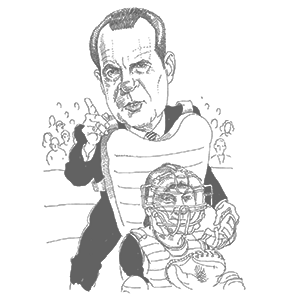
The Nixon Shock was a series of economic measures taken by U.S. President Richard Nixon in 1971 including unilaterally cancelling the direct convertibility of the United States dollar to gold that essentially ended the existing Bretton Woods system of international financial exchange.
The return to a gold standard is supported by followers of the Austrian School, largely because they object to the role of the government in issuing fiat currency through central banks. A number of gold standard advocates also call for a mandated end to fractional reserve banking.
read more »
Posted in Money, Politics, World |
1 Comment »


 The Daily Omnivore