July 25, 2012
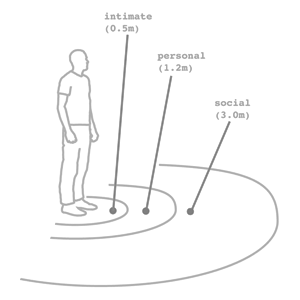
Proxemics [prok-see-miks] is a subcategory of the study of nonverbal communication along with haptics (touch), kinesics (body movement), vocalics (paralanguage), and chronemics (structure of time). Proxemics can be defined as ‘the interrelated observations and theories of man’s use of space as a specialized elaboration of culture.’
Edward T. Hall, the cultural anthropologist who coined the term in 1963, emphasized the impact of proxemic behavior (the use of space) on interpersonal communication. Hall believed that the value in studying proxemics comes from its applicability in evaluating not only the way man interacts with others in his daily life, but also ‘the organization of space in his houses and buildings, and ultimately the layout of his towns.’
read more »
Posted in Language, Science, World |
Leave a Comment »
July 25, 2012


Ambient awareness is a term used by social scientists to describe a new form of peripheral social awareness. This awareness is propagated from relatively constant contact with one’s friends and colleagues via social networking platforms on the Internet. Marketing professor Andreas Kaplan defines ambient awareness as ‘awareness created through regular and constant reception, and/or exchange of information fragments through social media.’
The term essentially defines the sort of omnipresent knowledge one experiences by being a regular user of media outlets that allow a constant connection with one’s social circle. According to Clive Thompson of ‘The New York Times,’ ambient awareness is ‘very much like being physically near someone and picking up on mood through the little things; body language, sighs, stray comments…’ Therefore, in effect two friends who regularly follow one another’s digital information can already be aware of each other’s lives without actually being physically present to have a conversation.
read more »
Posted in Language, Money, Technology |
Leave a Comment »
July 24, 2012

Projection mapping is a technology used to turn irregularly shaped objects into a display surface for projection. After the object is chosen or created, a virtual replica of the entire physical setup is created. A virtual model of the projection surface is created, and placed within a virtual environment. Coordinates need to be defined for where the object is placed in relation to the projector. Finally, the xyz orientation, position, and lens specification of the projector are adding to the virtual scene.
Video mapping first gained notoriety through guerilla advertising campaigns and video jockeys for electronic musicians. These advertising campaigns commonly used mapping techniques to project interactive scenes onto the sides of buildings. Common techniques for these performances included both 3-D mapping techniques and 3D projection to create the illusion of depth.
Posted in Technology |
Leave a Comment »
July 24, 2012

Late modernity (or liquid modernity) is a term that has been used to describe the condition or state of some highly developed present day societies. It regards their state as a continuation or development of modernity, rather than as a distinct new state, post-modernity.
‘Late modernity is defined by complex, global capitalist economies and a shift from state support and welfare to the privatization of services…a process fuelled by the information revolution, the capacity to move capital and information around the world instantaneously.’ Social theorists, ‘criticize adherents of postmodernity that presume the ending of the modernization process and the dawning of a new era. Contemporary modernity, they argue, rather involves a continuation or even a radicalization of the modernization process.’
read more »
Posted in Money, Politics, World |
Leave a Comment »
July 24, 2012


Pronoia [proh-noi-uh] is a neologism that is defined as the opposite state of mind as paranoia: having the sense that there is a conspiracy that exists to help the person. It is also used to describe a philosophy that the world is set up to secretly benefit people. The writer and Electronic Frontier Foundation co-founder John Perry Barlow defined pronoia as ‘the suspicion the Universe is a conspiracy on your behalf.’ The academic journal ‘Social Problems’ published an article entitled ‘Pronoia’ by Fred H. Goldner in 1982.
According to Goldner: ‘Pronoia is the positive counterpart of paranoia. It is the delusion that others think well of one. Actions and the products of one’s efforts are thought to be well received and praised by others. Mere acquaintances are thought to be close friends; politeness and the exchange of pleasantries are taken as expressions of deep attachment and the promise of future support. Pronoia appears rooted in the social complexity and cultural ambiguity of our lives: we have become increasingly dependent on the opinions of others based on uncertain criteria.’
read more »
Posted in Health, Humor, Language |
1 Comment »
July 24, 2012

Duff Beer is a brand of beer that originally started as a fictional beverage on the animated series ‘The Simpsons,’ since then it has become a real brand of beer in a number of countries without permission or consent from it’s original creator, Matt Groening, and has resulted in legal battles with varying results. Groening has stated that he will not license the Duff trademark to brew an actual beer, over concern that it would encourage children to drink.
It is Homer Simpson’s beer of choice and a parody of stereotypical commercial beer: very cheaply priced, poor-quality, and advertised everywhere. The name was inspired by one-syllable beer names in the US (such as ‘Bud’). In an excerpt from his autobiography, former Guns N’ Roses bassist Duff McKagan claimed that the beer was named after him as the writers were fans of the band and he was known for his extreme alcohol consumption.
read more »
Posted in Drugs, Food, Humor |
Leave a Comment »
July 24, 2012

A prepared piano is a piano that has had its sound altered by placing objects (preparations) between or on the strings or on the hammers or dampers. The idea of altering an instrument’s timbre through the use of external objects has been applied to instruments other than the piano, including the guitar and harp. Richard Bunger wrote a book ‘The Well Prepared Piano’ in which he explains how John Cage prepared his pianos and even which pianos are suitable, because of the deviation of string lengths within different brands.
Bunger also clarifies why the preparations were done in such ways; in other words, which adaptation creates which sounds (harmonics obtained, timbrel effects, etc.). The timbre of the instrument changes dramatically when preparations are introduced. Much of the technique is related to the harmonic positions of the strings. For instance a preparation on 1/2 of the string length causes a different sound than on 1/3. The preparations don’t cause a random sound, as is often assumed.
read more »
Posted in Art, Technology |
Leave a Comment »
July 23, 2012
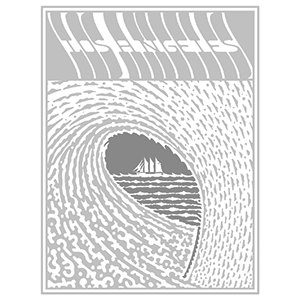
Inherent Vice is a novel by Thomas Pynchon, originally published in 2009. The term ‘inherent vice’ as a legal phrase refers to a ‘hidden defect (or the very nature) of a good or property which of itself is the cause of (or contributes to) its deterioration, damage, or wastage. Such characteristics or defects make the item an unacceptable risk to a carrier or insurer. If the characteristic or defect is not visible, and if the carrier or the insurer has not been warned of it, neither of them may be liable for any claim arising solely out of the inherent vice.’ The phrase appears often in William Gaddis’ ‘The Recognitions,’ a novel that influenced American post-modern literature and Pynchon. Gaddis’ novel uses the term to refer to defects in works of art.
In a generally favorable review, Michiko Kakutani of ‘The New York Times’ called it ‘Pynchon Lite,’ describing it as ‘a simple shaggy-dog detective story that pits likable dopers against the Los Angeles Police Department and its ‘countersubversive’ agents, a novel in which paranoia is less a political or metaphysical state than a byproduct of smoking too much weed.’
Posted in Art, Humor, Language |
2 Comments »
July 23, 2012

‘The Recognitions,’ published in 1955, is American author William Gaddis’s first novel.
The novel was poorly received initially, but Gaddis’s reputation grew, and the novel received belated fame as a masterpiece of American literature.
read more »
Posted in Art, Language |
Leave a Comment »
July 23, 2012
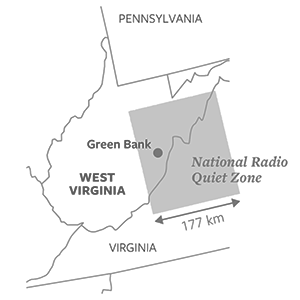
Idiopathic environmental intolerance attributed to electromagnetic fields (IEI-EMF) is a set of claims of adverse medical symptoms purportedly caused by exposure to electromagnetic fields. Other terms for IEI-EMF include electromagnetic hypersensitivity (EHS), electrohypersensitivity, electro-sensitivity, and electrical sensitivity (ES).
Although the thermal effects of electromagnetic fields on the body are established, self-described sufferers of electromagnetic hypersensitivity report responding to non-ionizing electromagnetic fields (or electromagnetic radiation) at intensities well below the limits permitted by international radiation safety standards. The majority of provocation trials to date have found that self-described sufferers of electromagnetic hypersensitivity are unable to distinguish between exposure to real and fake electromagnetic fields, and it is not recognized as a medical condition by the medical or scientific communities.
read more »
Posted in Health, Technology |
Leave a Comment »
July 23, 2012

The murders perpetrated by members of Charles Manson’s ‘Family’ were inspired in part by Manson’s prediction of Helter Skelter, an apocalyptic war he believed would arise from tension over racial relations between blacks and whites. This ‘chimerical vision’—as it was termed by the court that heard Manson’s appeal from his conviction for the Tate/LaBianca killings—involved reference to music of The Beatles (particularly songs from ‘The White Album’ of 1968) and to the New Testament’s Book of Revelation.
In its final form, which was reached by 1969, the scenario had Manson as not only the war’s ultimate beneficiary but its musical cause. He and the Family would create an album with songs whose messages concerning the war would be as subtle as those he had heard in songs of The Beatles. More than merely foretell the conflict, this would trigger it; for, in instructing ‘the young love,’ America’s white youth, to join the Family, it would draw the young, white female hippies out of San Francisco’s Haight-Ashbury.
read more »
Posted in Death, Philosophy, Politics |
1 Comment »
July 23, 2012

Rodney Greenblat (b. 1960) is an American graphic artist known best in the United States for the visual style of the computer games ‘PaRappa the Rapper’ and ‘UmJammer Lammy,’ and in Japan for his comic ‘Thunder Bunny.’
He was also the character designer for the ‘PaRappa Rappa’ anime that was released in Japan. He also designed They Might Be Giants’ self-titled debut album in 1986. He is currently an abstract painter in New York.
Posted in Art, Games, World |
Leave a Comment »


 The Daily Omnivore