July 23, 2012


Rhythm game refers to a genre of music-themed action video games. Games in the genre typically focus on dance or the simulated performance of musical instruments, and require players to press buttons in a sequence dictated on the screen. Doing so causes the game’s protagonist or avatar to dance or to play their instrument correctly, which increases the player’s score.
Many rhythm games include multiplayer modes in which players compete for the highest score or cooperate as a simulated musical ensemble. While conventional control pads may be used as input devices, rhythm games often feature novel game controllers that emulate musical instruments. Certain dance-based games require the player to physically dance on a mat, with pressure-sensitive pads acting as the input device.
read more »
Posted in Games, Money, Technology |
Leave a Comment »
July 23, 2012

PaRappa the Rapper is a rhythm video game (e.g. ‘Dance Dance Revolution’ and ‘Guitar Hero’) for the Sony PlayStation created by Masaya Matsuura (the former leader of the Japanese ‘Hyper Pop Unit’ PSY S) and his NanaOn-Sha company.
While the gameplay is not challenging for experienced gamers, the game is remembered for its unique graphic design, its quirky soundtrack and its bizarre plot. Despite being made in Japan, all of the game’s songs and dialogue are spoken in English in all versions. The game is named after its protagonist, Parappa, a 2D rapping dog with the motto, ‘I gotta believe!’ His name comes from the Japanese term for ‘paper thin.’
read more »
Posted in Games, Humor, Technology |
Leave a Comment »
July 23, 2012

Gitaroo Man is a 2001 rhythm video game developed by iNiS and published by Koei for PlayStation 2. The game features visual design by pop artist 326 (Mitsuru Nakamura) and an original soundtrack by Japanese band COIL. The player character is U-1, a young boy who finds out he is the last legendary hero of Planet Gitaroo, and the possessor of the Last Gitaroo, a legendary guitar.
Despite a number of positive reviews, the North American and European versions of ‘Gitaroo Man’ were produced in very low quantities by Koei and, as a result, have become somewhat rare; it is regarded as a cult video game. Around 2005 in North America, copies began popping up in GameStop game stores. This was due to a reprint by GameQuestDirect, similar to their previous reprints of PlayStation RPGs ‘Persona 2’ and ‘Rhapsody: A Musical Adventure,’ both of which were previously very rare.
Posted in Art, Games, Technology |
Leave a Comment »
July 19, 2012

Theobromine poisoning or chocolate poisoning is an adverse reaction to the alkaloid theobromine, found in chocolate, tea, cola beverages, açaí berries, and some other foods. Cacao beans contain about 1.2% theobromine by weight, while processed chocolate, in general, has smaller amounts.
The amount found in highly refined chocolate candies (~2 g/kg) is much lower than that of dark chocolate (~10 g/kg) or unsweetened baker’s chocolate (> 14 g/kg ). In general, the amount of theobromine found in chocolate is small enough such that chocolate can be safely consumed by humans. However, occasional serious side effects may result from the consumption of large quantities, especially in the elderly. In extreme cases, emergency room treatment may be required.
read more »
Posted in Death, Food, Health |
1 Comment »
July 19, 2012

US energy independence relates to the goal of reducing the US imports of oil and other foreign sources of energy. If total energy is looked at, the US is over 70% self-sufficient. Energy independence is espoused by those who want to leave America unaffected by global energy supply disruptions, and to restrict a reliance upon politically unstable states for its energy purposes.
Energy independence is highly concerned with oil, being perhaps the most important imported energy sources for purposes of both transportation and electricity. The United States is the world’s third largest producer of oil, but it also relies on imported oil. More oil is imported from Canada than any other country. 19% of imported oil comes from the Middle East. Such resources are finite and decreasing, despite an increase in demand. World-wide demand for oil is projected to grow 60% over the next two decades.
read more »
Posted in Money, Politics, World |
Leave a Comment »
July 19, 2012

In economics, the Jevons [jev-uhnz] paradox is the proposition that technological progress that increases the efficiency with which a resource is used tends to increase (rather than decrease) the rate of consumption of that resource. In 1865, the English economist William Stanley Jevons observed that technological improvements that increased the efficiency of coal use led to increased consumption of coal in a wide range of industries. He argued that, contrary to intuition, technological improvements could not be relied upon to reduce fuel consumption.
The issue has been re-examined by modern economists studying consumption rebound effects from improved energy efficiency. In addition to reducing the amount needed for a given use, improved efficiency lowers the relative cost of using a resource, which tends to increase the quantity of the resource demanded, potentially counteracting any savings from increased efficiency. Additionally, increased efficiency accelerates economic growth, further increasing the demand for resources. The Jevons paradox occurs when the effect from increased demand predominates, causing resource use to increase.
read more »
Posted in Money, Politics, Technology |
Leave a Comment »
July 19, 2012

Women in Refrigerators (or WiR) is a website that was created in 1999 by a group of comic book fans. The website features a list of female comic book characters that had been injured, killed, or depowered as a plot device within various superhero comic books. Also, the site seeks to analyze why these plot devices are used disproportionately on female characters.
The term was coined by comic book writer Gail Simone as a name for the website in early 1999 during on-line discussions about comic books with friends. It refers to an incident in ‘Green Lantern’ in 1994, written by Ron Marz, in which Kyle Rayner, the titular hero, comes home to his apartment to find that his girlfriend, Alex DeWitt, had been killed by the villain Major Force and stuffed in a refrigerator.
read more »
Posted in Death, Politics, Sex |
1 Comment »
July 19, 2012
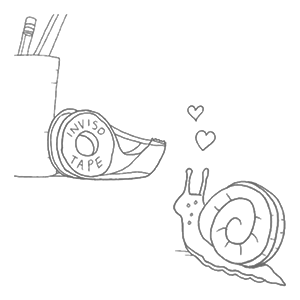
Parataxic [par-uh-tak-sik] distortion is term coined by american psychiatrist Harry S. Sullivan to explain the inclination to skew perceptions of others based on fantasy. The ‘distortion’ is in the perception of others, based not on actual experience with the individual but from a projected fantasy personality. For example: when one falls in love they can create an image of the person as the ‘perfect match’ or ‘soul mate’ only to find out later the person did not match the original perception.
The fantasy personality is created in part from experience and from emotional stress. The stress of forming a new relationship or finding a life mate, where one contemplates reproduction, can be seen as stress, although it is perceived as pleasurable. ‘Falling in love’ can create the atmosphere where parataxic distortion is primarily involved in the perception of the object of affection. It is possible in these situations for chemical influences to play a role in the process.
read more »
Posted in Health, Love, Sex |
1 Comment »
July 18, 2012

Yhprum’s Law is the opposite of Murphy’s Law (Yhprum = Murphy backwards). The simple formula of Yhprum’s Law is: ‘Everything, that can work, will work. It is attributed to Richard Zeckhauser, a professor for political economy at Harvard University: ‘Sometimes systems that should not work, work nevertheless.’
In 2006, Paul Resnick of the University of Michigan School of Information used this law to describe how intensive and seemingly altruistic participation by giving ranking is observed in the eBay system.
Posted in Humor, Language |
1 Comment »
July 18, 2012

Hanlon’s Razor is an eponymous adage that reads: ‘Never attribute to malice that which is adequately explained by stupidity.’
A common (and more laconic) British English variation, coined by Sir Bernard Ingham, is the saying ‘cock-up before conspiracy,’ deriving from this quotation: ‘Many journalists have fallen for the conspiracy theory of government. I do assure you that they would produce more accurate work if they adhered to the cock-up theory.’
read more »
Posted in Humor, Language |
1 Comment »
July 18, 2012
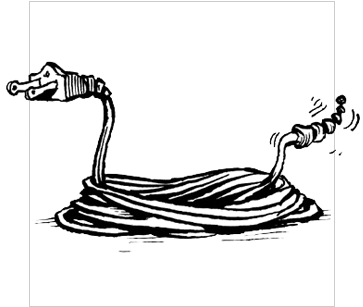
Resistentialism [ri-zis-ten-shul-iz-um] is a jocular theory to describe ‘seemingly spiteful behavior manifested by inanimate objects.’ For example, objects that cause problems (like lost keys or a fleeing bouncy ball) exhibit a high degree of malice toward humans and lend support to resistentialist beliefs. In other words, a war is being fought between humans and inanimate objects, and all the little annoyances objects give people throughout the day are battles between the two.
The term was coined by humorist Paul Jennings in a piece titled ‘Report on Resistentialism,’ published in ‘The Spectator’ in 1948 and reprinted in ‘The New York Times.’ The movement is a spoof of existentialism in general, and Jean-Paul Sartre in particular (Jennings gives the inventor of Resistentialism as Pierre-Marie Ventre). The slogan of Resistentialism is ‘Les choses sont contre nous’ — ‘Things are against us.’
read more »
Posted in Humor, Language, Philosophy |
Leave a Comment »
July 18, 2012
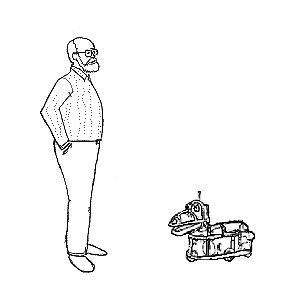
The intentional stance is a term coined by philosopher Daniel Dennett for the level of abstraction in which we view the behavior of a thing in terms of mental properties. It is part of a theory of mental content proposed by Dennett, which provides the underpinnings of his later works on free will, consciousness, folk psychology, and evolution.
‘Here is how it works: first you decide to treat the object whose behavior is to be predicted as a rational agent; then you figure out what beliefs that agent ought to have, given its place in the world and its purpose. Then you figure out what desires it ought to have, on the same considerations, and finally you predict that this rational agent will act to further its goals in the light of its beliefs. A little practical reasoning from the chosen set of beliefs and desires will in most instances yield a decision about what the agent ought to do; that is what you predict the agent will do.’
read more »
Posted in Health, Philosophy, Science |
Leave a Comment »




 The Daily Omnivore