July 11, 2012

Indie pop is a genre of alternative rock music that originated in the United Kingdom in the mid-1980s, with its roots in Scottish post-punk bands on the Postcard Records label in the early ’80s (Josef K and Orange Juice) and the dominant UK independent band of the mid-’80s, The Smiths. Indie pop was inspired by punk’s DIY ethic and related ideologies, and it generated a thriving fanzine, label, and club and gig circuit.
Indie pop differs from indie rock to the extent that it is more melodic, less abrasive, and relatively angst-free. The term ‘indie’ had been used for some time to describe artists on independent labels (and the labels themselves), but the key moment in the naming of ‘indie pop’ as a genre was the release of NME’s ‘C86’ tape in 1986.
read more »
Posted in Art, Money |
Leave a Comment »
July 11, 2012

Pop punk is a sub genre of alternative rock, which typically merges pop melodies with speedy punk tempos, chord changes, and loud guitars. Contemporary pop punk bands have a radio friendly sheen to their music, but still maintain much of the speed and attitude of classic punk rock. It is not clear when the term ‘pop punk’ was first used, but pop-influenced punk rock had been around since the mid- to late-1970s.
An early use of the term appeared in a 1977 ‘New York Times’ article, ‘Cabaret: Tom Petty’s Pop Punk Rock Evokes Sounds of 60s.’ In the mid-1990s, the California pop punk bands Green Day and The Offspring, who were later followed by Blink-182, would all achieve worldwide commercial success. From the mid-1990s onwards, some bands associated with the genre have been described as happy punk, faux-punk, mall punk, pseudo-punk,or bubblegum punk.
read more »
Posted in Art, Money |
Leave a Comment »
July 11, 2012

Top 40 is a music industry shorthand for the currently most-popular songs in a particular genre. When used without qualification, it typically refers to the best-selling or most frequently broadcast popular music songs of the previous week. Top 40 became the dominant radio format of the 1960s, 1970s, and 1980s. Its popularity coincided with the rapid changes in recording technology in the 1950s and 1960s. In 1954, the recording industry agreed upon a standard recording format for higher fidelity music, so any new record player could play any new record.
Also in that year, new single records were released on 45 rpm records, and the Top 40 thereafter became a survey of the popularity of these records (and their airplay on the radio). Tape recording had become perfected, allowing artists more freedom as they composed songs, especially novelty songs. By the late 1980s and the early 1990s, the 45 rpm record would decrease in popularity and other means would be used to evaluate the popularity of new songs, such as cassette-single, CD single, and digital MP3/AAC sales (plus radio airplay).
Posted in Art, Money, Technology |
Leave a Comment »
July 11, 2012

Mosquito control manages the population of mosquitoes to reduce their damage to human health, economies, and enjoyment. Mosquito control is a vital public-health practice throughout the world and especially in the tropics because mosquitoes spread many diseases, such as malaria. Mosquito-control operations are targeted against three different problems:
Nuisance mosquitoes (bother people around homes or in parks and recreational areas); Economically important mosquitoes (reduce real estate values, adversely affect tourism and related business interests, or negatively impact livestock or poultry production); and Public health (focusing on mosquitoes as vectors, or transmitters, of infectious disease).
read more »
Posted in Health, Money, Science |
Leave a Comment »
July 10, 2012

Time perception is a field of study within psychology and neuroscience; it refers to the sense of time, which differs from other senses since time cannot be directly perceived but must be reconstructed by the brain. Humans can perceive relatively short periods of time, in the order of milliseconds, and also durations that are a significant fraction of a lifetime. Human perception of duration is subjective and variable.
Some researchers attempt to categorize people by how they differ in their perception of time. Pioneering work, emphasizing species-specific differences, was done by Estonian naturalist Karl Ernst von Baer. Experimental work began under the influence of the psycho-physical notions of Gustav Theodor Fechner with studies of the relationship between perceived and measured time. Work with animals conducted by German biologist Jakob von Uexküll included measurement of length of momentum in snails.
read more »
Posted in Health, Science |
Leave a Comment »
July 9, 2012

The Bullingdon Club is a secret society dining club for exclusive students at Oxford University. The club has no permanent rooms and is notorious for its members’ wealth and destructive binges. Membership is by invitation only, and prohibitively expensive for most, given the need to pay for the uniform, dinners, and damages. The club was founded over 200 years ago. Originally it was a hunting and cricket club. This foundational sporting purpose is attested to in the Club’s symbol.
‘The Wisden Cricketer’ reports that the Bullingdon is ‘ostensibly one of the two original Oxford University cricket teams but it actually used cricket merely as a respectable front for the mischievous, destructive, or self-indulgent tendencies of its members.’ By the late 19th century, the present emphasis on dining within the Club began to emerge. ‘The Bullingdon Club dinners were the occasion of a great display of exuberant spirits, accompanied by a considerable consumption of the good things of life, which often made the drive back to Oxford an experience of exceptional nature.’
read more »
Posted in Education, Games, Money |
Leave a Comment »
July 9, 2012

Phoenix Wright: Ace Attorney is an adventure video game developed by Capcom. It was first released as ‘Gyakuten Saiban’ (literally ‘Turnabout Trial’) in Japan exclusively for the Game Boy Advance in 2001. The game stars Phoenix Wright, a rookie defense attorney in the Fey and Co. Law Offices, owned by fellow defense attorney Mia Fey. Other characters include Maya Fey, Mia’s sister; Miles Edgeworth, a rival prosecutor; Dick Gumshoe, a scatterbrained detective, and Larry Butz, an old friend of Phoenix’s.
The game features five court cases divided into episodes. Each case flips between two game modes: investigation and the actual trial. In the investigation aspect of the game, Phoenix gathers evidence and speaks to characters involved in the case. In the trial aspect of the game, Phoenix defends his client using said evidence, cross examines witnesses, and solves the mystery surrounding each case. The court perspective is usually in the third person, while the perspective outside of court is in the first person. Since the release of the Game Boy Advance version, the Ace Attorney series has produced many sequels and spin-offs, in a variety of formats including Nintendo’s WiiWare and Apple iOS.
Posted in Games, Politics, World |
Leave a Comment »
July 9, 2012

Black Hole is a comic written and illustrated by Charles Burns; it was published as a 12-issue limited series between 1995 and 2005. Set in the suburbs of Seattle during the mid-1970s, the comics follow a group of mostly middle class teenagers who, over the summer, contract a mysterious sexually transmitted disease known as ‘the Bug’ or ‘the teen plague,’ which causes them to develop bizarre unique physical mutations, turning them into social outcasts.
Burns has said that the mutations can be read as a metaphor for adolescence, sexual awakening, and the transition into adulthood. The look of the comic is meant to evoke the feel and atmosphere of classic 70s teen horror films like ‘The Last House on the Left,’ ‘Carrie,’ and ‘Halloween.’
Posted in Art, Language |
Leave a Comment »
July 9, 2012

Charles Burns (b. 1955) is an American cartoonist renowned for his meticulous, high-contrast and creepy artwork and stories. He lives in Philadelphia with his wife, painter Susan Moore.
His earliest works include illustrations for the ‘Sub Pop’ fanzine, and ‘Another Room Magazine’ of Oakland, CA, but he came to prominence when his comics were published for the first time in early issues of ‘RAW,’ the avant-garde comics magazine founded in 1980 by Françoise Mouly and Art Spiegelman. In 1982, Burns did a die-cut cover for ‘RAW’ #4. Raw Books also published two books of Burns as ‘RAW One-Shot: Big Baby’ and ‘Hard-Boiled Defective Stories.’
Posted in Art |
Leave a Comment »
July 9, 2012

Maakies is a syndicated weekly comic strip by Tony Millionaire. It began publication in 1994 in the ‘New York Press.’ It currently runs in many American alternative newsweeklies including ‘The Stranger,’ ‘LA Weekly,’ and ‘Only.’ It also appears in several international venues including the Italian comics magazine ‘Linus’ and the Swedish comics magazine ‘Rocky.’
The strip focuses on the darkly comic misadventures of Uncle Gabby (a drunken Irish sock monkey) and Drinky Crow (an alcoholic crow), two antiheroes with a propensity for drunkenness, violence, suicide, and venereal disease. According to Millionaire, ”Maakies’ is me spilling my guts… Writing and drawing about all the things that make me want to jump in the river, laughing at the horror of being alive.’ Maakies strips typically take place in an early 19th century nautical setting. There is rarely any continuity between strips.
read more »
Posted in Art, Drugs, Humor |
Leave a Comment »
July 9, 2012

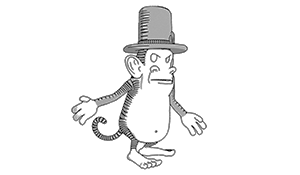
Tony Millionaire (b. 1956) (real name Scott Richardson) is an American cartoonist, illustrator and author known for his syndicated comic strip ‘Maakies’ and the ‘Sock Monkey’ series of comics and picture books. The nautical settings of much of Millionaire’s work draw inspiration from his childhood memories of his grandparents’ artwork and seaside home in Massachusetts as well as the novels of Patrick O’Brian, of which he is an avid reader. He draws in a lush style that mingles naturalistic detail with strong doses of the fanciful and grotesque. His linework resembles that of Johnny Gruelle, whom he cites as one of his main sources of inspiration along with Ernest Shepard and ‘all those freaks from the twenties and thirties who did the newspaper strips’; many of Millionaire’s admirers adduce a similarity to the work of E. C. Segar in particular. He draws with a fountain pen.
When asked in interviews why he uses a pseudonym, Millionaire maintains that he does not, and that ‘Tony Millionaire’ is his real name: ‘It is my legal name, and it’s been around a lot longer than I’ve been a cartoonist.’ He has claimed that his unusual surname is an Old French word meaning ‘a person who owns a thousand serfs.’ Skeptics trace the origin of the name to a character in an episode of the ’60s TV series ‘I Dream of Jeannie.’ Millionaire has speculated that in the future he may publish some family-friendly works of his under a different moniker in order to dissociate them from his other, more ribald output.
read more »
Posted in Art, Humor, Language |
Leave a Comment »
July 9, 2012

The Believer is a United States literary magazine that also covers other arts and general culture. Founded and designed in 2003 by the writer and publisher Dave Eggers of McSweeney’s Publishing, it is edited by novelists Vendela Vida and Heidi Julavits, along with’Village Voice’ editor Ed Park. The magazine is published in San Francisco nine times a year. Eggers and his cohorts initially planned to ‘focus on writers and books we like,’ with a nod to ‘the concept of the inherent Good.’
The magazine urges readers and writers to ‘reach beyond their usual notions of what is accessible or possible.’ Illustrations and cartoons are featured throughout the magazine. The cover illustrations are done by Charles Burns, while most of the other portraits and line drawings are by Tony Millionaire (following Gilbert Hernandez from the fifth issue on). Michael Kupperman’s ‘Four-Color Comics’ has appeared in many issues, and in most issues a series of images from a given artist or other source run throughout the articles à la ‘The New Yorker.’
Posted in Art, Language |
Leave a Comment »


 The Daily Omnivore