March 29, 2013

Superfolks is a 1977 novel by Robert Mayer, which satirizes the superhero and comic book genres, and was aimed at a more adult audience than those genres typically attracted. Superfolks examines comic book conventions and clichés from a more serious, ‘literary’ perspective.
The novel was influential on many writers of superhero comic books in the 1980s and 1990s, notably Alan Moore and Kurt Busiek. Although the book’s pop culture references clearly date it to the 1970s, its influence on the deconstruction of the superhero genre is still felt through Moore’s ‘Watchmen,’ ‘Marvelman,’ and ‘Superman: Whatever Happened to the Man of Tomorrow?’
read more »
Posted in Humor, Language |
Leave a Comment »
March 28, 2013
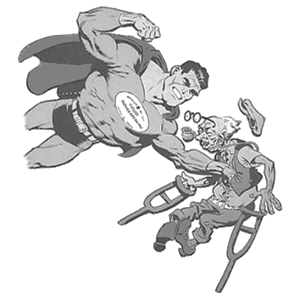
‘Superduperman‘ is a satirical story by cartoonists Harvey Kurtzman and Wally Wood that was published in the fourth issue of ‘Mad’ in 1953. Lampooning both Superman and Captain Marvel, it revolutionized the types of stories seen in ‘Mad,’ leading to greatly improved sales. Writers such as Alan Moore have cited this story as an influence.
The plot parallels the Superman scenario of the period: ‘Clark Bent’ is a lowly assistant to the copy boy at ‘The Daily Dirt’ newspaper, where he tries, unsuccessfully, to woo the narcissistic and indifferent ‘Lois Pain.’
read more »
Posted in Humor, Money |
1 Comment »
March 28, 2013
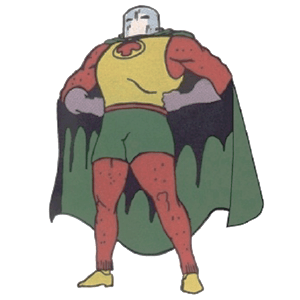
The Red Tornado is a fictional character, a superhero in the DC Comics universe, debuting during the Golden Age of Comic Books. Created by Sheldon Mayer, she first appeared in her civilian identity as Abigail Mathilda ‘Ma’ Hunkel in All-American Publications’ ‘All-American Comics’ #3 (June 1939), and became the ‘Red Tornado’ in ‘All-American Comics’ #20 (Nov. 1940).
As the Red Tornado, she was one of the first superhero parodies, as well as one of the first female superheroes (possibly the very first), and, when occasionally disguised as a man, comics’ first cross-dressing heroine. (Madame Fatal, earlier that year, was the first cross-dressing hero.) Initially as simply ‘Ma Hunkel,’ the Golden Age Red Tornado originated in Sheldon Meyer’s semi-autobiographical humor feature ‘Scribbly,’ about a boy cartoonist, in ‘All-American Comics.’ The feature ran through ‘All-American Comics’ #59, in 1944, the year DC Comics absorbed All-American Publications.
read more »
Posted in Humor |
Leave a Comment »
March 28, 2013
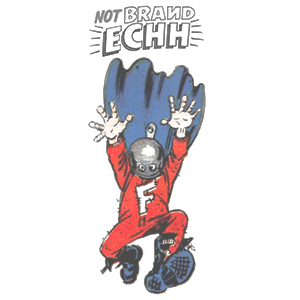
Forbush Man is the mascot of Marvel Comics’ satirical ‘Not Brand Echh’ (1967); he is the alter-ego of Irving Forbush, a fictional gofer at Marvel Comics. Forbush was dreamed up in 1955 by Marvel editor Stan Lee to refer to an imaginary low-grade colleague who was often the butt of Lee’s jokes.
Irving Forbush was originally introduced in 1955 in Marvel’s short-lived ‘Snafu’ magazine as a clone of the ‘Mad Magazine’ mascot Alfred E. Neuman (‘Snafu’ was itself a virtual clone of ‘Mad’). Forbush was given a line in the magazine’s content page where he was credited as Snafu’s founder (much as Benjamin Franklin was given the same credit in the ‘Saturday Evening Post’). (‘Snafu’ also listed another Forbush family member, as the other side of the magazine’s content column read ‘Losted [sic] by his cousin, Melvin Forbush’).
read more »
Posted in Humor |
Leave a Comment »
March 28, 2013
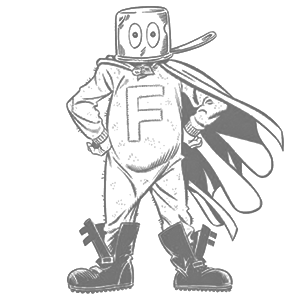
Not Brand Echh was a satiric comic book series published by Marvel Comics that parodied its own superhero stories as well as those of other comics publishers. Running for 13 issues from 1967 to 1969, it included among its contributors such notable writers and artists as Stan Lee, Jack Kirby, Gene Colan, Bill Everett, John and Marie Severin, and Roy Thomas.
With issue #9, it became a 68-page, 25¢ ‘giant,’ relative to the typical 12¢ comics of the times. Its mascot, ‘Forbush Man,’ introduced in the first issue, was a superhero wannabe with no superpowers and a costume of red long johns emblazoned with the letter ‘F’ and a cooking pot, with eye-holes, covering his never-revealed head. His secret identity was eventually revealed in issue #5 (Dec. 1967) as Irving Forbush, Marvel’s fictitious office gofer.
read more »
Posted in Humor |
Leave a Comment »
March 28, 2013
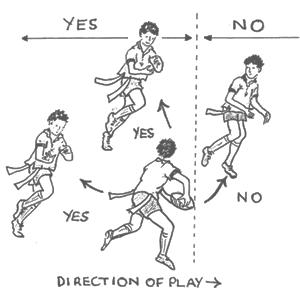
In American football, a lateral pass or lateral, officially backward pass (onside pass in Canadian football), occurs when the ball carrier throws the football to any teammate behind him or directly next to him (i.e. on or behind a line running through the ball and parallel to the line of scrimmage). A lateral pass is distinguished from a forward pass, in which the ball is thrown forward, towards the opposition’s end zone. In a lateral pass the ball is not advanced, but unlike a forward pass a lateral may be attempted from anywhere on the field by any player to any player at any time.
While the forward pass is an invention of the North American game, the lateral and backward pass is also a part of rugby union and rugby league, where such passes are much more common. Compared to its use in rugby, laterals and backward passes are less common in North American football, due to a much greater focus on ball control in American football strategy; they are most commonly used by the quarterback, after taking the snap, to quickly transfer (‘pitch’) the ball a short distance to a nearby running back (or, rarely, wide receiver) on a rushing play. Laterals are also often seen as part of a last-minute desperation strategy or as part of a trick play.
read more »
Posted in Games, World |
Leave a Comment »
March 28, 2013
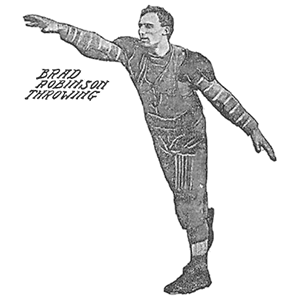
In several forms of football a forward pass is a throwing of the ball in the direction that the offensive team is trying to move, towards the defensive team’s goal line. The forward pass is one of main differences between gridiron football (American football and Canadian football) in which the play is legal and widespread, and rugby football (union and league) from which the North American games evolved, in which the play is illegal.
In some football codes, such as association football (soccer), the kicked forward pass is used so ubiquitously that it is not thought of as a distinct kind of play at all. In these sports, the concept of offside is used to regulate who can be in front of the play or be nearest to the goal. However, this has not always been the case. Some earlier incarnations of football allowed unlimited forward passing, while others had strict offside rules similar to rugby.
read more »
Posted in Games, World |
Leave a Comment »
March 27, 2013

Rick Berry (b. 1952) is a contemporary American expressionistic figurative artist based in the Boston area. Berry creates art for galleries, illustration, and paintings for theatrical performances. Berry’s work has appeared in many science fiction, fantasy and comic books, including Neil Gaiman’s ‘Sandman,’ ‘Magic: The Gathering’ cards, and Stephen King novels. In 1985, Berry created the first digitally painted book cover worldwide for William Gibson’s ‘Neuromancer.’
Berry was born in San Bernardino, California. His father, an air force fighter pilot, was frequently stationed in China. Berry’s childhood home was populated with Asian art which fascinated Berry and later found its way into his works.
read more »
Posted in Art |
Leave a Comment »
March 27, 2013

Phil Hale (b. 1963) is an American figurative painter who currently resides in London, England. Prior to turning to fine arts he worked as an illustrator, doing mostly figurative work. He was apprenticed to/ partnered with American painter Rick Berry. His current work focuses on figure as well, in depictions of slightly surreal scenes with strange characters performing various physical feats, usually in a confrontation of some sort. He seems to take keen interest in tension and emphasis of angular and dynamic aspects of the figure, almost always incorporating slight anatomical distortions to great effect.
A portrait of former UK Prime Minister, Tony Blair by the artist was unveiled in Westminster in 2008. Mr Blair sat for the portrait during his final months in office in 2007. Hale recently formed the movie production company ‘unprofessional.com’ with his son Callum Hale Thomson. It specializes in bespoke analogue filmmaking.
Posted in Art |
Leave a Comment »
March 27, 2013

Genetic algorithms are a kind of algorithm used to find approximations in search problems. Genetic algorithms are a class of evolutionary algorithms (algorithms that simulate evolution: each generation of solution is subjected to some kind of fitness function; those that survive are then recombined in some way to make the next generation of solution).
The concept of genetic algorithms is a search technique often used in computer science to find complex, non-obvious solutions to algorithmic optimization and search problems. Genetic algorithms are categorized as global search heuristics, and have a wide variety of applications, particularly in generating useful Artificial Intelligence agents in computer games.
read more »
Posted in Games, Technology |
Leave a Comment »
March 27, 2013

In Computer Science, especially in artificial intelligence, evolutionary algorithms (EA) are a kind of algorithm that simulate evolution to optimize something.
Each generation of solution is subjected to some kind of fitness function; those that survive are then recombined in some way to make the next generation of solution. This is done until a certain level of fitness is reached, or a determined number of generations have been used.
read more »
Posted in Technology |
Leave a Comment »
March 27, 2013
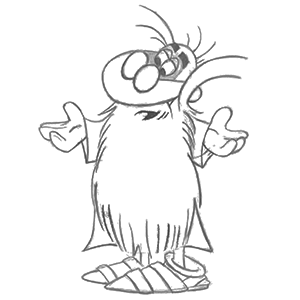
The 2000 Year Old Man is a persona in a comedy skit, originally created by Mel Brooks and Carl Reiner in 1961. Mel Brooks played the oldest man in the world, interviewed by Carl Reiner in a series of comedy routines that appeared on television, as well as being made into a collection of records. In a Jewish accent, Brooks would improvise answers to topics such as the earliest known language (‘basic Rock’). The inspiration for the skit was a tape-recorded exchange between Brooks and Reiner at a party. The tape recorder was brought into the mix shortly after the opening salvos, as the two comics soon had the party audience in stitches.
In 1961, when the duo began doing the skit on television, Brooks had just undergone surgery for gout. Because of his post-surgical discomfort, Brooks quipped, ‘I feel like a 2000-year-old man,’ which led Reiner to begin questioning him about what it’s like to be a 2000-year-old man and to describe history as Brooks saw it. Many of the jokes (especially the caveman jokes) were eventually brought to the screen in Brooks’ film ‘History of the World, Part I.’
Posted in Humor |
Leave a Comment »


 The Daily Omnivore