March 22, 2013
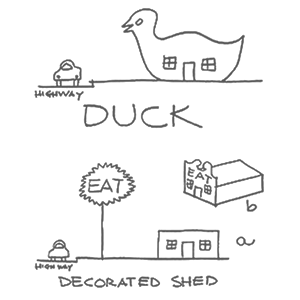
The Big Duck is a ferrocement (cement, sand, and steel mesh) building in the shape of a duck located in Flanders, New York, on Long Island. It was originally built in 1931 by duck farmer Martin Maurer in nearby Riverhead, and used as a shop to sell ducks and duck eggs.
The Big Duck is a prime example of literalism in advertising. The building measures 18 feet (5.5 m) wide, 30 feet (9.1 m) long and 20 feet (6.1 m) tall to the top of the head. The duck’s eyes are made from Ford Model T tail lights and the interior floor space is confined to 11 feet (3.4 m) by 15 feet (4.6 m).
read more »
Posted in Humor, Language, Money |
Leave a Comment »
March 22, 2013
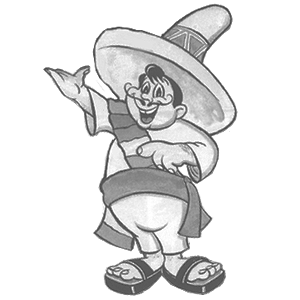
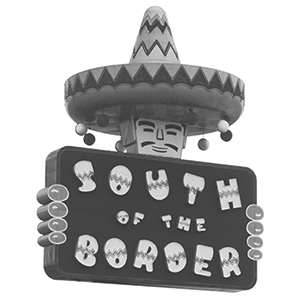
South of the Border is a roadside attraction on Interstate 95 south of the border between North and South Carolina, which serves as a rest stop for vacationers and tourists traveling to and from Florida. The rest area features not only restaurants, gas stations and a motel, but also a small amusement park, shopping (including, formerly, adult entertainment at the ‘Dirty Old Man Shop’), and, famously, fireworks. Its mascot is Pedro, an extravagantly stereotypical Mexican bandido.
It is known for being advertised by hundreds of billboards along surrounding highways, starting over 150 miles away. Federal Reserve Chairman Ben Bernanke, originally from nearby Dillon, South Carolina, worked for a summer as a poncho-wearing waiter at South of the Border to help pay his way through Harvard. South of the Border also hosted the bar/night club ‘Pedro’s’ from 1985-1998. This was a popular spot for revellers including many Lumbee Indians who visited the club from neighboring (and dry) Robeson County.
read more »
Posted in Humor, Money |
Leave a Comment »
March 21, 2013
Tourist trap is an establishment, or group of establishments, that has been created or re-purposed with the aim of attracting tourists and their money. Tourist traps will typically provide services, entertainment, souvenirs and other products for tourists to purchase.
While the term may have negative connotations for some, such establishments may be viewed by tourists as fun and interesting diversions. In some areas like Ishpeming, Michigan, Flush toilets may be a sufficient draw to entice tourists to stop as they are not readily available at many tourist facilities in Michigan’s Upper Peninsula. Wall Drug, in South Dakota, began its tourist trade simply by offering ice water.
Posted in Humor, Money |
Leave a Comment »
March 21, 2013

Poutine [poo-teen] (French: ‘a mess’) is a typical Canadian dish (originally from Quebec), made with french fries, topped with brown gravy (meat stock based) and cheese curds (solid parts of soured milk).
Poutine is sold by fast food chains, in small ‘greasy spoon’ type diners (commonly known as ‘cantines’ or ‘casse-croûtes’ in Quebec) and pubs, as well as by roadside chip wagons (commonly known as ‘cabanes à patates,’ literally meaning ‘potato shacks’). International chains like McDonald’s and KFC sell mass-produced poutine in Canada.
read more »
Posted in Food, World |
Leave a Comment »
March 21, 2013

Prison sexuality deals with sexual relationships between confined individuals or those between a prisoner and a prison employee (or other persons to whom prisoners have access). Since prisons are separated by gender, most sexual activity is conducted with a same-sex partner, often in contradiction to a person’s normal social sexual orientation. Exceptions to this are sex with an employee of the opposite sex, as well as conjugal visits.
According to ‘Human Rights Watch’ 2001 report ‘No Escape: Male Rape in U.S. Prisons,’ sexual slavery frequently poses as a consensual sexual relationship. Rape victims are often intimidated into feigning consent to sexual activity, to the point of becoming ‘slaves’ and the figurative property of their rapists. This occurs in both male and female prisons.
read more »
Posted in Politics, Sex |
Leave a Comment »
March 21, 2013

The treatment of animals in rodeo has been a source of concern for the industry, the public, and the law for decades. Protests were first raised in the 1870s, and, in the middle twentieth century, laws were enacted to curb events using animals. The American Humane Association (AHA) has worked with the rodeo industry (specifically, the PRCA, Professional Rodeo Cowboys Association) to establish rules improving animal treatment in rodeo and the treatment of rodeo animals. Today, animal cruelty complaints in rodeo are still very much alive, and continue to be a source of aggravation to the rodeo industry.
The PRCA (which governs about a third of the rodeos conducted in the United States annually) has provided rules for its members regarding animal welfare. Some locals have banned the use of certain rodeo tack (equipment worn by an animal) including flank straps (also called ‘bucking straps,’ irritants which encourage bucking) and certain events such as steer tripping (roping). Some charreada (amateur Mexican-American rodeo) events staged in the United States saw a crack down in the early years of the twenty-first century.
read more »
Posted in Games, Money, Politics |
1 Comment »
March 21, 2013

Mutton busting is an event held at rodeos similar to bull riding or bronc riding, in which children ride or race sheep. In the event, a sheep is held still, either in a small chute or by an adult handler while a child is placed on top in a riding position. Once the child is seated atop the sheep, the sheep is released and usually starts to run in an attempt to get the child off.
There are no set rules for mutton busting, no national organization, and most events are organized at the local level. The vast majority of children participating in the event fall off in less than 8 seconds. Organizations such as the ASPCA discourage the practice on the grounds that it does not promote kindness to, or respect of, animals.
Posted in Games, Humor |
Leave a Comment »
March 21, 2013

Consumerism is a social and economic order that encourages the purchase of goods and services in ever-greater amounts. The term is often associated with criticisms of consumption starting with American economist Thorstein Veblen. However, the term is also used to refer to the consumerists movement, consumer protection or consumer activism, which seeks to protect and inform consumers by requiring such practices as honest packaging and advertising, product guarantees, and improved safety standards.
In economics, consumerism refers to economic policies placing emphasis on consumption. In an abstract sense, it is the belief that the free choice of consumers should dictate the economic structure of a society. Consumerism has weak links with the Western world, but is in fact an international phenomenon. People purchasing goods and consuming materials in excess of their basic needs is as old as the first civilizations.
read more »
Posted in Money, Politics |
Leave a Comment »
March 20, 2013

Margaret Sanger (1879 – 1966) was an American birth control activist, sex educator, and nurse. Sanger popularized the term ‘birth control,’ opened the first birth control clinic in the United States, and established Planned Parenthood. Sanger’s efforts contributed to the landmark U.S. Supreme Court case which legalized contraception in the United States.
Sanger is a frequent target of criticism by opponents of birth control and has also been criticized for supporting eugenics (‘racial hygiene’), but remains an iconic figure in the American reproductive rights movement. Sanger’s early years were spent in New York City. In 1914, prompted by suffering she witnessed due to frequent pregnancies and self-induced abortions, she started a monthly newsletter, ‘The Woman Rebel.’ Sanger’s activism was influenced by the conditions of her youth—her mother had 18 pregnancies in 22 years, and died at age 50 of tuberculosis and cervical cancer.
read more »
Posted in Health, Politics, Sex |
Leave a Comment »
March 20, 2013
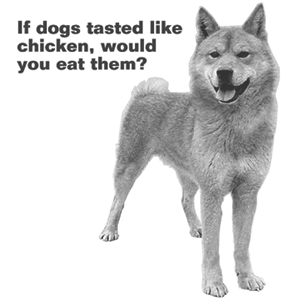
The Nureongi is a yellowish, local dog breed from Korea. It is most often used as a livestock dog, raised for its meat and not commonly kept as a pet. This dog has no formal name in the Korean language. ‘Nureongi’ and ‘hwangu’ are informal Korean words meaning ‘yellow one,’ and might best translate as ‘Brownie’ or ‘Blackie. Another common term is the Korean slang ‘ddong-gae,’ meaning ‘dung dogs’ or ‘shit dogs,’ which refers to the common dogs’ habit of eating feces.
The consumption of dog meat in South Korea, where it is known as ‘Gaegogi,’ has a long history in that country, as well as that of other East Asian cultures. In recent years, it has been controversial both in South Korea and around the world, due to animal rights and sanitary concerns. There is a large and vocal group of Korean people that are against the practice of eating dog meat. There is also a large population of people in South Korea that do not eat or enjoy the meat, but do feel strongly that it is the right of others to do so. There is a smaller but still vocal group of pro-dog cuisine people in South Korea who want to popularize the consumption of dog in Korea and the rest of the world, considering it to be part of the traditional culture of Korea with a long history worth preserving.
Posted in Food, Politics, World |
1 Comment »
March 20, 2013
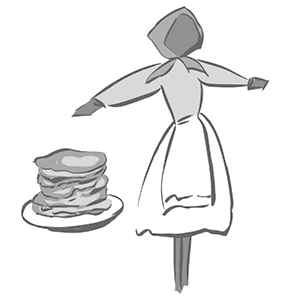
Maslenitsa (also known as Butter Week) is an Eastern Slavic religious and folk holiday. It is celebrated during the last week before Great Lent—that is, the seventh week before Eastern Orthodox Pascha (Easter). Maslenitsa corresponds to the Western Christian Carnival, except that Orthodox Lent begins on a Monday instead of a Wednesday, and the Orthodox date of Easter can differ greatly from the Western Christian date.
Maslenitsa has its origins in both pagan and Christian traditions. In Slavic mythology, Maslenitsa is a celebration of the imminent end of the winter. As the culmination of the celebration, on Sunday evening, Lady Maslenitsa is stripped of her finery and put to the flames of a bonfire. Any remaining blintzes are also thrown on the fire and Lady Maslenitsa’s ashes are buried in the snow (to ‘fertilize the crops’).
read more »
Posted in Food, Philosophy, World |
Leave a Comment »
March 20, 2013

The rasputitsa refers to the biannual mud seasons when unpaved roads become difficult to traverse in parts of Belarus, Russia, and Ukraine. The word may be translated as the ‘quagmire season’ because during this period the large flatlands become extremely muddy and marshy, as do most unpaved roads. The rasputitsa occurs more strongly in the spring due to the melting snow but it usually recurs in the fall due to frequent heavy rains. The rasputitsa seasons of Russia are well known as a great defensive advantage in wartime. Napoleon found the mud in Russia to be a very great hindrance in 1812.
During the Second World War the month-long muddy period slowed down the German advance during the Battle of Moscow, and may have helped save the Soviet capital, as well as the presence of ‘General Winter,’ that followed the autumn rasputitsa period – this sort of wintertime hindrance to German military motor vehicle transport on the Eastern Front partly inspired the design and mass production of a unique fully tracked artillery tractor for such conditions.
read more »
Posted in Language, War, World |
Leave a Comment »


 The Daily Omnivore