April 9, 2013

Earth sheltering is the architectural practice of using earth against building walls for external thermal mass, to reduce heat loss, and to easily maintain a steady indoor air temperature. Earth sheltering is popular in modern times among advocates of passive solar and sustainable architecture, but has been around for nearly as long as humans have been constructing their own shelter.
The expression ‘earth-sheltering’ is a generic term, with the general meaning: building design in which soil plays an integral part. More specifically, a building can be described as earth-sheltered if its external envelope is in contact with a thermally significant volume of soil or substrate (where ‘thermally significant’ means making a functional contribution to the thermal effectiveness of the building in question).
read more »
Posted in Technology, World |
Leave a Comment »
April 9, 2013

B-O-B is a ‘wildly successful’ series of sex education videos covering the practice of a woman penetrating a man’s anus with a strap-on dildo (known as ‘pegging’). The first of the two videos, which was released in 1998, became the best selling video to date for ‘Good Vibrations,’ a sex-toy company. The videos star sexologist Carol Queen, who discusses pegging and also demonstrates the practice with her lover.
The videos also contain footage of other couples engaging in the practice. The porn star Chloe appears in the second video; as she is best known as an anal queen, her use of a strap-on dildo is a ‘role reversal.’ Sex columnist Dan Savage, who popularized the term ‘pegging,’ originally offered ‘bob’ (short for ‘Bend over Boyfriend’) as one of two alternatives for the term.
read more »
Posted in Education, Sex |
Leave a Comment »
April 8, 2013


One aspect of how women are portrayed in popular culture is a purported rivalry between blonde and brunettes. The rivalry in American society dates back to at least 1875 when the first female professional baseball players were assigned to teams according to their hair color.
Baseball historian John Thorn notes that blonde and brunette baseball teams barnstormed the country in the late 1800s. A more contemporary example is the gridiron football game called ‘blondes vs. brunettes powderpuff football,’ a charity event that raises money for the Alzheimer’s Association. The annual contests were started in the fall of 2005, in Washington D.C.
read more »
Posted in Humor, Love |
Leave a Comment »
April 8, 2013

The Shouting Hill is a hill in the Israeli controlled portion of the Golan Heights. During the Six Day War, Israel captured the majority of the heights. The Shouting Hill is located close to the ceasefire line that separates Syrian controlled territory and the territory occupied by Israel. The hill is situated near the Druze village of Majdal Shams; community members were separated after the war.
Very few visits were allowed between the families from both sides of the ceasefire line. Israel and Syria are still in an official state of war. There is also no telecommunications or mail allowed between the sides. As a result families come to the hill from both sides of the border to see and talk (actually shout into megaphones) to their relatives on the other side. However, with the advent of mobile phones, people don’t do this as often, except on special occasions like weddings or when they want to see each other and they use binoculars.
Posted in Politics, War, World |
1 Comment »
April 8, 2013

A black bloc is a tactic for protests and marches where individuals wear black clothing, scarves, sunglasses, ski masks, motorcycle helmets with padding, or other face-concealing and face-protecting items. The clothing is used to conceal marchers’ identities, allow them to appear as one large unified mass, and promote solidarity.
The tactic was developed in the 1980s in the European autonomist movement’s protests against squatter evictions, nuclear power, and restrictions on abortion among other things. Black blocs gained broader media attention outside Europe during the 1999 Seattle WTO protests, when a black bloc damaged property of GAP, Starbucks, Old Navy, and other multinational retail locations in downtown Seattle.
read more »
Posted in Money, Politics, World |
Leave a Comment »
April 7, 2013

Leaderless resistance, or phantom cell structure, is a political resistance strategy in which small, independent groups (covert cells), including individuals (solo cells), challenge an established adversary such as a government. Leaderless resistance can encompass anything from non-violent disruption and civil disobedience to bombings, assassinations and other violent agitation. Leaderless cells lack bidirectional, vertical command links and operate without hierarchical command.
Given the simplicity of the strategy, as well as the fact that it is difficult to stamp out, leaderless resistance has been employed by a wide-range of movements, from terrorist and hate groups, advocating on a range of issues like animal-liberation, radical environmentalism, anti-corporatism, anti-abortion activism, and resistance to military invasion or colonialism.
read more »
Posted in Politics, War |
Leave a Comment »
April 3, 2013
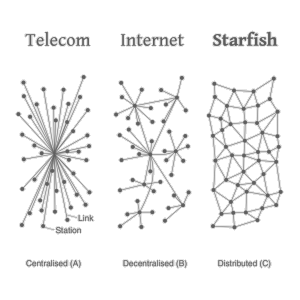
‘The Starfish and the Spider: The Unstoppable Power of Leaderless Organizations’ is a 2006 book by Ori Brafman (author of the 2010 book ‘Click: The Magic of Instant Connections’) and Rod Beckstrom (President of ICANN); it is an exploration of the implications of the recent rise of decentralized organizations such as Wikipedia, Grokster and YouTube.
The book contrasts them to centralized organizations, such as Encyclopædia Britannica. The spider and starfish analogy refers to the contrasting biological nature of the respective organisms, starfish have a decentralized neural structure permitting regeneration, whereas spiders have in a hierarchical nervous system.
read more »
Posted in Language, Money, Technology |
Leave a Comment »
April 3, 2013

Copwatch is a network of activist organizations that observe and document police activity. They believe that monitoring police activity on the streets is a way to prevent police brutality. The stated goal of at least one Copwatch group is to engage in monitoring and videotaping police activity in the interest of holding the police accountable in the events involving assaults or police misconduct.
Copwatch groups also hold ‘Know Your Rights’ forums to educate the public about their legal and human rights when interacting with the police, and some groups organize events to highlight problems of police abuse in their communities. Copwatch was first started in Berkeley, California in 1990.
read more »
Posted in Politics |
Leave a Comment »
April 3, 2013

Experimental archaeology puts archaeological source material, like ancient structures or artifacts, to real world tests. It should not be confused with primitive technology which is not concerned with any archaeological or historical evidence. Living history and historical reenactment, which are generally undertaken as a hobby, are the lay person’s version of this academic discipline.
One of the main forms of experimental archaeology is the creation of copies of historical structures using only historically accurate technologies. This is sometimes known as reconstruction archaeology or reconstructional archaeology; however, reconstruction implies an exact replica of the past, when it is in fact just a construction of one person’s idea of the past; the more archaeologically correct term is a ‘working construction of the past.’
read more »
Posted in Science, Technology, World |
Leave a Comment »
April 3, 2013

Damascus steel was a type of steel used in Middle Eastern swordmaking. Damascus steel was created from wootz steel, a steel developed in India around 300 BCE. These swords are characterized by distinctive patterns of banding and mottling reminiscent of flowing water.
Such blades were reputed to be tough, resistant to shattering and capable of being honed to a sharp, resilient edge. The original method of producing Damascus steel is not known. Recreating Damascus steel is a subfield of experimental archaeology. Many have attempted to discover or reverse-engineer the process by which it was made.
read more »
Posted in Technology, World |
Leave a Comment »
April 3, 2013

A rag-and-bone man collects unwanted household items and sells them to merchants. Traditionally this was a task performed on foot, with the scavenged materials (which included rags, bones and various metals) kept in a small bag slung over the shoulder.
Some wealthier rag-and-bone men used a cart, sometimes pulled by horse. 19th-century rag-and-bone men typically lived in penury, surviving on the proceeds of what they collected each day. Conditions improved following the Second World War, but the trade declined during the latter half of the 20th century. Lately, however, due in part to the soaring price of scrap metal, rag-and-bone men can once again be seen at work.
read more »
Posted in Money, World |
Leave a Comment »
April 2, 2013

The Zabbaleen (Egyptian Arabic: ‘Garbage people’) are teenagers and adults who have served as Cairo’s informal garbage collectors for the past 70 to 80 years. They are also known as ‘Zarraba’ (‘pig-pen operators’).
Spread out among seven different settlements scattered in the Greater Cairo Urban Region, the Zabbaleen population is between 50,000 and 70,000. The largest settlement is Mokattam village, nicknamed ‘Garbage City,’ located at the foot of the Mokattam Mountains, next to Manshiyat Naser, a slum settlement on the outskirts of Cairo. The Zabbaleen community in Mokattam Village has a population of around 20,000 to 30,000, over 90 percent of which are Coptic Christians.
read more »
Posted in Money, Politics, World |
Leave a Comment »


 The Daily Omnivore