July 14, 2013
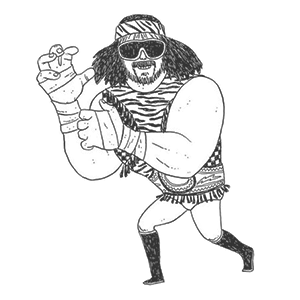
Machismo [mah-cheez-moh] is a negative descriptor of, for example, sexism, misogyny, chauvinism and hypermasculinity and hegemonic masculinity.
Scholars characterize such macho men as violent, rude, womanizing, and prone to alcoholism; domineering through intimidation, seducing and controlling women and children through violence and intimidation. However, some societies and academics place traditional gender roles – social norm for certain communities, followed by others by admiration or convention – as the most important component of machismo.
read more »
Posted in Politics, Sex, World |
1 Comment »
July 14, 2013

Hypermasculinity [hahy-per-mas-kyuh-lin-i-tee] is a psychological term for the exaggeration of male stereotypical behavior, such as an emphasis on physical strength, aggression, and sexuality . This term can be pejorative, though it is also used when examining the behavior (as adaptive or maladaptive) dispassionately.
One of the first studies of hypermasculinity was conducted by pyschologists Donald L. Mosher and Mark Sirkin in 1984. Mosher and Sirkin have operationally defined hypermasculinity or the ‘macho personality’ as consisting of the following three variables: a) ‘callous sexual attitudes toward women,’ b) ‘the belief that violence is manly,’ and c) ‘the experience of danger as exciting.’ They developed the Hypermasculinity Inventory (HMI) designed to measure the three components. Research has found that hypermasculinity is associated with sexual and physical aggression against women. Prisoners have higher hypermasculinity scores than control groups.
Posted in Language, Sex |
Leave a Comment »
July 14, 2013
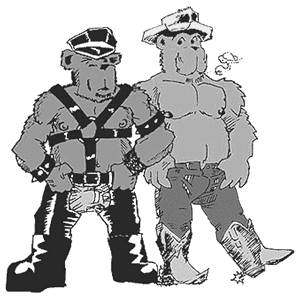
The Natural Bears Classification System (NBCS), also called the ‘bear code,’ is a set of symbols using letters, numbers and other characters commonly found on modern, Western computer keyboards, and used for the self-identification of those who self-identify as ‘bears’ in the sense of a mature gay or bisexual man with facial or substantial body hair.
These codes are used in email, Usenet, and Internet forum postings to identify the physical type and preferences of the poster.
read more »
Posted in Language, Sex |
Leave a Comment »
July 14, 2013
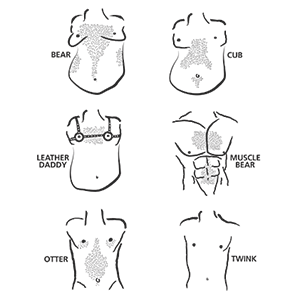
In gay culture, a Bear is a large, hairy man who projects an image of rugged masculinity. As a rising subculture in the gay and bisexual male communities, Bears are one of many LGBT communities with events, codes, and a culture-specific identity.
The term was popularized by Richard Bulger, who, along with his then partner Chris Nelson (1960–2006) founded ‘Bear Magazine’ in 1987. There is some contention surrounding whether Bulger originated the term and the subculture’s conventions. Author George Mazzei, for example, wrote an article for ‘The Advocate’ in 1979 called ‘Who’s Who in the Zoo?,’ that characterized homosexuals as seven types of animals, including bears.
read more »
Posted in Language, Sex |
1 Comment »
July 14, 2013
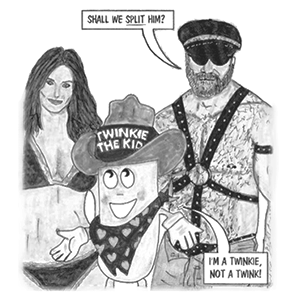
Twink [twingk] is a gay slang term describing a young or young-looking man with a slender, ectomorph build (long and thin), little or no body hair, and no facial hair. In some societies, the terms ‘fox,’ ‘plum,’ ‘chick,’ or ‘chicken’ are preferred. The related term ‘twinkle-toes,’ which implies that a man is effeminate, tends to be used in a derogatory manner. The terms can be complimentary or pejorative. The opposite of a twink in gay slang is a ‘bear,’ a large, hairy man who projects an image of rugged masculinity.
The term’s namesake is the ‘golden-colored phallic-shaped snack cake’ Hostess Twinkie, commonly regarded as the quintessential junk food: ‘little nutritional value, sweet to the taste and creme-filled.’ In ‘Queering Pornography: Desiring Youth, Race and Fantasy in Gay Porn,’ essayist Zeb J. Tortorici notes that gay twink porn thrives on the production and performance of ‘consumable and visually/anally receptive masculinity.’
read more »
Posted in Language, Sex |
Leave a Comment »
July 13, 2013

‘Everytime‘ is a 2004 song by pop star Britney Spears from her fourth album, ‘In the Zone.’ After Spears ended her relationship with singer Justin Timberlake in 2002, she made friends with her backing vocalist Annet Artani.
They started writing songs together at Spears’s house in Los Angeles, and then traveled to Lombardy, Italy, where ‘Everytime’ was written. Spears composed the music on her piano, and she developed the lyrics with Artani. According to Artani, the song was written as a response to Timberlake’s 2002 single ‘Cry Me a River’ and various of his radio interviews. Spears has neither confirmed nor denied these allegations.
read more »
Posted in Art |
Leave a Comment »
July 13, 2013
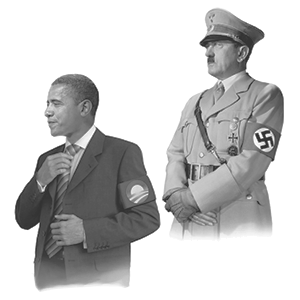
In historical analysis, biblical criticism and comparative mythology parallelomania [par-uh-lel-uh-mey-nee-uh] refers to a phenomenon where authors perceive apparent similarities and construct parallels and analogies without historical basis.
The concept was introduced to scholarly circles in 1961 by Rabbi Samuel Sandmel of the Hebrew Union College in a paper of the same title, where he stated that he had first encountered the term in a French book of 1830, but did not recall the author or the title. Sandmel stated that the simple observations of similarity between historical events are often less than valid, but at times lead to a phenomenon where authors first notice a supposed similarity, overdose on analogy, and then, ‘proceeds to describe source and derivation as if implying a literary connection flowing in an inevitable or predetermined direction.’
read more »
Posted in Education, Language, Philosophy |
Leave a Comment »
July 12, 2013

A tater tot is a side dish made from deep-fried, grated potatoes. They are widely recognized by their crispness and cylindrical shape. Tater Tots is a registered trademark of Ore-Ida (a division of the HJ Heinz Company), which has become genericized.
The product was created in 1953 when Ore-Ida founders F. Nephi Grigg and Golden Grigg were trying to figure out what to do with leftover slivers of cut-up potatoes, which at the time was being sold to feed livestock at low margins. They chopped up the slivers, added flour and seasoning, then pushed the mash through holes and sliced off pieces of the extruded mixture. The product was first offered in stores in 1956.
read more »
Posted in Food |
Leave a Comment »
July 11, 2013
Sympathetic magic, also known as ‘imitative magic,’ is a type of magic based on imitation or correspondence.
It has been said that the theory of sympathetic magic was first popularized in 1889 by Scottish anthropologist Sir James George Frazer in ‘The Golden Bough’ (a comparative study of mythology and religion); German geographer and ethnographer Richard Andree, however, anticipates Frazer, writing of ‘Sympathie-Zauber’ in his 1878 ‘Ethnographische Parallelen und Vergleiche’ (‘Ethnographic Parallels and Comparisons). Frazer further subcategorized sympathetic magic into two varieties: that relying on similarity, and that relying on contact or ‘contagion.’
read more »
Posted in Health, Philosophy |
Leave a Comment »
July 9, 2013

Lennie Briscoe is a fictional character on NBC’s long-running police procedural and legal drama television series ‘Law & Order.’ He was portrayed by Jerry Orbach for 12 season. The character was introduced in the 1992 episode ‘Point of View’ as the new senior detective in the NYPD’s 27th Detective Squad in the 27th Police Precinct’s Station House. His boss during his first season on the show is Capt. Don Cragen; a year later, Lt. Anita Van Buren takes over the 27th Squad.
He was previously assigned as a detective in the 116th Det. Squad in Queens. Briscoe joins the squad after Det. Mike Logan’s (Chris Noth) partner, Sgt. Phil Cerreta (Paul Sorvino), is shot by a black market arms dealer, and Logan transfers to a desk job in another precinct. After Logan is transferred to Staten Island in 1995, Det. Rey Curtis (Benjamin Bratt) becomes Briscoe’s partner. Four years later, Curtis goes into early retirement to take care of his multiple sclerosis–stricken wife, and he is replaced by Det. Ed Green (Jesse L. Martin) in 1999.
read more »
Posted in Art, Politics |
Leave a Comment »
July 8, 2013
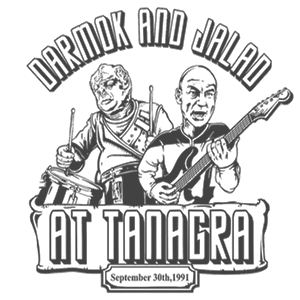
‘Darmok‘ is the 102nd episode of the science fiction television series ‘Star Trek: The Next Generation,’ the second episode of the fifth season. The episode features Paul Winfield, who previously played Captain Terrell in ‘Star Trek II: The Wrath of Khan.’
The senior crew discuss their latest mission: to make contact with the Tamarian race who have been transmitting signals toward Federation space for weeks. The Enterprise makes contact with a Tamarian ship in orbit around the planet El-Adrel. Though the universal translator can translate their words, the Tamarians only communicate through metaphor which baffles the Enterprise crew. Likewise, the Tamarians cannot understand Picard’s straightforward use of language.
read more »
Posted in Art, Language |
Leave a Comment »
July 3, 2013

An open secret is a concept or idea that is ‘officially’ secret or restricted in knowledge but is actually widely known; or it refers to something that is widely known to be true but which none of the people most intimately concerned is willing to categorically acknowledge in public.
The existence of the British Secret Intelligence Service (MI6) was widely known for several decades before the government’s official acknowledgement of the organization in 1994. Likewise, Delta Force, the elite US Army unit, can be considered an open secret, since its existence has been denied in the past by the government. Israel is widely acknowledged to possess nuclear weapons. This can be considered an open secret, because the Israeli government has never explicitly stated whether or not it possesses a nuclear stockpile, officially maintaining a policy of deliberate ambiguity.
read more »
Posted in Language, Politics, World |
1 Comment »


 The Daily Omnivore