September 5, 2013
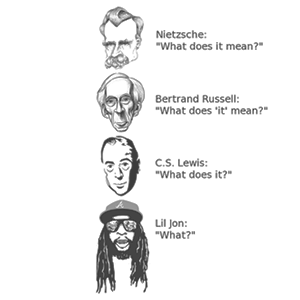
In historiography (the study of historical methods) and the philosophy of history, progress (from Latin ‘progressus,’ ‘an advance’) is the idea that the world can become increasingly better in terms of science, technology, modernization, liberty, democracy, quality of life, etc.
Although progress is often associated with the Western notion of change in a straight, linear fashion, alternative conceptions exist, such as the cyclic theory of eternal return (the belief that the universe has been recurring, and will continue to recur, in a self-similar form an infinite number of times across infinite time or space), or the ‘spiral-shaped’ dialectic progress of Hegel, Marx, et al.
read more »
Posted in Philosophy, Science, Technology |
Leave a Comment »
September 4, 2013

The ‘Stoned Ape‘ theory of human evolution was proposed by American psychonaut Terence Mckenna in his book ‘Food of the Gods’ to explain the rapid development of the human neocortex.
McKenna proposed that the transformation from humans’ early ancestors Homo erectus to the species Homo sapiens mainly had to do with the addition of the mushroom Psilocybe cubensis in its diet – an event which according to his theory took place about 100,000 BCE. One of the effects that comes about from the ingestion of low doses is improved visual acuity. According to McKenna, this would infer an evolutionary advantage to early human hunters.
read more »
Posted in Drugs, Philosophy, Science |
2 Comments »
September 4, 2013
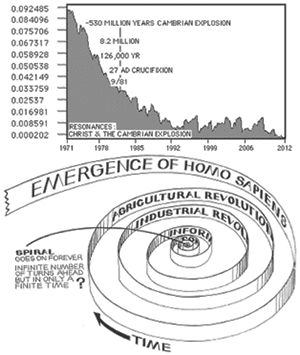
Novelty theory was developed by American psychonaut Terence McKenna to explain the increasing complexity of reality; according to the theory, the universe has a teleological attractor at the end of time that increases interconnectedness. McKenna predicted that a singularity of infinite complexity would be reached in 2012 at which point anything and everything imaginable would occur simultaneously. He referred to this as the Eschaton. He conceived this idea over several years in the early to mid-1970s while using psilocybin mushrooms and DMT.
McKenna viewed the universe as a swarm of matter waves, spiralling down the gradient of their synergetic (energetically favorable) constructive interference. He saw the universe as being ‘pulled from the future toward a goal that is as inevitable as a marble reaching the bottom of a bowl when you release it up near the rim…it comes to rest at the lowest energy state, which is the bottom of the bowl. That’s precisely my model of human history.’
read more »
Posted in Drugs, Philosophy |
Leave a Comment »
September 4, 2013
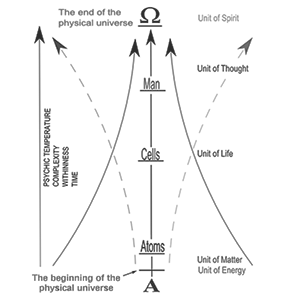
The Law of Complexity/Consciousness is the tendency in matter to become more complex over time and at the same time to become more conscious. The law was first formulated by 20th century Jesuit priest and paleontologist Pierre Teilhard de Chardin, who held that at all times and everywhere, matter is endeavoring to complexify upon itself, as observed in the evolutionary history of the Earth.
Matter complexified from inanimate matter, to plant life, to animal-life, to human-life. Or, from the geosphere, to the biosphere, to the noosphere (of which humans represented, because of their possession of a consciousness which reflects upon themselves). As evolution rises through the geosphere, biosphere, and noosphere, matter continues to rise in a continual increase of both complexity and consciousness.
read more »
Posted in Philosophy, Science, World |
3 Comments »
September 3, 2013

Left-libertarianism is a school of political thought that stresses equally both individual freedom and social justice. There are three overlapping subgroups within left-libertarianism:
1) Anti-authoritarian, anti-propertarian varieties of left-wing politics, and in particular of the socialist movement. 2) The Steiner–Vallentyne school, a political philosophy in the liberal tradition which embraces egalitarian views concerning natural resources, holding that it is not legitimate for someone to claim private ownership of such resources to the detriment of others. 3) Left-wing market anarchism, which stresses the socially transformative potential of non-aggression and free markets.
read more »
Posted in Money, Philosophy, Politics |
1 Comment »
September 2, 2013

‘Childhood’s End‘ is a 1953 science fiction novel by the British author Arthur C. Clarke. The story follows the peaceful alien invasion of Earth by the mysterious Overlords, whose arrival ends all war, helps form a world government, and turns the planet into a near-utopia.
Many questions are asked about the origins and mission of the aliens, but they avoid answering, preferring to remain in their spacecraft, governing through indirect rule. Decades later, the Overlords show themselves, and their impact on human culture leads to a final utopic Golden Age, but at the cost of humanity’s identity and eventually the planet itself.
read more »
Posted in Language, Philosophy, World |
Leave a Comment »
September 1, 2013

Swedish Fish is a fish-shaped wine gum (gum drop type) candy. In 1957, Malaco, a Swedish confectionery manufacturer, expanded its business by exporting a few of their products to North America. Various licorice ribbon and licorice lace candies were the first products to be exported. Malaco CEO Thor Fjørgerson called the move ‘a landmark day for Sweden/US relations.’
International trade experts hailed the move, as it allowed Malaco to extend its brand beyond the Scandinavian Peninsula. Malaco’s export trade grew and in the late 1960s and early 1970s, Swedish Fish and Swedish Berries were developed specifically for the North American market. Malaco was eventually acquired by Leaf International.
read more »
Posted in Food, World |
Leave a Comment »
September 1, 2013

The Wheel of Time is a series of epic fantasy novels written by American author James Oliver Rigney, Jr., under the pen name Robert Jordan. Originally planned as a six-book series, the series now spans fourteen volumes, in addition to a prequel novel and a companion book. Jordan began writing the first volume, ‘The Eye of the World,’ in 1984 and it was published in January 1990.
The author died in 2007 while working on what was planned to be the final volume in the series, although he had prepared extensive notes so another author could complete the book according to his wishes.
read more »
Posted in Art, Language, Philosophy |
Leave a Comment »


 The Daily Omnivore