January 19, 2015

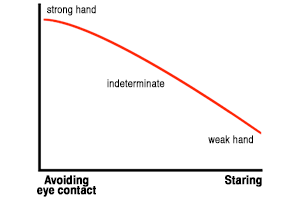
A tell in poker is a change in a player’s behavior or demeanor that can indicate the strength of their hand. A player gains an advantage if they observe and understand the meaning of another player’s tell, particularly if the tell is unconscious and reliable. Sometimes a player may fake a tell, hoping to induce their opponents to capitalize on bad information. More often, people try to avoid giving out a tell, by maintaining an expressionless ‘poker face’ regardless of how strong or weak their hand is.
A tell may be common to a class of players or unique to a single player. Some possible tells include leaning forward or back, placing chips with more or less force, fidgeting, doing chip tricks, showing nervous tics, or changing one’s breathing, tone of voice, facial expressions, direction of gaze. Other tells are associated with a player’s actions with the cards, cigarettes, or drinks, or merely by their style of play.
read more »
Posted in Games, Money |
Leave a Comment »
January 18, 2015
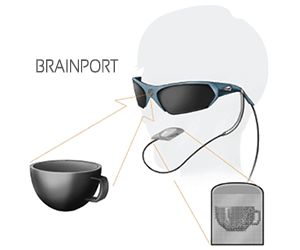
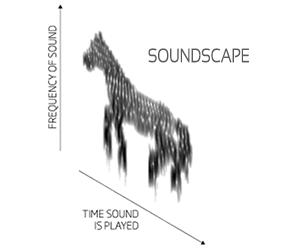
Sensory substitution means to transform the characteristics of one sensory modality (e.g. light, sound, temperature, taste, pressure, smell) into stimuli of another sensory modality (e.g. Tactile–Visual, converting video footage into into tactile information, such as vibration). These systems can help handicapped people by restoring their ability to perceive aspects of a defective physical sense.
A sensory substitution system consists of three parts: a sensor, a coupling system, and a stimulator. The sensor records stimuli and gives them to a coupling system which interprets the signals and transmits them to a stimulator. If the sensor obtains signals of a kind not originally available to the bearer it is called ‘sensory augmentation’ (e.g. implanting magnets under the fingertips imparts magnetoception, sensation of electromagnetic fields). Sensory substitution is based on research in human perception (the organization, identification, and interpretation of sensory information in order to represent and understand the environment) and neuroplasticity (how entire brain structures, and the brain itself, can change from experience).
read more »
Posted in Health, Science, Technology |
Leave a Comment »
January 8, 2015
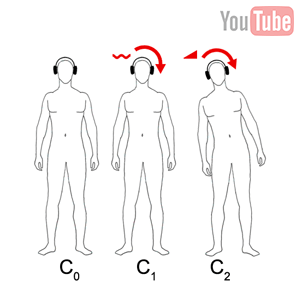
Galvanic [gal-van-ik] vestibular [ve-stib-yuh-ler] stimulation (GVS) is the process of sending electric messages to a nerve in the ear that maintains balance. This technology has been investigated for both military and commercial purposes, and is being applied in Atsugi, Japan, the Mayo Clinic in the US, and a number of other research institutions around the world for use in biomedical engineering, pilot training, and entertainment.
A patient undergoing GVS noted: ‘I felt a mysterious, irresistible urge to start walking to the right whenever the researcher turned the switch to the right. I was convinced — mistakenly — that this was the only way to maintain my balance. The phenomenon is painless but dramatic. Your feet start to move before you know it. I could even remote-control myself by taking the switch into my own hands.’
Posted in Health, Science, Technology |
1 Comment »
December 26, 2014

Yank tank (or máquina) is a slang term referring to American cars, especially large models produced in the 1950s and 1960s common in Cuba today. In 1962 a US embargo against Cuba was introduced, effectively cutting trade between the two countries. This meant that the cars in Cuba could no longer receive new replacement parts when something broke. Currently, the only way to keep these cars on the road today is by using Cuban ingenuity to adapt household products and Soviet technology (such as train parts) for use in these vehicles.
If a car is unable to be repaired at the time, it is usually either ‘parked’ for future repair or ‘parted out’ (to produce extra income for the owner’s family) so that other cars can remain on the road. During the years of Soviet Union influence on Cuba, Ladas, Moskvitchs, and Volgas became the main cars imported by the communist regime, mainly for state use. As a result of these internal economic restrictions, to this day there is no such thing as a new or used private European or Asian automotive dealership branch in Cuba for independent purchasing by regular Cubans.
read more »
Posted in Politics, Technology, World |
1 Comment »
December 26, 2014

The Fenton Art Glass Company was founded in 1905 by brothers Frank L. Fenton and John W. Fenton in an old glass factory in Martins Ferry, Ohio. Originally, they painted glass blanks from other glass makers, but started making their own glass when they moved across the Ohio river to Williamstown, West Virginia, and built a factory in 1906. The first year for glass production was 1907. Frank Fenton was the designer and decorator. From 1905 to 1920, the designs made there were heavily influenced by two other glass companies: Tiffany and Steuben. But the many different colors were the work of Jacob Rosenthal, a famous glass chemist who is known for developing chocolate and golden agate glass. Towards the end of 1907, the Fenton brothers were the first to introduce carnival glass (metallic or iridescent glass), which later became a popular collector’s item.
During the Great Depression and World War II, Fenton produced practical items (such as mixing bowls and tableware) due to shortages. At the same time, they continued creating new colors. Towards the end of the Great Depression they also produced perfume bottles for the Wrisley Company in 1938. The bottles were made in French opalescent glass with the hobnail pattern (similar to the studs on the sole of a hiking boot). In 1939, Fenton started selling Hobnail items in milk glass (opaque or translucent glass, often in white). Hobnail milk glass would become the top-selling line and allowed the Fenton company to expand.
read more »
Posted in Art |
Leave a Comment »
December 21, 2014

Shalom [shuh-lohm] bayit [buy-eet] (Hebrew: ‘peace of the home’) is the Jewish religious concept of domestic harmony and good relations between husband and wife. In a Jewish court of law, shalom bayit is the Hebrew term for ‘marital reconciliation.’
Throughout the history of the Jewish people, Jews have held an ideal standard for Jewish family life that is manifested in the term shalom bayit. Shalom bayit signifies completeness, wholeness, and fulfillment. Hence, the ideal Jewish marriage is characterized by peace, nurturing, respect, and ‘chesed’ (roughly meaning ‘kindness,’ more accurately ‘loving-kindness’), through which a married couple becomes complete. The Jewish religion advocates that God’s presence dwells in a pure and loving home.
read more »
Posted in Love, Philosophy |
Leave a Comment »
December 18, 2014

Wu wei [woo-wey] is an important concept in Taoism that literally means non-action or non-doing. In the Chinese classic text the ‘Tao te Ching’ (‘Book of the Way and the Power’) Laozi explains that beings (or phenomena) that are wholly in harmony with the Tao (‘the Way’) behave in a completely natural, uncontrived way. The goal of spiritual practice for the human being is, according to Laozi, the attainment of this purely natural way of behaving. He likened it to the planets revolving around the the sun, without any sort of control, force, or attempt to revolve themselves, instead engaging in effortless and spontaneous movement.
Several chapters of the ‘Tao Te Ching’ allude to ‘diminishing doing’ or ‘diminishing will’ as the key aspect of the sage’s success. Taoist philosophy recognizes that the Universe already works harmoniously according to its own ways; as a person exerts their will against or upon the world they disrupt the harmony that already exists. This is not to say that a person should not exert agency and will. Rather, it is how one acts in relation to the natural processes already extant. The how, the Tao of intention and motivation, that is key. According to Laozi: ‘The Sage is occupied with the unspoken, and acts without effort. Teaching without verbosity, producing without possessing, creating without regard to result, claiming nothing, the Sage has nothing to lose.’
read more »
Posted in Philosophy, World |
Leave a Comment »
December 17, 2014

An argot [ahr-goh] is a secret language used by various groups — e.g. schoolmates, outlaws, colleagues, among many others — to prevent outsiders from understanding their conversations. The term is also used to refer to the informal specialized vocabulary from a particular field of study, occupation, or hobby, in which sense it overlaps with jargon (non-standard definitions). French author Victor Hugo was one of the first to research argot extensively. He describes it in his 1862 novel ‘Les Misérables’ as the language of the dark; at one point, he says, ‘What is argot; properly speaking? Argot is the language of misery.’ The earliest known record of the term in this context was in a 1628 document. The word was probably derived from the contemporary name, ‘les argotiers,’ given to a group of thieves at that time.
Under the strictest definition, an argot is a proper language, with its own grammar and style. But such complete secret languages are rare, because the speakers usually have some public language in common, on which the argot is largely based. Such argots are mainly versions of another language, with a part of its vocabulary replaced by words unknown to the larger public; argot used in this sense is synonymous with cant language, such as verlan and louchébem (similar to Pig Latin), which retain French syntax and apply transformations only to individual words (and often only to a certain subset of words, such as nouns, or semantic content words). Such systems are examples of ‘argots à clef,’ or ‘coded argots.’ Specific words can go from argot into common speech or the other way. For example, modern French ‘loufoque’ (‘crazy, goofy’), now common usage, originates in the louchébem transformation of ‘fou'(‘crazy’). ‘Piaf’ is a Parisian argot word for ‘bird, sparrow’ taken up by the singer Edith Piaf as her stage name.
Posted in Games, Language, World |
Leave a Comment »
December 17, 2014

Louchébem [loo-shuh-behm] is Parisian and Lyonnaise butchers’ (French boucher) slang, similar to Pig Latin and Verlan. It originated in the mid-19th century and was in common use until the 1950s. Each word is transformed by moving the first consonant to the end; and suffixes such as -ème, -ji, -oc, -muche are added at the end; the letter ‘L’ is placed at the beginning of the new word. Note that spelling often becomes phoneticized.
Even today, Louchébem is still well-known and used among those working at point-of-sale in the meat retail industry. Some words have even leaked into common, everyday use by the masses; an example is the word ‘loufoque,’ meaning unsound of mind. In 1937, English novelist E.C. Bentley used the language as a plot point in his short story, ‘The Old-Fashioned Apache.’
Posted in Games, Language, World |
Leave a Comment »
December 16, 2014

Jargon [jahr-guhn], or term of art, is ‘the technical terminology or characteristic idiom of a special activity or group.’ The word ‘jargon’ is French and is believed to have been derived from the Latin ‘gaggire,’ meaning ‘to chatter,’ which was used to describe something in which the speaker did not understand.
An ‘industry term’ is jargon that is associated with one particular industry. Jargon is similar to slang, both are non-standard definitions often created by and for subcultures. It is also common for each generation to create their own jargon. Whether this is because they want to identify with each other and thus create a language of their own, or conversely, if they deliberately do not want to be understood by anybody else (e.g. texting slang used by teens to communicate messages their parents won’t be able to translate).
read more »
Posted in Language, Money, Technology |
Leave a Comment »
December 15, 2014

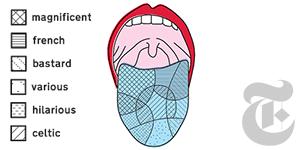
Creolization [kree-uh-lahy-zey-shuhn] is the process of two or more cultures mixing, as happened in in the Americas between people of indigenous, African, and European descent. Creolization is traditionally used to refer to the Caribbean but can be extended to represent other diasporas. The mixing of populations creates a cultural melting pot which ultimately leads to the formation of new identities. Creolization also is the mixing of the ‘old’ and ‘traditional,’ with the ‘new’ and ‘modern.’
Furthermore, creolization occurs when participants actively select cultural elements that may become part of or inherited culture. Social scientist Robin Cohen states that Creolization is a condition in which ‘the formation of new identities and inherited culture evolve to become different from those they possessed in the original cultures,’ and then creatively merge these to create new varieties that supersede the prior forms.
read more »
Posted in Language, Politics, World |
1 Comment »
December 14, 2014

The pizza effect is a term used especially in religious studies and sociology for the phenomenon of elements of a nation or people’s culture being transformed or at least more fully embraced elsewhere, then re-imported back to their culture of origin, or the way in which a community’s self-understanding is influenced by (or imposed by, or imported from) foreign sources.
It is named after the idea that modern pizza was developed among Italian immigrants in the United States (rather than in native Italy where in its simpler form it was originally looked down upon), and was later exported back to Italy to be interpreted as a delicacy in Italian cuisine. Other culinary examples include chicken tikka masala, popularized in the UK before gaining prominence in India, and General Tso’s chicken, a dish unknown in China before it was introduced by chefs returning from the States.
read more »
Posted in Food, Philosophy, World |
Leave a Comment »



