March 6, 2026

Philadelphia’s Magic Gardens is a non-profit organization, folk art environment, and gallery space on South Street in Philadelphia, Pennsylvania. It is the largest work created by mosaic artist Isaiah Zagar. The Magic Gardens spans three city lots, and includes indoor galleries and a large outdoor labyrinth.
The mosaics are made up of everything from kitchen tiles and mirror shards to bike wheels, Latin-American art, and china plates. The space is open for public view, from 11:00-6:00 Wednesday through Monday and closed on Tuesdays.
read more »
Posted in Art |
Leave a Comment »
February 26, 2026
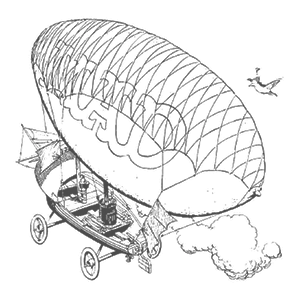
Mad has made frequent use of esoteric words, including potrzebie, furshlugginer, veeblefetzer, Moxie, ganef, halavah, and axolotl. Many, but not all of these words are of Yiddish or Jewish origin. Favored humorous names included Melvin, Bitsko, Kaputnik, Cowznofski, and Fonebone. Mad used the word ‘ecch’ or its cousins ‘blecch’ and ‘yecch’ as an all-purpose expression of disgust so often that even The Simpsons later made passing references to the practice, showing Mad covers with the unseen parodies ‘Beauty and the Blecch’ and ‘NYPD Blecch’.
The word ‘hoohah’ was an early running gag, often exclaimed by excited characters in the comic book issues written by Harvey Kurtzman; the first story in the first issue of Mad was titled ‘Hoohah!’. Its Eastern European feel was a perfect fit for the New York Jewish style of the publication. The precise origin of ‘hoohah’ is unknown, although it may have sprung from the Hungarian word for ‘wow’, which is hűha.
read more »
Posted in Art, Humor |
Leave a Comment »
December 29, 2025
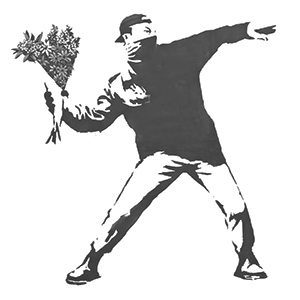
The Flower Thrower, Flower Bomber, Rage, or Love is in the Air is a 2003 stencil mural in Beit Sahour in the West Bank by the graffiti artist Banksy, depicting a masked man throwing a bunch of flowers. It is considered one of Banksy’s most iconic works.
It was inspired by images of 1960s protests, such as Bruno Barbey photograph of the May 68 protests in France (e.g. his photograph of Boulevard Saint-Germain, 6th arrondissement, Paris, France. May 6, 1968). An earlier version was originally drawn by Banksy in 1999 and presented at his first exhibition in 2000.
Posted in Art |
Leave a Comment »
December 17, 2025
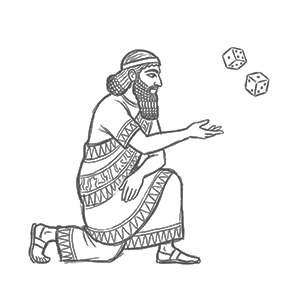
‘The Lottery in Babylon’ (‘La lotería en Babilonia’) is a fantasy short story by Argentine writer Jorge Luis Borges. It first appeared in 1941 in the literary magazine ‘Sur,’ and was then included in the 1941 collection ‘The Garden of Forking Paths’ (‘El jardín de los senderos que se bifurcan’), which in turn became the part one of ‘Ficciones’ (1944). Translated into English by John M. Fein, it was published in ‘Prairie Schooner’ (1959), and in ‘Labyrinths’ (1962).
The story describes a mythical Babylon in which all activities are dictated by an all-encompassing lottery, which people must live by, and has full control over many’s lives, a metaphor for the role of chance in one’s life.
read more »
Posted in Art, Philosophy |
Leave a Comment »
December 1, 2025
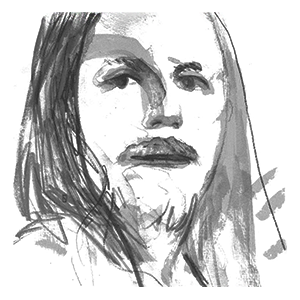
Wolfgang Beltracchi [bel-trah-kee] (b. 1951) is a German former art forger and visual artist who has admitted to forging hundreds of paintings in an international art scam netting millions of euros. Beltracchi, together with his wife Helene, sold forgeries of alleged works by famous artists, including Max Ernst, Heinrich Campendonk, Fernand Léger, and Kees van Dongen. Though he was found guilty for forging 14 works of art that sold for a combined $45m (£28.6m), he claims to have faked ‘about 50’ artists. The total estimated profits Beltracchi made from his forgeries surpasses $100m.
In 2011, after a 40-day trial, Beltracchi was found guilty and sentenced to six years in a German prison. His wife, Helene, was given a four-year sentence, and both were ordered to pay millions in restitution. Beltracchi was freed in 2015, having served just over three years in prison. He is today a successful artist who sells his paintings and sculptures to international collectors without the protection of art makers and the international art market.
read more »
Posted in Art, Money |
1 Comment »
November 13, 2025
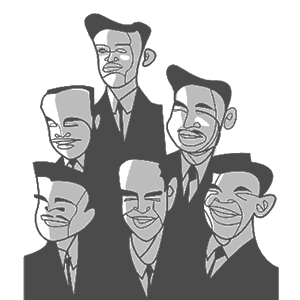
The Funk Brothers were a group of Detroit-based session musicians who performed the backing to most Motown recordings from 1959 until the company moved to Los Angeles in 1972.
Its members are considered among the most successful groups of studio musicians in music history. Among their hits are ‘My Girl,’ ‘I Heard It Through the Grapevine,’ ‘Baby Love,’ ‘ I Was Made to Love Her,’ ‘Papa Was a Rollin’ Stone,’ ‘The Tears of a Clown,’ ‘Ain’t No Mountain High Enough,’ and ‘Heat Wave’. Some combination of the members played on each of Motown’s 100-plus U.S. R&B number one singles and 50-plus U.S. Pop number ones released from 1961 to 1972.
read more »
Posted in Art, Money |
1 Comment »
April 21, 2025

Prussian blue (also known as Berlin blue, Brandenburg blue, Parisian and Paris blue) is a dark blue pigment produced by oxidation of ferrous ferrocyanide salts. Turnbull’s blue is essentially identical chemically, excepting that it has different impurities and particle sizes—because it is made from different reagents—and thus it has a slightly different color.
Prussian blue was created in the early 18th century and is the first modern synthetic pigment. It is prepared as a very fine colloidal dispersion, because the compound is not soluble in water. It contains variable amounts of other ions and its appearance depends sensitively on the size of the colloidal particles. The pigment is used in paints, it became prominent in 19th-century aizuri-e Japanese woodblock prints, and it is the traditional ‘blue’ in technical blueprints.
read more »
Posted in Art, Science |
Leave a Comment »
March 3, 2025
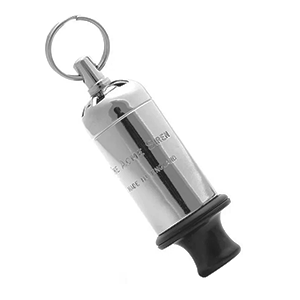
The Acme siren is a musical instrument used in concert bands for comic effect. Often used in cartoons, it produces the stylized sound of a police siren. It is one of the few aerophones in the percussion section of an orchestra. The instrument is typically made of metal and is cylindrical. Inside the cylinder is a type of fan-blade which, when the performer blows through one end, spins and creates the sound. The faster the performer blows, the faster the fan-blade moves and the higher the pitch the instrument creates. Conversely, the slower the performer blows, the lower the pitch.
Iannis Xenakis used it in the 1960s in his works Oresteia, Terretektorh, and Persephassa. A siren was used in Bob Dylan’s classic album, ‘Highway 61 Revisited.’ One is also heard in Stevie Wonder’s song ‘Sir Duke’ just before the second chorus. Dan Zanes also uses a siren in his version of ‘Washington at Valley Forge.’ Acme is the trade name of J Hudson & Co of Birmingham, England, who developed and patented the Acme siren in 1895. It was sometimes known as ‘the cyclist’s road clearer.’
Posted in Art, Humor |
Leave a Comment »
February 5, 2025

Pono [poh-noh] (Hawaiian for ‘proper’ or ‘righteousness’) was a portable digital media player and music download service for high-resolution audio. It was developed by musician Neil Young and his company PonoMusic, which raised money for development and initial production through a crowd-funding campaign on Kickstarter. Production and shipments to backers started in 2014, and shipments to the general public began in the first quarter of 2015.
Pono’s stated goal to present songs ‘as they first sound during studio recording sessions,’ using ‘high-resolution’ 24-bit 192kHz audio instead of ‘the compressed audio inferiority that MP3s offer’ received mixed reactions, with some describing Pono as a competitor to similar music services such as HDtracks, but others doubting its potential for success. Pono was discontinued in 2017, and alternative plans were later abandoned.
read more »
Posted in Art, Money, Technology |
Leave a Comment »
December 2, 2024

Video nasty is a colloquial term popularized by the National Viewers’ and Listeners’ Association (NVALA) in the United Kingdom to refer to a number of films, typically low-budget horror or exploitation films, distributed on video cassette in the early 1980s that were criticized by the press, social commentators, and various religious organisations for their violent content.
These video releases were not brought before the British Board of Film Classification (BBFC) due to a loophole in film classification laws that allowed videos to bypass the review process. The resulting uncensored video releases led to public debate concerning the availability of these films to children due to the unregulated nature of the market.
read more »
Posted in Art, Politics, World |
Leave a Comment »
May 20, 2024

The Polish School of Posters refers to a highly influential artistic movement that emerged in Poland after World War II, primarily from the 1950s through the 1980s, characterized by its unique graphic design style, particularly in the realm of poster art.
Despite the restrictions of the communist regime, Polish poster artists enjoyed a surprising degree of creative liberty compared to other art forms. They often used surreal, abstract, and metaphorical illustrations to convey complex ideas and emotions, and many posters served as subtle critiques of the political and social realities of the time. Posters featured vivid colors, strong contrasts, and simplified forms to create eye-catching, impactful designs. Distinctive, expressive lettering was hand-drawn and integrated into the overall composition.
read more »
Posted in Art, World |
Leave a Comment »
April 19, 2024

The Mexican filter is a yellow-colored or sepia filter that is sometimes employed in films and television productions to visually represent scenes set in Mexico, as well as other Latin American and South Asian countries. It has been criticized for tending to wash out the faces of people with darker skin, and for stereotyping the countries it depicts. Notable examples of Mexican filter use include: ‘Traffic’ (2000), ‘Breaking Bad’ (2008), ‘Extraction’ (2020), ‘Saw X’ (2023).
The use of yellow color filters for Mexico began around 2000, when technical advancements in film-making allowed the easier use of color filters. Traditionally used to convey a sense of heat and aridity, the use of yellow color filters for Mexico eventually became a trope. It has been disputed that temperature is a good justification for using the Mexican filter given that hot cities in the United States are rarely if ever depicted with yellow filters.
Posted in Art, World |
Leave a Comment »


 The Daily Omnivore