April 8, 2011

Nardwuar the Human Serviette (b. 1968), is a Canadian celebrity interviewer and musician from Vancouver. He is the lead singer and keyboardist for ‘The Evaporators’ and plays in ‘Thee Goblins.’ He legally changed his name from John Ruski in 1986.
Nardwuar got his start in media at the University of British Columbia radio station CITR 101.9 FM in Vancouver. His show has been running every Friday afternoon (3:30-5:00 p.m. Pacific) since October 1987. The program features a mix of eclectic music, along with interviews and commentary.
read more »
Posted in Art, Humor |
1 Comment »
April 8, 2011


Tyler, the Creator (b. 1991) is an American rapper and record producer from Los Angeles, California. He is the leader of the hip hop collective OFWGKTA. He has rapped on, and produced for, nearly every OFWGKTA release.
Posted in Art, Money |
Leave a Comment »
April 7, 2011

The Criterion Collection is a video-distribution company selling ‘important classic and contemporary films’ to cinema aficionados founded in 1984. Criterion Collection releases were the first to provide several features that have become standard.
The 1984 Criterion Laserdisc release of King Kong included the world’s first optional commentary audio track. The Criterion series is noted for helping to standardize the letterbox ratio, bonus features, and special editions. They are also known for taking great lengths to restore and clean all movies released on their label.
read more »
Posted in Art, Money |
Leave a Comment »
April 7, 2011

Odd Future Wolf Gang Kill Them All, often abbreviated OFWGKTA or Odd Future, are a hip hop collective from Los Angeles, California. They have released three mixtapes and nine studio albums, all available for free on their website. Rapper/producer Tyler the Creator is the de facto leader of Odd Future. Other members include rappers Hodgy Beats, Earl Sweatshirt, Domo Genesis, Mike G, singer Frank Ocean, producers Left Brain, Syd Bennett, Matt Martians, Hal Williams and Jasper Dolphin.
As of February 2011, their ages range from 16 to 23 years old. There are three groups inside the collective: MellowHype, The Jet Age of Tomorrow and EarlWolf. MellowHype consists of rapper Hodgy Beats and producer Left Brain, The Jet Age of Tomorrow consists of producers Matt Martians and Hal Williams and EarlWolf consists of Tyler, the Creator and Earl Sweatshirt.
Posted in Art |
Leave a Comment »
April 7, 2011
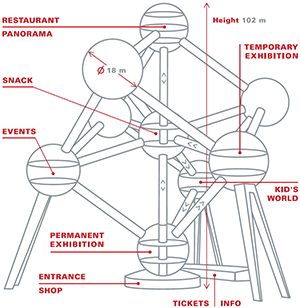
The Atomium is a monument in Brussels, originally built for Expo ’58, the 1958 Brussels World’s Fair. Designed by Belgian engineer, André Waterkeyn, it stands 102-metres (335 ft) tall. It has nine steel spheres connected so that the whole forms the shape of a unit cell of an iron crystal magnified 165 billion times. Tubes connect the spheres along the 12 edges of the cube and all eight vertices to the center. They enclose escalators connecting the spheres containing exhibit halls and other public spaces. The top sphere provides a panoramic view of Brussels. Each sphere is 18 meters in diameter.
Three of the four uppermost spheres lack vertical support and hence are not open to the public for safety reasons, although the sphere at the pinnacle is open to the public. The original design called for no supports; the structure was simply to rest on the spheres. Wind tunnel tests proved that the structure would have toppled in an 80 km/h wind. Support columns were added to achieve enough resistance against overturning.
Posted in Art, Technology, World |
1 Comment »
April 7, 2011

The blue hour comes from the French expression l’heure bleue, which refers to the period of twilight each morning and evening where there is neither full daylight nor complete darkness. The time is considered special because of the quality of the light at this time of day. The phrase is also used to refer to Paris immediately prior to World War I, which was considered to be a time of relative innocence.
In English culture the term was used to describe the period of inactivity and uselessness a drinker encounters when Pubs and other licensed premises have closed after the lunch-time session (typically 15:30 hrs) and will not open for the evening session until (typically 18:30 hrs).
Posted in Art, Drugs, Language |
Leave a Comment »
April 7, 2011

In photography and cinematography, the golden or magic hour, is the first and last hour of sunlight during the day, when a specific photographic effect is achieved due to the quality of the light. Typically, lighting is softer (more diffuse) and warmer in hue. When the Sun is near the horizon, sunlight travels through more of the atmosphere, reducing the intensity of the direct light, so that more of the illumination comes from indirect light from the sky.
More blue light is scattered, so that light from the Sun appears more reddish. In addition, the Sun’s small angle with the horizon produces longer shadows. In the middle of the day, the bright overhead Sun can create too-bright highlights and dark shadows. Because the contrast is less during the golden hour, shadows are less dark, and highlights are less likely to be overexposed.
Posted in Art, Language, Science |
Leave a Comment »
April 7, 2011

Martini Shot is a Hollywood term that describes the final shot set-up of the day, so named because ‘the next shot is out of a glass,’ referring to a post-wrap drink.
Posted in Art, Drugs, Humor |
Leave a Comment »
April 7, 2011
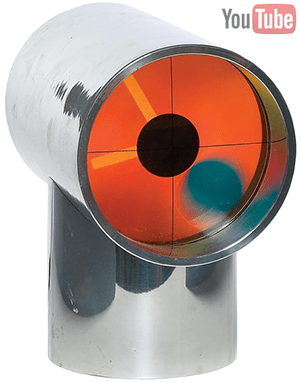
The Aurora Clock has been in production for over 40 years. There are continuously changing colors and surprising color ‘shifts’ when the secondhand disk overlaps the minute & hour hands, and the colors change depending on your viewing angle. The color changes have to do with polarized light and a phenomenon called bi-refractance. Vectors of light are being rotated as they pass through each material which is very different from color filtering.
The first Aurora clocks were made by Rathcon and called the Spectrum. Then they were manufactured by Kirsch-Hamilton. Next, in the late 80’s, Hampton Haddon had a version made in Japan, but abandoned the clock around 1991. In 1993 we at ChronoArt started manufacturing Luminas (a different polarized light clock) and then a year later started also manufacturing new Auroras.
Posted in Art, Technology |
Leave a Comment »
April 7, 2011
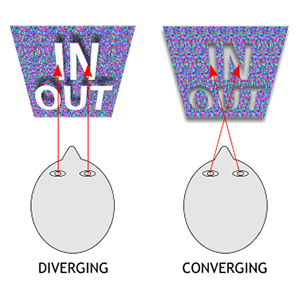
An autostereogram [aw-toh-ster-ee-uh-gram] is a stereogram (an optical illusion of depth created from flat images), designed to create the visual illusion of a three-dimensional scene from a two-dimensional image in the human brain.
In order to perceive 3D shapes in these autostereograms, the brain must overcome the normally automatic coordination between focusing and vergence (the simultaneous movement of both eyes in opposite directions to obtain or maintain single binocular vision).
read more »
Posted in Art, Games, Technology |
Leave a Comment »
April 7, 2011
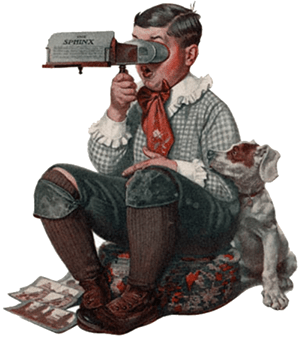
A stereogram [ster-ee-uh-gram] is an optical illusion of depth created from flat, two-dimensional image or images. Originally, the term referred to a pair of stereo images which could be viewed using a stereoscope. Other types of stereograms include anaglyphs and autostereograms. The stereogram was discovered by Victorian scientist, Charles Wheatstone in 1838. He found an explanation of binocular vision which led him to construct a stereoscope based on a combination of prisms and mirrors to allow a person to see 3D images from two 2D pictures. A stereoscope presents 2D images of the same object from slightly different angles to the left eye and the right eye, allowing the brain to reconstruct the original object via binocular disparity.
Oliver Wendell Holmes, Sr. invented an improved form of stereoscope in 1861, which had no mirrors and was inexpensive to produce. These stereoscopes were immensely popular for decades. Salvador Dalí created some impressive stereograms in his exploration in a variety of optical illusions. Stereograms were re-popularized by the creation of autostereograms on computers, wherein a 3D image is hidden in a single 2D image, until the viewer focuses their eyes correctly. The Magic Eye series is a popular example of this. Magic Eye books refer to autostereograms as stereograms, leading most people to believe that the word stereogram is synonymous with autostereogram.
Posted in Art, Technology |
Leave a Comment »
April 6, 2011


A baseball cap is a type of hat with a long, stiff brim, that is a part of the traditional baseball uniform worn by players, with the brim pointing forward to shield the eyes from the sun.
In 1860, the Brooklyn Excelsiors wore the ancestor of the modern rounded-top baseball cap, and by 1900, the ‘Brooklyn style’ cap became popular. During the 1940s, latex rubber became the stiffening material inside the hat and the modern baseball cap was born. The ‘bill’ or ‘brim’ was designed to protect a player’s eyes from the sun. Typically, the brim was much shorter in the earlier days of the baseball hat. Also, the hat has become more structured, versus the overall ‘floppy’ cap of the 19th and early 20th centuries.
read more »
Posted in Art, Games, War |
Leave a Comment »





 The Daily Omnivore