March 4, 2011

eBoy (‘Godfathers of Pixel’) is a pixel art group founded in 1997 by Kai Vermehr, Steffen Sauerteig and Svend Smital. Their work makes intense use of popular culture and commercial icons, and their style is presented in three-dimensional isometric illustrations filled with robots, cars, guns and girls.
‘If we don’t work on other projects at the same time it takes about six to eight weeks to finish a very detailed cityscape, three eBoy’s working on it, nearly full time. But, if we have to do it in our spare time, which happens often, it could take years to finish a picture since we can’t spend so much time on it.’
Posted in Art, Technology |
Leave a Comment »
March 4, 2011

Pixels is a short film created and directed by French film-maker Patrick Jean. It’s about the invasion of New York by a classic 8-bit video games, such as Space Invaders, Pac-Man, Tetris, Arkanoid, and others. Pixels was picked up by Adam Sandler’s production company to be developed into a feature film.
Posted in Art, Technology |
Leave a Comment »
March 4, 2011

Pixel art is a form of digital art, created through the use of raster graphics software, where images are edited on the pixel level. Graphics in most old (or relatively limited) computer and video games, graphing calculator games, and many mobile phone games are mostly pixel art. The term pixel art was first published by Adele Goldberg and Robert Flegal of Xerox Palo Alto Research Center in 1982. The concept, however, goes back about 10 years before that, for example in Richard Shoup’s SuperPaint system in 1972, also at Xerox PARC.
Some traditional art forms, such as counted-thread embroidery (including cross-stitch) and some kinds of mosaic and beadwork, are very similar to pixel art. These art forms construct pictures out of small colored units similar to the pixels of modern digital computing. Image filters (such as blurring or alpha-blending) or tools with automatic anti-aliasing are considered not valid tools for pixel art, as such tools calculate new pixel values automatically, contrasting with the precise manual arrangement of pixels associated with pixel art.
Posted in Art, Technology |
2 Comments »
March 4, 2011


Eating Animals is the third book by the American writer Jonathan Safran Foer, published in 2009. It is a work of non-fiction exploring the topics of factory farming and commercial fisheries. He examines topics such as by-catch (fish caught unintentionally in a fishery while intending to catch other fish) and slaughterhouse conditions, learning that Indonesian shrimp trawlers kill 58 pounds of sea creatures for every 1 pound of shrimp, and that in American slaughterhouses, cows are consistently ‘bled, dismembered, and skinned while conscious.’
He also explores the health risks which pervade American factory farming, for example that H1N1 originated in a North Carolina factory farm, and that according to Consumer Reports, 98 percent of American chicken is infected with campylobacter or salmonella at the time of consumption. Foer also examines the cultural meaning of food, beginning with the experience of his own grandmother, who survived the holocaust, with a lifelong obsession over food. He builds on and ultimately criticizes the work of Michael Pollan on our relationship to the food we eat.
Posted in Art, Food, Health |
Leave a Comment »
March 4, 2011

Pogo is an electronic music artist living in Perth, Western Australia. His work consists of recording small sounds from a film or a specific scene, and sequencing the sounds together to form a new piece of music, a method of sampling first made popular by House music producer and UK Garage influence Todd Edwards in the 1990s.
His track Alice is a composition of sounds from the Disney film Alice in Wonderland. Pogo took part in a project hosted by Disney/Pixar to produce a track based on their film, Up. He has later since produced two more mixes, ‘Toyz Noize’ and ‘Buzzwing,’ based on the movie Toy Story. Pogo has since produced tracks using samples from films such as Mary Poppins, Snow White, Harry Potter and the Sorcerer’s Stone, The Sword in the Stone, Chitty Chitty Bang Bang, Hook, Toy Story, Willy Wonka & the Chocolate Factory and Terminator 2: Judgment Day.
Posted in Art, Technology |
Leave a Comment »
March 3, 2011

Bridget Riley (b. 1931) is an English painter who is one of the foremost proponents of op art. She was born in London and studied at the Royal College of Art, where her fellow students included artists Peter Blake and Frank Auerbach. Her early work was figurative with a semi-impressionist style. Around 1960 she began to develop her signature style consisting of black and white geometric patterns that explore the dynamism of sight and produce a disorienting effect on the eye.
They present a great variety of geometric forms that produce sensations of movement or color. Visually, these works relate to many concerns of the period: a perceived need for audience participation (this relates them to the ‘Happenings,’ for which the period is famous), challenges to the notion of the mind-body duality which led some people to experiment with hallucinogenic drugs; concerns with a tension between a scientific future which might be very beneficial or might lead to a nuclear war; and fears about the loss of genuine individual experience in a Brave New World.
Posted in Art |
Leave a Comment »
March 3, 2011

C. Allan Gilbert (1873 – 1929) was a prominent American illustrator. He is especially remembered for a widely published drawing (a memento mori) titled ‘All Is Vanity.’ The drawing employs a double image (or visual pun) in which the scene of a woman admiring herself in a mirror, when viewed from a distance, appears to be a human skull.
It is less widely known that Gilbert was an early contributor to animation, and a camouflage artist (or camoufleur) for the U.S. Shipping Board during World War I.
Posted in Art, World |
Leave a Comment »
March 3, 2011

The term illusory motion is used to define the appearance of movement in a static image. This is an optical illusion in which a static image appears to be moving due to the cognitive effects of interacting color contrasts and shape position.
Another type of motion illusion that causes an optical illusion is when a moving object appears to be moving in a path other than what is perceived by the brain. An example of this can be demonstrated by placing a colored filter over ones eye of the observer, and swinging a ball back and forth in front of them. To the observer the ball appears to be swinging in a circular motion.
Posted in Art, Science |
Leave a Comment »
March 3, 2011
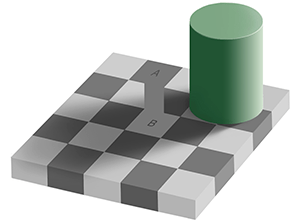

An optical illusion is characterized by visually perceived images that differ from objective reality. An illusion is different from a hallucination; a hallucination is sensing something which is not real, but an illusion is interpreting what we sense wrongly.
The information gathered by the eye is processed in the brain to give a percept that does not tally with a physical measurement of the stimulus source. There are three main types: literal optical illusions that create images that are different from the objects that make them, physiological ones that are the effects on the eyes and brain of excessive stimulation of a specific type (brightness, tilt, color, movement), and cognitive illusions where the eye and brain make unconscious inferences.
Posted in Art, Science |
Leave a Comment »
March 3, 2011

Seattle Hempfest is an annual event in Seattle, Washington, the world’s largest annual gathering advocating decriminalization of marijuana. Founded in 1991 as the Washington Hemp Expo (attended by 500 people), it has grown into a 2-day annual political rally, concert, and arts and crafts fair with attendance typically over 250,000. Speakers have included Seattle city council member Nick Licata, actor/activist Woody Harrelson, travel writer and TV host Rick Steves, and former chief of the Seattle Police Department Norm Stamper.
Sixty people were cited for illegal marijuana use at the 1997 Hempfest, and about twenty were arrested the following year. Eventually Hempfest and the police reached a modus vivendi: there was only one arrest in 2001. The political context surrounding marijuana in Seattle and Washington has changed considerably over the years. Washington legalized medical marijuana in 1998. In 2003, Seattle passed an initiative that made adult personal use marijuana offenses the city’s lowest law enforcement priority.
Posted in Art, Drugs, Politics |
Leave a Comment »
March 3, 2011

The King of Kong: A Fistful of Quarters is a 2007 American documentary film that follows Steve Wiebe as he tries to take the world high score for the arcade game Donkey Kong from reigning champion Billy Mitchell. The film premiered at the 2007 Slamdance Film Festival.
A scripted film adaptation is already in the works. Director Seth Gordon has said that the movie might be a sequel instead of a remake, telling the story of how the documentary changed both men’s lives, as well as their continuing rivalry.
Posted in Art, Games, Humor |
Leave a Comment »
March 2, 2011

Transcendent Man is a documentary film by filmmaker Barry Ptolemy. The film chronicles the life and ideas of Ray Kurzweil, inventor, futurist, and author of ‘The Singularity is Near.’ ‘Transcendent Man’ presents his vision of technological singularity, the point in the future in which technology will be advancing so rapidly that humans will have to enhance themselves with artificial intelligence in order to keep up.
Kurzweil predicts the dawning of a new civilization in which humans will no longer be dependent upon their physical bodies, will become trillions of times more intelligent, and lose the ability to distinguish between real and virtual reality. He believes this will cause human aging and illness to be reversed, world hunger and poverty to be solved, and death to be ‘cured.’ Critics accuse him of being too optimistic, and argue that the dangers of the Singularity far outweigh the benefits, pointing out the apocalyptic implications.
Posted in Art, Philosophy, Technology |
Leave a Comment »




 The Daily Omnivore