March 7, 2011

Twin Peaks is an American TV drama created by David Lynch and Mark Frost. The series follows the investigation of the brutal murder of a popular teenager and homecoming queen, Laura Palmer, by FBI Special Agent Dale Cooper. The pilot episode was broadcast in April 1990 on ABC, which led to another seven episodes being produced and a second season, which aired until June 1991.
As with much of Lynch’s other work (notably ‘Blue Velvet’), ‘Twin Peaks’ explores the gulf between the veneer of small-town respectability and the seedier layers of life lurking beneath it. Each character from the town leads a double life that is slowly uncovered as the series progresses.
read more »
Posted in Art, Philosophy |
Leave a Comment »
March 7, 2011

Arzell ‘Z. Z.’ Hill (1935 – 1984) was an American blues singer, in the soul blues tradition, known for his 1970s and 1980s recordings for Malaco. His 1982 album, Down Home, stayed on the Billboard soul album chart for nearly two years. The track ‘Down Home Blues’ has been called the best-known blues song of the 1980s. This track plus the songs ‘Taxi,’ ‘Someone Else Is Steppin’ In,’ and ‘Open House’ have become R&B/Southern soul standards
Posted in Art |
Leave a Comment »
March 7, 2011

ZZ Top is an American rock band, sometimes referred to as ‘That Little Ol’ Band from Texas.’ Their style, which is rooted in the blues, has come to incorporate elements of arena, Southern, and boogie rock. The band is from Houston, Texas, formed in 1969. Musician Billy Gibbons and drummer Dan Mitchell, originally in a band called the ‘Moving Sidewalks,’ got together with bassist Lanier Greig, forming ZZ Top. In 1969, Greig and Mitchell were replaced by Dusty Hill and Frank Beard from the band ‘American Blues.’
They were signed to London Records in 1970 and released several albums. After years of touring, the band went on a two-year break in 1977, which resulted in Gibbons and Hill growing chest-length beards. The band’s name was rumored to have derived from Zig-Zag and TOP rolling papers. Gibbons, however it actually refers to an apartment Gibbons lived in, with a row of flyers on a wall, including Z. Z. Hill and B.B. King posters. Coming to the conclusion that B.B. King was on the ‘top,’ Gibbons settled with the name ‘ZZ Top.’
Posted in Art, Money |
Leave a Comment »
March 7, 2011
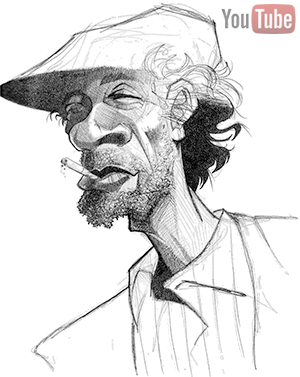
Gil Scott-Heron (b. 1949) is an American poet, musician, and author known primarily for his late 1970s and early 1980s work as a spoken word performer and his collaborative soul works with musician Brian Jackson, which featured a musical fusion of jazz, blues and soul music, as well as lyrical content concerning social and political issues of the time, delivered in both rapping and melismatic vocal styles by Scott-Heron.
The music of these albums, most notably ‘Pieces of a Man’ and ‘Winter in America’ in the early 1970s, influenced and helped engender later African-American music genres such as hip hop and neo soul. Scott-Heron’s recording work is often associated with black militant activism and has received much critical acclaim for one of his most well-known compositions ‘The Revolution Will Not Be Televised.’
Posted in Art, Money, Politics |
Leave a Comment »
March 6, 2011
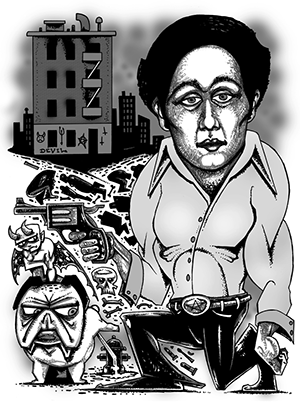
A Son of Sam Law is a law designed to keep criminals from profiting from their crimes, such as by selling their stories to publishers. These laws authorize the state to seize money earned from such a deal and use it to compensate the criminal’s victims. In certain cases a Son of Sam law can be extended beyond the criminals themselves to include friends, neighbors, and family members of the lawbreaker who seek to profit by telling publishers and filmmakers of their relation to the criminal. In other cases, a person may be barred from financially benefiting from the sale of a story or any other mementos pertaining to the crime—if the criminal was convicted after the date lawmakers passed the law in the states where the crime was committed.
The first such law was created in New York after the Son of Sam murders committed by serial killer David Berkowitz. It was enacted after rampant speculation about publishers offering large amounts of money for Berkowitz’s story. The law was invoked in New York 11 times between 1977 and 1990, including once against Mark David Chapman, murderer of musician John Lennon. Critics disputed the law on First Amendment grounds. It was argued that “Son of Sam” laws take away the financial incentive for many criminals to tell their stories, some of which (such as the Watergate scandal) were of vital interest to the general public.
Posted in Art, Money, Politics |
Leave a Comment »
March 4, 2011

Mass games or mass gymnastics are a form of performing arts in which large numbers of performers take part in a highly regimented performance that emphasizes group dynamics rather than individual prowess. The effect of displaying huge images is achieved by a having large number of individuals each being dressed in a particular color or holding a colored hard paper above their heads.
Because of the vast scale of the performance, with often tens of thousands of performers, mass games are performed in stadiums, often accompanied by a background of card-turners occupying the seats on the opposite side from the viewers. The rapid change of images was achieved by changing a card with another in swift and synchronized movement. The synchronization is achieved after several hours-long rehearsals and employs much choreography.
read more »
Posted in Art, Politics, World |
Leave a Comment »
March 4, 2011

eBoy (‘Godfathers of Pixel’) is a pixel art group founded in 1997 by Kai Vermehr, Steffen Sauerteig and Svend Smital. Their work makes intense use of popular culture and commercial icons, and their style is presented in three-dimensional isometric illustrations filled with robots, cars, guns and girls.
‘If we don’t work on other projects at the same time it takes about six to eight weeks to finish a very detailed cityscape, three eBoy’s working on it, nearly full time. But, if we have to do it in our spare time, which happens often, it could take years to finish a picture since we can’t spend so much time on it.’
Posted in Art, Technology |
Leave a Comment »
March 4, 2011

Pixels is a short film created and directed by French film-maker Patrick Jean. It’s about the invasion of New York by a classic 8-bit video games, such as Space Invaders, Pac-Man, Tetris, Arkanoid, and others. Pixels was picked up by Adam Sandler’s production company to be developed into a feature film.
Posted in Art, Technology |
Leave a Comment »
March 4, 2011

Pixel art is a form of digital art, created through the use of raster graphics software, where images are edited on the pixel level. Graphics in most old (or relatively limited) computer and video games, graphing calculator games, and many mobile phone games are mostly pixel art. The term pixel art was first published by Adele Goldberg and Robert Flegal of Xerox Palo Alto Research Center in 1982. The concept, however, goes back about 10 years before that, for example in Richard Shoup’s SuperPaint system in 1972, also at Xerox PARC.
Some traditional art forms, such as counted-thread embroidery (including cross-stitch) and some kinds of mosaic and beadwork, are very similar to pixel art. These art forms construct pictures out of small colored units similar to the pixels of modern digital computing. Image filters (such as blurring or alpha-blending) or tools with automatic anti-aliasing are considered not valid tools for pixel art, as such tools calculate new pixel values automatically, contrasting with the precise manual arrangement of pixels associated with pixel art.
Posted in Art, Technology |
2 Comments »
March 4, 2011

Eating Animals is the third book by the American writer Jonathan Safran Foer, published in 2009. It is a work of non-fiction exploring the topics of factory farming and commercial fisheries. He examines topics such as by-catch (fish caught unintentionally in a fishery while intending to catch other fish) and slaughterhouse conditions, learning that Indonesian shrimp trawlers kill 58 pounds of sea creatures for every 1 pound of shrimp, and that in American slaughterhouses, cows are consistently ‘bled, dismembered, and skinned while conscious.’
He also explores the health risks which pervade American factory farming, for example that H1N1 originated in a North Carolina factory farm, and that according to Consumer Reports, 98 percent of American chicken is infected with campylobacter or salmonella at the time of consumption. Foer also examines the cultural meaning of food, beginning with the experience of his own grandmother, who survived the holocaust, with a lifelong obsession over food. He builds on and ultimately criticizes the work of Michael Pollan on our relationship to the food we eat.
Posted in Art, Food, Health |
Leave a Comment »
March 4, 2011

Pogo is an electronic music artist living in Perth, Western Australia. His work consists of recording small sounds from a film or a specific scene, and sequencing the sounds together to form a new piece of music, a method of sampling first made popular by House music producer and UK Garage influence Todd Edwards in the 1990s.
His track Alice is a composition of sounds from the Disney film Alice in Wonderland. Pogo took part in a project hosted by Disney/Pixar to produce a track based on their film, Up. He has later since produced two more mixes, ‘Toyz Noize’ and ‘Buzzwing,’ based on the movie Toy Story. Pogo has since produced tracks using samples from films such as Mary Poppins, Snow White, Harry Potter and the Sorcerer’s Stone, The Sword in the Stone, Chitty Chitty Bang Bang, Hook, Toy Story, Willy Wonka & the Chocolate Factory and Terminator 2: Judgment Day.
Posted in Art, Technology |
Leave a Comment »
March 3, 2011

Bridget Riley (b. 1931) is an English painter who is one of the foremost proponents of op art. She was born in London and studied at the Royal College of Art, where her fellow students included artists Peter Blake and Frank Auerbach. Her early work was figurative with a semi-impressionist style. Around 1960 she began to develop her signature style consisting of black and white geometric patterns that explore the dynamism of sight and produce a disorienting effect on the eye.
They present a great variety of geometric forms that produce sensations of movement or color. Visually, these works relate to many concerns of the period: a perceived need for audience participation (this relates them to the ‘Happenings,’ for which the period is famous), challenges to the notion of the mind-body duality which led some people to experiment with hallucinogenic drugs; concerns with a tension between a scientific future which might be very beneficial or might lead to a nuclear war; and fears about the loss of genuine individual experience in a Brave New World.
Posted in Art |
Leave a Comment »




