February 27, 2011

Persepolis is a French-language autobiographical comic by Marjane Satrapi depicting her childhood up to her early adult years in Iran during and after the Islamic revolution. The title is a reference to the ancient capital of the Persian Empire, Persepolis. Drawn in black and white, the graphic novel found great popularity following its release, and was translated into several languages. The English edition combines the first two French books and was translated by Blake Ferris and Satrapi’s husband, Mattias Ripa.
In 2007, an animated film adaptation of the graphic novel was created, with author Satrapi co-directing with French comic artist Vincent Paronnaud. The film utilized the same style of the graphic novel, although there are a handful of scenes in the present day that are shown in color, while the rest of the flashback events are illustrated in black and white, as in the novel.
Posted in Art, Politics, World |
Leave a Comment »
February 27, 2011

Rhythms del Mundo (lit. ‘World Rhythms’) is a 2006 nonprofit album, which fuses Cuban musicians including Ibrahim Ferrer and Omara Portuondo of the Buena Vista Social Club with artists such as Dido, Arctic Monkeys, U2, Coldplay, Sting, Jack Johnson, Maroon 5, Franz Ferdinand, Kaiser Chiefs and others. A follow-up album, Rhythms del Mundo Classics, was released in 2009. Album proceeds benefits the environmental nonprofit organization Artists Project Earth, which raises funds for climate change projects and disaster relief efforts.
Posted in Art, Money, Politics |
Leave a Comment »
February 24, 2011


Takashi Miike (b. 1960) is a highly prolific and controversial Japanese filmmaker. He has directed over seventy theatrical, video, and television productions since his debut in 1991. In the years 2001 and 2002 alone, Miike is credited with directing fifteen productions.
His films range from violent and bizarre to dramatic and family-friendly. He gained international fame in 2000 when his romantic horror film Audition (1999) played at international film festivals. He has since gained a strong cult following in the West that is growing with the increase in DVD releases of his works.
Posted in Art |
1 Comment »
February 24, 2011

Cibo Matto (meaning ‘crazy food’ in Italian) was a New York City-based band formed by two Japanese women, Yuka Honda and Miho Hatori, in 1994. The lyrics in their songs are primarily concerned with food and their sound has been described as a combination of Jazz, Hip-Hop, Brazilian music, African Drumming, and Disco samples. While the two founding members of the group are Japanese expatriates, they are not especially popular in Japan; the group did not gain nearly as large a following in Japan as it did in the United States.
Posted in Art |
Leave a Comment »
February 24, 2011

The Go! Team are an English sextet. They combine indie rock and garage rock with a mixture of blaxploitation and Bollywood soundtracks, double dutch chants, old school hip hop and distorted guitars similar to the style of Sonic Youth. Their songs are a mix of live instrumentation and samples from various sources. The band’s vocals vary between performances: while live vocals are handled mostly by Ninja (with Tsuchida and Fukami-Taylor also singing some solos), vocals on record consist of sampled and guest voices, not just Ninja’s.
Posted in Art |
Leave a Comment »
February 24, 2011

Miike Snow are a Swedish indie pop band formed in 2007. The band consists of producing team Christian Karlsson and Pontus Winnberg, also known as Bloodshy & Avant. The name ‘Miike Snow’ is said to have come from one of their friends called Mike Snow, with the spelling of ‘Miike’ coming from the Japanese film director Takashi Miike.
Posted in Art |
Leave a Comment »
February 24, 2011
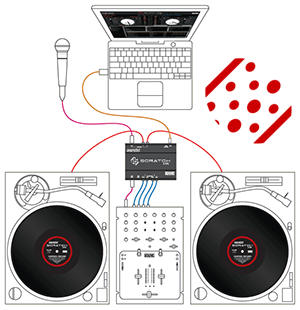
Vinyl emulation software allows the user to physically manipulate the playback of digital audio files on a computer using the turntables as an interface. Vinyl emulation normally uses special vinyl records which are played on conventional turntables. The result is digital audio playback that feels like it can be manipulated like a vinyl record.
However, there is always a short delay between the needle’s reading of the time code and the software’s playback of the audio. This delay is usually between 6 and 30 milliseconds. The delay is treated as a figure of merit for vinyl emulation products. A shorter delay allows the DJ to have better response and control of the music. In some countries, including the United Kingdom and Finland, a digital DJ license is required to legally play copyrighted music with vinyl emulation software.
Posted in Art, Technology |
Leave a Comment »
February 24, 2011

Gadsby: A Story of Over 50,000 Words Without Using the Letter ‘E’ is a 1939 novel by Ernest Vincent Wright. The plot revolves around the dying fictional city of Branton Hills, which is revitalized thanks to the efforts of protagonist John Gadsby and a youth group he organizes. The novel is written as a lipogram: a constrained writing or word game consisting of writing paragraphs or longer works in which a particular letter or group of letters is avoided. Though self-published and little-noticed in its time, the book is a favorite of fans of constrained writing and is a sought-after rarity among some book collectors.
Posted in Art, Language |
Leave a Comment »
February 24, 2011
Retroactive continuity (often shortened to retcon) refers to the alteration of previously established facts in a literary work. Retcons may be carried out for a variety of reasons, such as to accommodate sequels or further derivative works in the same series, to reintroduce popular characters, to resolve chronological issues, to reboot a familiar series for modern audiences, or to simplify an excessively complex continuity structure.
Retcons are common in pulp fiction, especially comic books published by long-established houses such as DC, Marvel and leading manga publishers. The long history of popular titles and the plurality of writers who contribute stories can often create situations that demand clarification or revision of exposition. Retcons appear as well in soap operas, serial drama, movie sequels, professional wrestling, video games, radio series, and other kinds of serial fiction.
Posted in Art, Language |
Leave a Comment »
February 24, 2011

Green Lantern is the name of several fictional characters, superheroes appearing in comic books published by DC Comics. The first (Alan Scott) was created by writer Bill Finger and artist Martin Nodell in All-American Comics #16 (July 1940). Each Green Lantern possesses a power ring and power lantern that gives the user great control over the physical world as long as the wielder has sufficient willpower and strength to wield it. The power ring can generate a variety of effects, sustained purely by the ring wearer’s imagination and strength of will. The greater the user’s willpower, the more effective the ring.
Stories in 2006 retconned the ring’s long-established ineffectiveness on yellow objects, stating that the ring-wielder need only feel fear, understand it and overcome it in order to affect yellow objects (however, it is a learned and practiced ability, making it a weakness to some Green Lanterns), giving retroactive credence to the explanation of the ring’s real but surmountable weakness to yellow.
Posted in Art |
Leave a Comment »
February 24, 2011
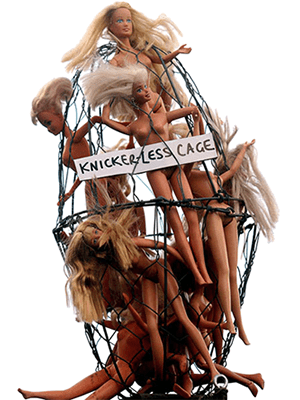
The Turnip Prize is a spoof UK award that satirises the Tate Gallery’s Turner Prize by rewarding deliberately bad modern art. It was started mainly as a joke in 1999, but has gained national media attention and inspired other similar prizes. Credit is given for entries that have bad puns as titles, display ‘lack of effort’ and pass the crucial test of ‘is it shit?’; conversely, entries which show ‘too much effort’ or are ‘not shit enough’ are disqualified. The first prize is a turnip nailed to a block of wood.
Posted in Art, Humor |
Leave a Comment »
February 24, 2011
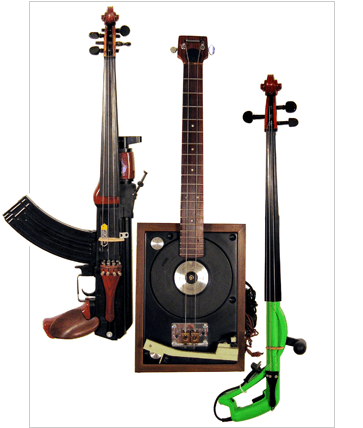
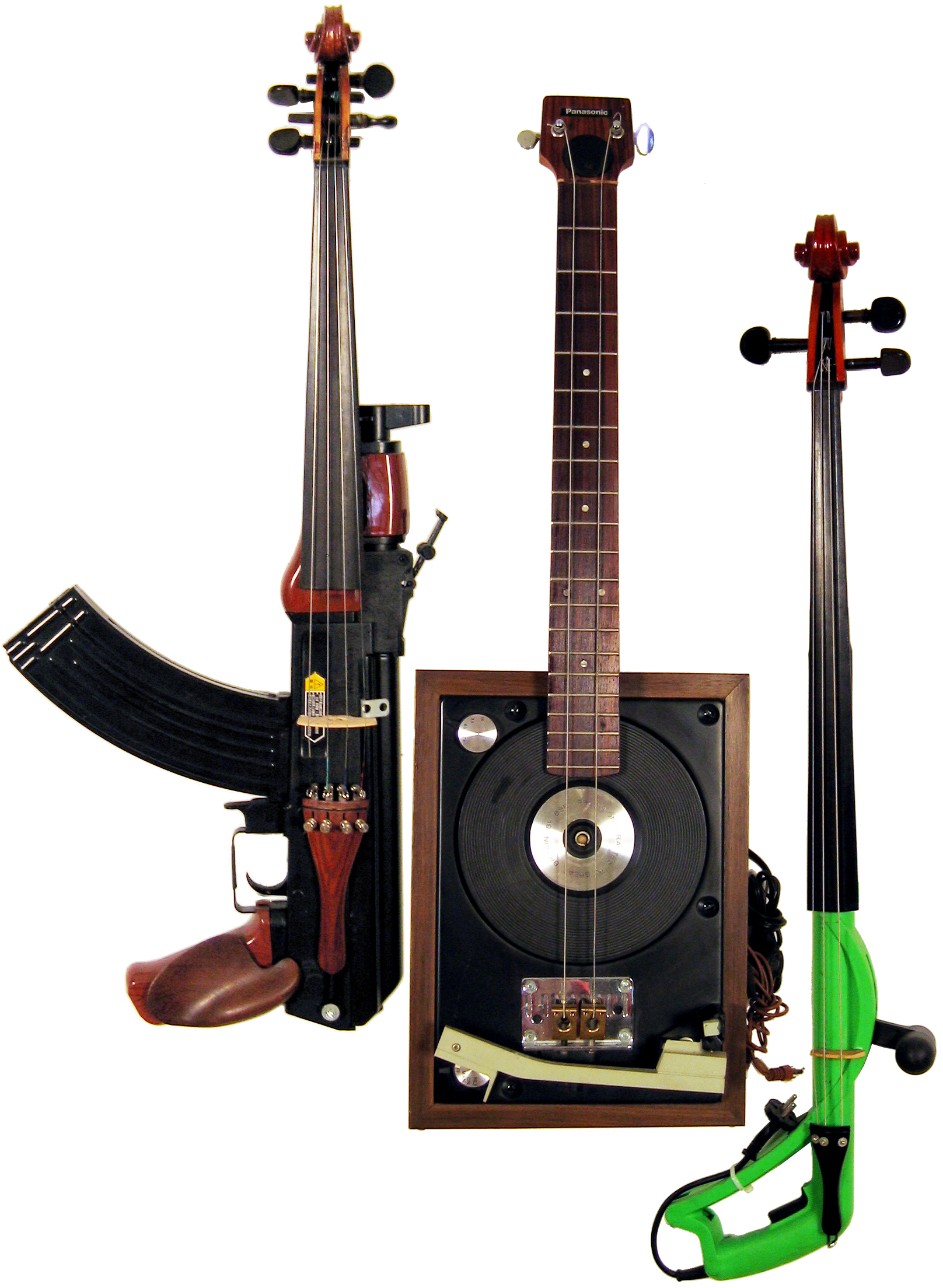
Ken Butler (b. 1948) is an artist and musician, as well as an experimental musical instrument builder. His Hybrid musical instruments and other artworks explore the interaction and transformation of common and uncommon objects, altered images, sounds and silence. The idea of bricolage, essentially using whatever is ‘at hand,’ is at the center of his art, encompassing a wide range of practice that combines live music, instrument design, performance art, theater, sculpture, installation, photography, film/video, graphic design, drawing, and collage.
Posted in Art, Technology |
Leave a Comment »




 The Daily Omnivore