February 24, 2011
Retroactive continuity (often shortened to retcon) refers to the alteration of previously established facts in a literary work. Retcons may be carried out for a variety of reasons, such as to accommodate sequels or further derivative works in the same series, to reintroduce popular characters, to resolve chronological issues, to reboot a familiar series for modern audiences, or to simplify an excessively complex continuity structure.
Retcons are common in pulp fiction, especially comic books published by long-established houses such as DC, Marvel and leading manga publishers. The long history of popular titles and the plurality of writers who contribute stories can often create situations that demand clarification or revision of exposition. Retcons appear as well in soap operas, serial drama, movie sequels, professional wrestling, video games, radio series, and other kinds of serial fiction.
Posted in Art, Language |
Leave a Comment »
February 24, 2011

Green Lantern is the name of several fictional characters, superheroes appearing in comic books published by DC Comics. The first (Alan Scott) was created by writer Bill Finger and artist Martin Nodell in All-American Comics #16 (July 1940). Each Green Lantern possesses a power ring and power lantern that gives the user great control over the physical world as long as the wielder has sufficient willpower and strength to wield it. The power ring can generate a variety of effects, sustained purely by the ring wearer’s imagination and strength of will. The greater the user’s willpower, the more effective the ring.
Stories in 2006 retconned the ring’s long-established ineffectiveness on yellow objects, stating that the ring-wielder need only feel fear, understand it and overcome it in order to affect yellow objects (however, it is a learned and practiced ability, making it a weakness to some Green Lanterns), giving retroactive credence to the explanation of the ring’s real but surmountable weakness to yellow.
Posted in Art |
Leave a Comment »
February 24, 2011
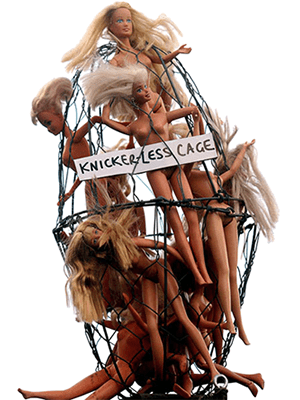
The Turnip Prize is a spoof UK award that satirises the Tate Gallery’s Turner Prize by rewarding deliberately bad modern art. It was started mainly as a joke in 1999, but has gained national media attention and inspired other similar prizes. Credit is given for entries that have bad puns as titles, display ‘lack of effort’ and pass the crucial test of ‘is it shit?’; conversely, entries which show ‘too much effort’ or are ‘not shit enough’ are disqualified. The first prize is a turnip nailed to a block of wood.
Posted in Art, Humor |
Leave a Comment »
February 24, 2011

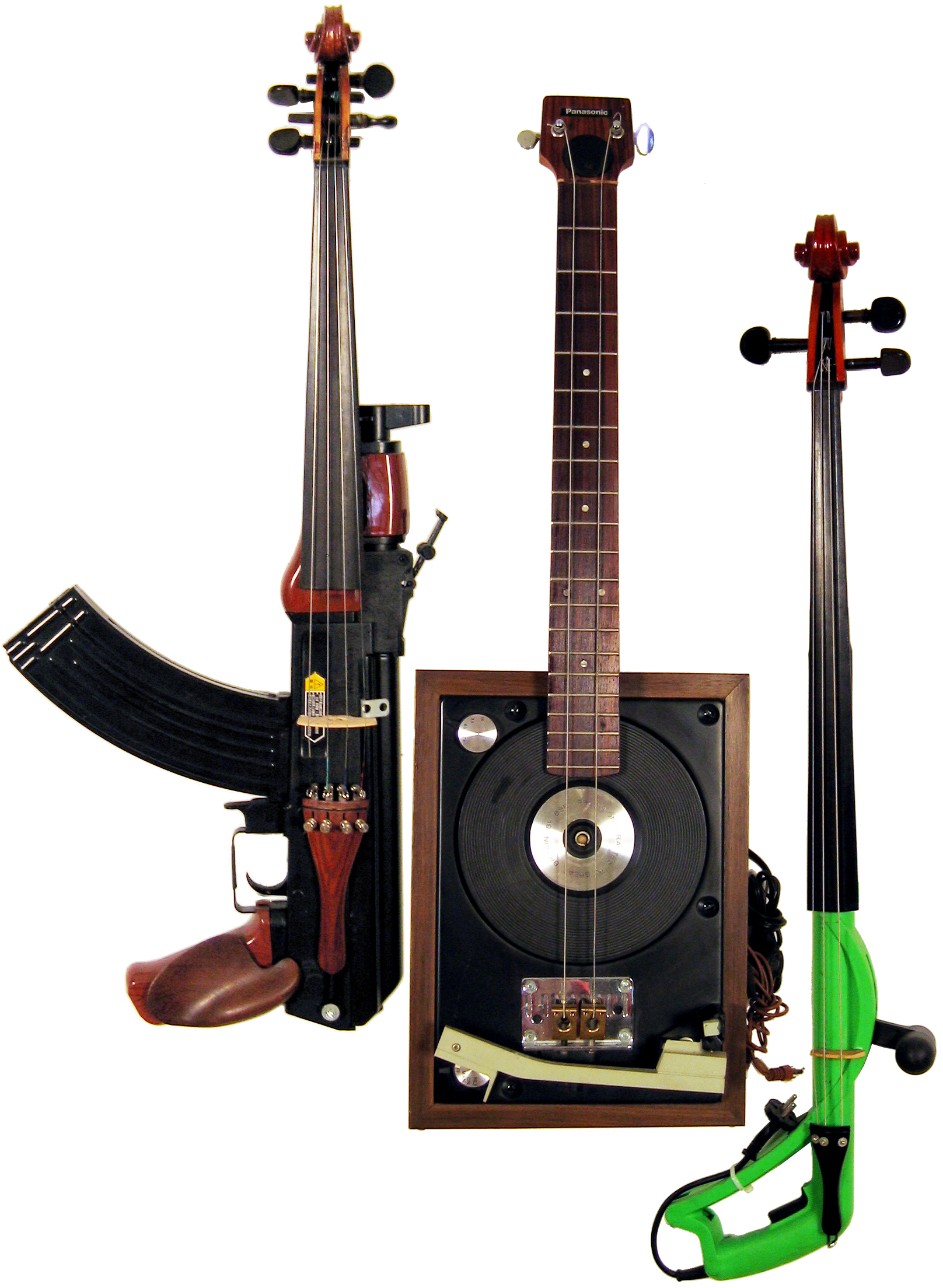
Ken Butler (b. 1948) is an artist and musician, as well as an experimental musical instrument builder. His Hybrid musical instruments and other artworks explore the interaction and transformation of common and uncommon objects, altered images, sounds and silence. The idea of bricolage, essentially using whatever is ‘at hand,’ is at the center of his art, encompassing a wide range of practice that combines live music, instrument design, performance art, theater, sculpture, installation, photography, film/video, graphic design, drawing, and collage.
Posted in Art, Technology |
Leave a Comment »
February 24, 2011
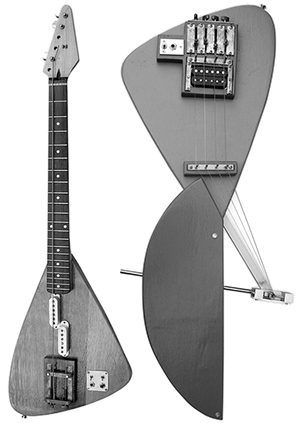
Yuri Landman (b. 1973) is a Dutch luthier (someone who makes or repairs stringed instruments) who has made several experimental electric string instruments for a list of artists including Lee Ranaldo of Sonic Youth, Liars, Jad Fair of Half Japanese and Liam Finn. He has also been active as a comic book creator, musician, and singer.
Posted in Art, Technology |
Leave a Comment »
February 23, 2011
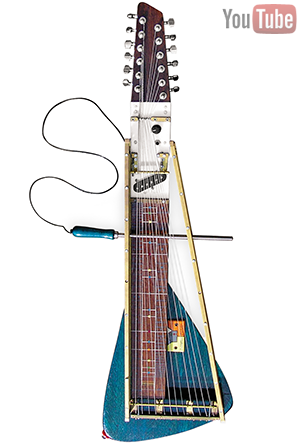
The Moodswinger is a twelve string electric zither with an additional third bridge designed by Dutch luthier Yuri Landman. The rod which functions as the third bridge divides the strings into two sections to cause an overtone multiphonic sound. In 2006 Landman was contacted by the noise band Liars to make an instrument for them. Although it closely resembles an electric guitar, it is actually a zither, as it has neither frets nor a proper neck. The pickup and electronics are built into the neck instead of in the body like usual electric guitars.
After Liars received their Moodswinger, they started recording their fourth album ‘Liars.’ The song ‘Leather Prowler’ is played with the Moodswinger, in many reviews confused with a piano. In 2008 the Moodswinger II was released as a serial product. Jessie Stein of The Luyas owns a copy. In 2009 Landman created a derivative version of the instrument called the Home Swinger, for workshops at festivals, where participants built their own copy within four hours.
Posted in Art, Technology |
Leave a Comment »
February 23, 2011

Here Comes Science is a 2009 children’s album from Brooklyn-based band They Might Be Giants, packaged as a CD/DVD set. The album is the third in their line of educational albums, following 2005’s Here Come the ABCs and 2008’s Here Come the 123s. It is the band’s 14th studio album and fourth children’s album.
Posted in Art, Education, Science |
Leave a Comment »
February 23, 2011

‘Ghost sign‘ is a term for old hand-painted advertising signage that has been preserved on a building for an extended period of time. The signage may be kept for its nostalgic appeal, or simply indifference by the owner. They are also called ‘fading ads’ and ‘brickads.’ In many cases these are advertisements painted on brick that remained over time. Many ghost signs still visible are from the 1890s to 1960s. Such signs were most commonly used in the decades before the Great Depression.
As signage advertising formats changed, less durable signs appeared in the later 20th century, and ghost signs from that era are less common. Kathleen Hulser of the New York Historical Society, said, ‘[The signs] evoke the exuberant period of American capitalism. Consumer cultures were really getting going and there weren’t many rules yet, no landmarks preservation commission or organized community saying: ‘Isn’t this awful? There’s a picture of a man chewing tobacco on the corner of my street.’
Posted in Art, Language, Money |
Leave a Comment »
February 23, 2011

Britpop is a subgenre of alternative rock that that grew out of the British independent music scene of the early 1990s and was characterized by bands influenced by British guitar pop music of the 1960s and 1970s. The movement developed as a reaction against various musical and cultural trends in the late 1980s and early 1990s, particularly the grunge phenomenon from the United States. In the wake of the musical invasion into the UK of American grunge bands, new British groups such as Suede and Blur launched the movement by positioning themselves as opposing musical forces, referencing British guitar music of the past and writing about uniquely British topics and concerns.
These bands were soon joined by others including Oasis, Pulp, Supergrass, Sleeper and Elastica. Britpop groups brought British alternative rock into the mainstream and formed the backbone of a larger British cultural movement called ‘Cool Britannia.’ Although its more popular bands were able to spread their commercial success overseas, especially to the United States, the movement largely fell apart by the end of the decade.
Posted in Art, Language, World |
Leave a Comment »
February 23, 2011

Cool Britannia is a media term that was used during the mid-to-late 20th century to describe the contemporary culture of the United Kingdom. The term was prevalent during the 1990s and later became closely associated with the early years of ‘New Labour’ under Tony Blair. It is a pun on the title of the British patriotic song ‘Rule, Britannia!’
The phrase ‘Cool Britannia’ was first used in 1967 as a song title by the Bonzo Dog Doo Dah Band. The phrase reappeared in the mid-1990s as a registered trade mark for one of Ben & Jerry’s ice-creams (vanilla with strawberries and chocolate-covered shortbread). The ice cream name and recipe was coined in early 1996 by an American lawyer living in London, Sarah Moynihan-Williams, as a winning entry in a Ben and Jerry’s ice cream competition. The phrase was quickly adopted in the media and in advertising.
Posted in Art, World |
Leave a Comment »
February 23, 2011


Nasser Bouzida (also known as The Bongolian) is a member of Big Boss Man, an electric funk quartet formed in the U.K. in 1998. The original lineup was and still is Bouzida on organs, percussion and occasional vocals, Scott Milsom on the bass guitar, Trevor Harding on the electric guitar and Nick Nicholls on drums.
Posted in Art |
Leave a Comment »
February 23, 2011

Reggie Watts is a New York-based comedian and musician.
Watts’ shows are mostly improvised and consist of stream of consciousness stand-up in various shifting personae, mixed with loop pedal-based a cappella compositions.
Posted in Art, Humor |
Leave a Comment »