February 27, 2011


A MacGuffin is a plot element that catches the viewers’ attention or drives the plot of a work of fiction. The defining aspect of a MacGuffin is that the major players in the story are (at least initially) willing to do and sacrifice almost anything to obtain it, regardless of what the MacGuffin actually is. In fact, the specific nature of the MacGuffin may be ambiguous, undefined, generic, left open to interpretation or otherwise completely unimportant to the plot. Common examples are money, victory, glory, survival, a source of power, or a potential threat, or it may simply be something entirely unexplained.
The MacGuffin is common in films, especially thrillers. Usually, though not always, the MacGuffin is the central focus of the film in the first act, and then declines in importance as the struggles and motivations of characters play out. It may come back into play at the climax of the story, but sometimes the MacGuffin is actually forgotten by the end of the film. The director and producer Alfred Hitchcock popularized both the term and the technique, with his 1935 film ‘The 39 Steps,’ an early example of the concept.
Posted in Art, Language |
Leave a Comment »
February 27, 2011

Wabi-sabi represents a comprehensive Japanese world view or aesthetic centered on the acceptance of transience. The aesthetic is sometimes described as one of beauty that is ‘imperfect, impermanent and incomplete.’ It is a concept derived from the Buddhist assertion of the Three marks of existence (impermanence, suffering, and non-self).
Characteristics of the wabi-sabi aesthetic include asymmetry, asperity, simplicity, economy, austerity, modesty, intimacy and appreciation of the ingenuous integrity of natural objects and processes.
read more »
Posted in Art, Philosophy, World |
Leave a Comment »
February 27, 2011

Mono no aware (literally ‘the pathos of things’), also translated as ‘an empathy toward things,’ or ‘a sensitivity of ephemera,’ is a Japanese term used to describe the awareness of ‘mujo’ or the transience of things and a gentle sadness (or wistfulness) at their passing. The term was coined in the eighteenth century by the Edo period Japanese cultural scholar Motoori Norinaga, and was originally a concept used in his literary criticism of ‘The Tale of Genji,’ and later applied to other seminal Japanese works including the ‘Man’yōshū,’ becoming central to his philosophy of literature, and eventually to Japanese cultural tradition.
The word is derived from the Japanese word ‘mono’ (lit. ‘things’) and ‘aware,’ which was a Heian period expression of measured surprise (similar to ‘ah’ or ‘oh’), translating roughly as ‘pathos,’ ‘poignancy,’ ‘deep feeling,’ or ‘sensitivity.’ Thus, mono no aware has frequently been translated as “the ‘ahh-ness’ of things,” life and love. The quintessentially ‘Japanese’ director Yasujiro Ozu was well known for creating a sense of mono no aware, frequently climaxing with a character saying a very understated ‘ii tenki desu ne’ (‘It is fine weather, isn’t it?’), after both a familial and societal paradigm shift, such as daughter being married off, against the backdrop of a swiftly changing Japan.
Posted in Art, Language, World |
Leave a Comment »
February 27, 2011

Saudade is a Portuguese word difficult to translate adequately, which describes a deep emotional state of nostalgic longing for something or someone that one was fond of and which is lost. It often carries a fatalist tone and a repressed knowledge that the object of longing might really never return. Saudade has been described as a ‘vague and constant desire for something that does not and probably cannot exist … a turning towards the past or towards the future.’ A stronger form of saudade may be felt towards people and things whose whereabouts are unknown, such as a lost lover, or a family member who has gone missing.
It may also be translated as a deep longing or yearning for something which does not exist or is unattainable. Saudade was once described as ‘the love that remains’ or ‘the love that stays’ after someone is gone. Saudade is the recollection of feelings, experiences, places or events that once brought excitement, pleasure, well-being, which now triggers the senses and makes one live again.
Posted in Art, Language, World |
Leave a Comment »
February 27, 2011

Persepolis is a French-language autobiographical comic by Marjane Satrapi depicting her childhood up to her early adult years in Iran during and after the Islamic revolution. The title is a reference to the ancient capital of the Persian Empire, Persepolis. Drawn in black and white, the graphic novel found great popularity following its release, and was translated into several languages. The English edition combines the first two French books and was translated by Blake Ferris and Satrapi’s husband, Mattias Ripa.
In 2007, an animated film adaptation of the graphic novel was created, with author Satrapi co-directing with French comic artist Vincent Paronnaud. The film utilized the same style of the graphic novel, although there are a handful of scenes in the present day that are shown in color, while the rest of the flashback events are illustrated in black and white, as in the novel.
Posted in Art, Politics, World |
Leave a Comment »
February 27, 2011

Rhythms del Mundo (lit. ‘World Rhythms’) is a 2006 nonprofit album, which fuses Cuban musicians including Ibrahim Ferrer and Omara Portuondo of the Buena Vista Social Club with artists such as Dido, Arctic Monkeys, U2, Coldplay, Sting, Jack Johnson, Maroon 5, Franz Ferdinand, Kaiser Chiefs and others. A follow-up album, Rhythms del Mundo Classics, was released in 2009. Album proceeds benefits the environmental nonprofit organization Artists Project Earth, which raises funds for climate change projects and disaster relief efforts.
Posted in Art, Money, Politics |
Leave a Comment »
February 24, 2011


Takashi Miike (b. 1960) is a highly prolific and controversial Japanese filmmaker. He has directed over seventy theatrical, video, and television productions since his debut in 1991. In the years 2001 and 2002 alone, Miike is credited with directing fifteen productions.
His films range from violent and bizarre to dramatic and family-friendly. He gained international fame in 2000 when his romantic horror film Audition (1999) played at international film festivals. He has since gained a strong cult following in the West that is growing with the increase in DVD releases of his works.
Posted in Art |
1 Comment »
February 24, 2011

Cibo Matto (meaning ‘crazy food’ in Italian) was a New York City-based band formed by two Japanese women, Yuka Honda and Miho Hatori, in 1994. The lyrics in their songs are primarily concerned with food and their sound has been described as a combination of Jazz, Hip-Hop, Brazilian music, African Drumming, and Disco samples. While the two founding members of the group are Japanese expatriates, they are not especially popular in Japan; the group did not gain nearly as large a following in Japan as it did in the United States.
Posted in Art |
Leave a Comment »
February 24, 2011

The Go! Team are an English sextet. They combine indie rock and garage rock with a mixture of blaxploitation and Bollywood soundtracks, double dutch chants, old school hip hop and distorted guitars similar to the style of Sonic Youth. Their songs are a mix of live instrumentation and samples from various sources. The band’s vocals vary between performances: while live vocals are handled mostly by Ninja (with Tsuchida and Fukami-Taylor also singing some solos), vocals on record consist of sampled and guest voices, not just Ninja’s.
Posted in Art |
Leave a Comment »
February 24, 2011

Miike Snow are a Swedish indie pop band formed in 2007. The band consists of producing team Christian Karlsson and Pontus Winnberg, also known as Bloodshy & Avant. The name ‘Miike Snow’ is said to have come from one of their friends called Mike Snow, with the spelling of ‘Miike’ coming from the Japanese film director Takashi Miike.
Posted in Art |
Leave a Comment »
February 24, 2011
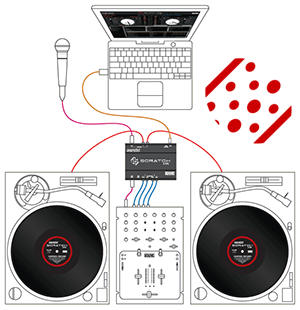
Vinyl emulation software allows the user to physically manipulate the playback of digital audio files on a computer using the turntables as an interface. Vinyl emulation normally uses special vinyl records which are played on conventional turntables. The result is digital audio playback that feels like it can be manipulated like a vinyl record.
However, there is always a short delay between the needle’s reading of the time code and the software’s playback of the audio. This delay is usually between 6 and 30 milliseconds. The delay is treated as a figure of merit for vinyl emulation products. A shorter delay allows the DJ to have better response and control of the music. In some countries, including the United Kingdom and Finland, a digital DJ license is required to legally play copyrighted music with vinyl emulation software.
Posted in Art, Technology |
Leave a Comment »
February 24, 2011

Gadsby: A Story of Over 50,000 Words Without Using the Letter ‘E’ is a 1939 novel by Ernest Vincent Wright. The plot revolves around the dying fictional city of Branton Hills, which is revitalized thanks to the efforts of protagonist John Gadsby and a youth group he organizes. The novel is written as a lipogram: a constrained writing or word game consisting of writing paragraphs or longer works in which a particular letter or group of letters is avoided. Though self-published and little-noticed in its time, the book is a favorite of fans of constrained writing and is a sought-after rarity among some book collectors.
Posted in Art, Language |
Leave a Comment »




